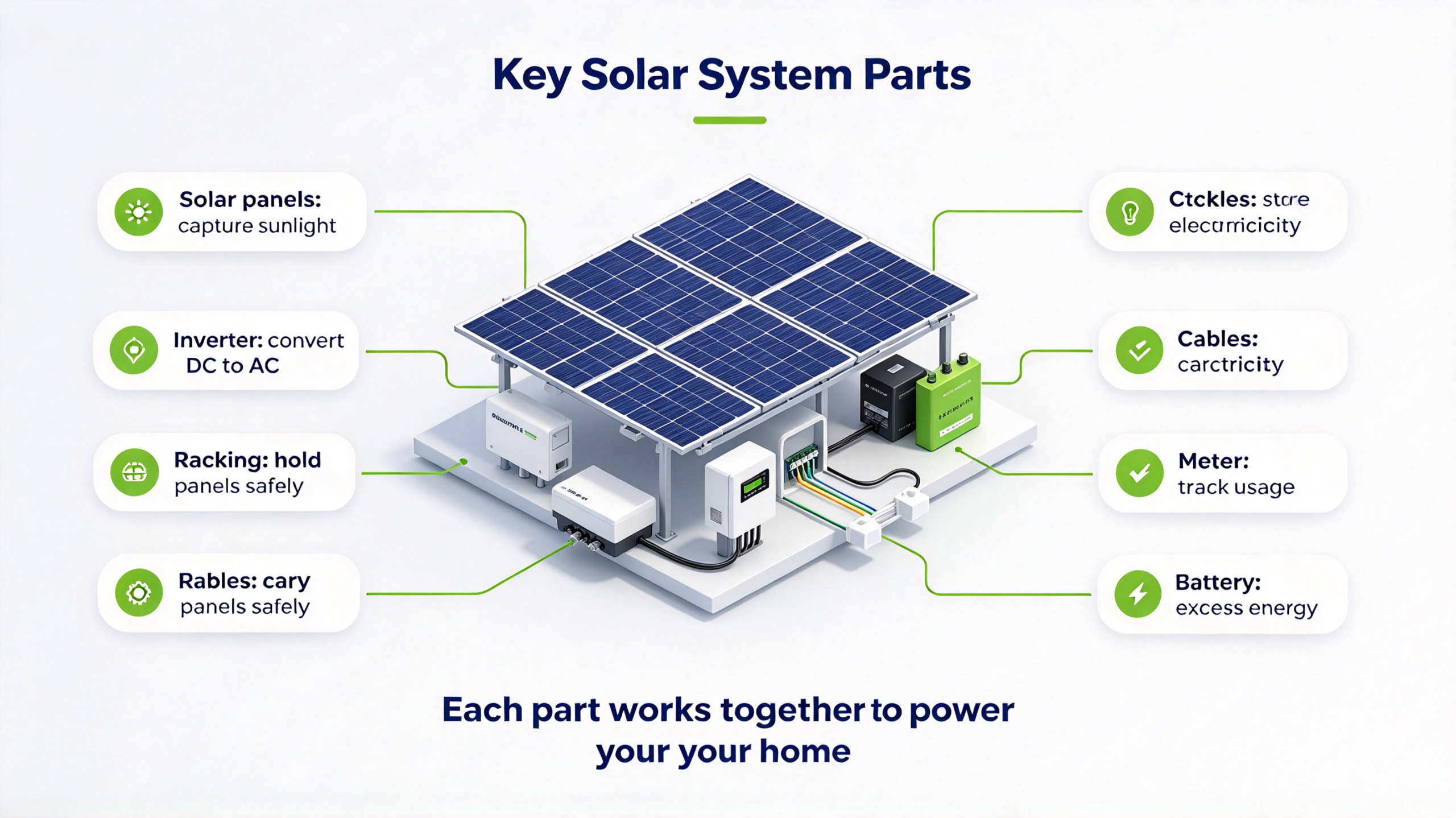
TL;DR: The main solar system components are the panels, the inverter, the racking that holds them down, the wiring and disconnect switches, the monitoring device and your utility meter. A battery is optional. The inverter is the part most likely to fail first and the part you will replace at least once in 25 years. Knowing which part does what makes it much easier to understand quotes, warranties and any fault you ever see on your system.
Solar quotes are full of part names, and most homeowners nod along without knowing which ones matter. That makes it hard to compare two proposals or to tell whether a fault is serious.
Here is what each component does, how long it lasts, and what usually goes wrong with it.
The Panels
Panels convert sunlight into direct current electricity. They have no moving parts, which is why they are the most reliable part of the system.
Serves: 25 to 30 years, usually backed by a 25-year performance warranty that guarantees a minimum output rather than a minimum physical condition.
What to check: Panel brand, model and wattage on the quote. “Tier 1” is a category, not a specification.
What fails: Rarely anything internally. When panels do go wrong it is usually physical damage – hail, debris, a dropped tool during installation – or micro cracks that reduce output gradually rather than causing a hard failure.
The Inverter
The inverter turns the DC electricity from the panels into AC electricity your house can use, and it manages the system’s safety checks. It is the hardest working component on the system.
There are two common types. A string inverter is one central unit for the whole array. Microinverters are small units fitted under each panel, so every panel operates independently.
Serves: Around 10 to 12 years for a string inverter, and 20 to 25 years for microinverters.
What to check: Inverter brand and model, whether it can handle a battery later, and whether it has backup capability if you want power during an outage.
What fails: The inverter is the most common failure point on any system, and most owners replace one at least once. A replacement string inverter typically costs $1,500 to $3,500 installed. If you see a fault code on the display or in the app, our guide to solar inverter error codes explains what the main families of fault mean.
The Racking and Mounting
Racking is the aluminium or steel frame that holds the panels at the correct angle and fixes them to your roof or to the ground. It is the part that has to survive wind uplift and snow load.
Serves: 25 years or more, and it is normally covered by the installer’s workmanship warranty rather than by a manufacturer.
What to check: The attachment method, and whether the mounting is rated for your local wind and snow load.
What fails: Fasteners that back out over years of thermal cycling, and undersized attachment spacing. After a severe storm, racking and roof attachments are the parts worth inspecting first.
The Wiring, Disconnects and Rapid Shutdown
This is the least glamorous part of the system and the one most often skimped on.
- DC and AC disconnects are the safety switches that let an electrician isolate the array. They are inexpensive parts that make service work safe.
- Rapid shutdown is a device required by electrical code that reduces voltage at the panels so firefighters can work on a roof safely. If a quote does not mention it, ask.
- Conduit and cabling carry the current between the panels, the inverter and your main panel. Loose or corroded connectors are a leading cause of ground and arc faults.
What to check: That cable runs are in conduit rather than exposed, and that connectors are the same brand and model throughout. Mixed connectors are a common source of faults.
The Monitoring System
Monitoring collects production data and sends it to an app or web portal. It is not required for the system to work, but it is the only way to know the system is performing as promised.
What to check: Whether the monitoring is manufacturer-based or third-party, whether it needs your Wi-Fi, and what happens to the data if you change internet provider.
Why it matters: A gradual drop in output is invisible without monitoring. Comparing this year’s production with last year’s is the fastest way to catch a failing inverter or a damaged panel. Our guide to tracking your system’s output shows how to read the numbers.
The Utility Meter and Interconnection
Your utility meter measures both the power you draw and the power you export. On a system with net metering, it effectively runs backwards when you produce more than you use.
What to check: Whether your utility requires a meter swap, and how long that takes after installation. Until the meter is changed and permission to operate is granted, the system cannot be switched on.
The Battery, If You Have One
A battery stores surplus power for evening use and outages. It is the only major component that is genuinely optional.
Serves: Around 10 to 15 years for a modern lithium system.
What to check: Usable capacity in kilowatt-hours, whether the inverter can manage it, and how many units the system can accept later if you want to expand.
Which Parts Fail First
| Rank | Component | Typical issue |
|---|---|---|
| 1 | Inverter | Component failure, fault codes, replacement needed once in the system’s life |
| 2 | Connectors and cabling | Loose or corroded connectors causing ground or arc faults |
| 3 | Racking fasteners | Backing out over time, or loose after storm uplift |
| 4 | Roof flashing | Water ingress around mounting points |
| 5 | Panels | Physical damage rather than internal failure |
Which Warranty Covers What
| Component | Who backs the warranty | Typical length |
|---|---|---|
| Panels | Panel manufacturer | 25 years performance, 10-25 years product |
| Inverter | Inverter manufacturer | 10-12 years string, up to 25 years micro |
| Battery | Battery manufacturer | 10-15 years |
| Racking and roof work | Your installer | 10-25 years workmanship |
| Monitoring | Manufacturer or provider | Varies |
| Everything about how it was put together | Your installer | Workmanship warranty only |
The distinction matters when something goes wrong. Manufacturer warranties survive even if your installer closes, while the workmanship warranty does not. Our guide to what solar warranties cover explains the difference in detail.
The Abbreviations You Will See on a Quote
- kW – the size of the array. A typical home system is 6 to 10 kW.
- kWh – energy, and how battery capacity is measured.
- DC – the current the panels produce. AC – the current your house uses.
- MPPT – the tracking technology inside an inverter that extracts more power from the array.
- String – a group of panels wired together into one circuit.
- Rapid shutdown – the code-required device that makes the array safer for firefighters.
- PTO – permission to operate, the utility’s approval before the system can be switched on.
FAQ
What are the main components of a solar system?
Panels, the inverter, racking and mounting, wiring with disconnect switches and rapid shutdown, a monitoring device, and your utility meter. A battery is optional and only present if you chose storage.
Which solar component fails most often?
The inverter. It is the hardest working part of the system, and most owners replace one during the 25-year life of the array. Panels themselves rarely fail internally.
How long does each part last?
Panels 25 to 30 years, inverters 10 to 12 years for string units and 20 to 25 for microinverters, racking 25 years or more, batteries 10 to 15 years.
Do I need a battery included in the system?
No. A grid-tied system works without one. A battery is worth adding if you face outages, want to store cheap overnight power, or want backup for essential circuits.
What does rapid shutdown mean on my quote?
It is a device required by electrical code that lowers voltage at the panels so firefighters can safely work on a roof with an array on it. It is a safety requirement, not an optional extra.
Related: Solar Panel Warranties Explained – What’s Covered and for How Long