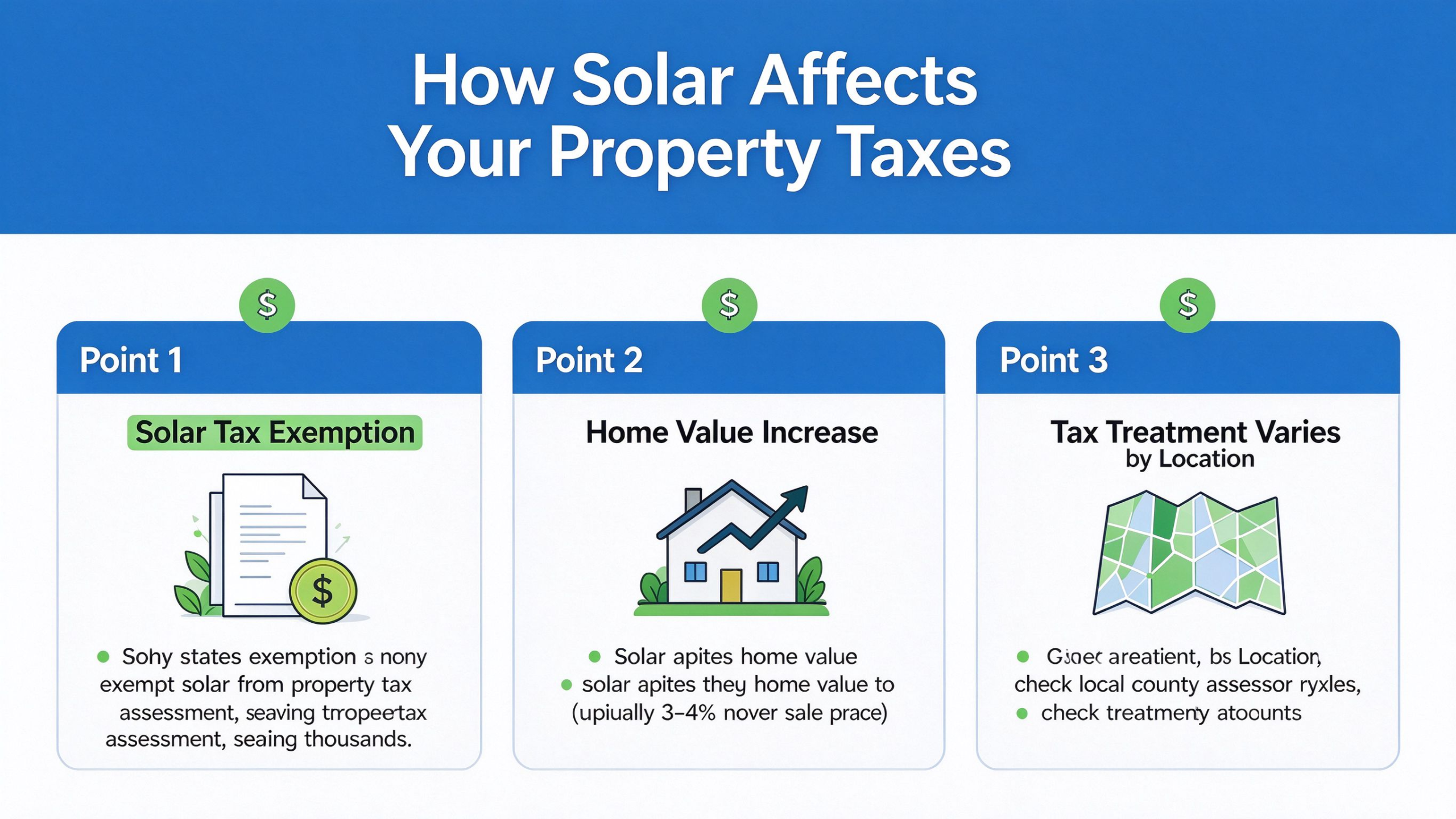
TL;DR: Do solar panels increase property taxes? Sometimes, and it depends almost entirely on where you live. A solar array can raise your property’s assessed value, but many states exempt solar improvements from assessment. The answer is decided by your state law and your local assessor, so check both before you sign.
Do Solar Panels Increase Property Taxes?
The short answer: possibly, but usually less than homeowners expect, and in many places not at all.
The confusion comes from two different questions that get mixed together. Does solar increase your home’s value? Usually yes, at least somewhat. Does that higher value automatically raise your tax bill? That is where the rules take over, and they vary from state to state and sometimes from county to county.
How Property Assessments Actually Work
A property tax bill is a simple multiplication: assessed value x local tax rate. Your assessor’s job is to estimate what the property is worth, and improvements that raise market value are normally candidates for a higher assessment.
Solar fits that description on paper. A house with a working array sells for more than an identical house without one, which is exactly the kind of thing an assessment is supposed to capture.
What stops it from being automatic is policy. Many states decided years ago that taxing solar would work against their own energy goals, so they carved out an exemption or a credit.
The Two Situations You Will Run Into
| Your state | What usually happens | What to do |
|---|---|---|
| Solar is exempt or credited | The improvement is excluded from assessed value, in full or up to a limit | Confirm whether you must file a form to claim it |
| No exemption | The array may be counted like any other improvement | Ask the assessor how solar is treated before you install |
Notice that neither row says “the tax doubles.” Even where solar is counted, the effect is the added value multiplied by your rate, not the system’s sticker price. A rise in assessed value of $10,000 against a local rate of 1% is about $100 a year, not $25,000. Whether that is worth worrying about depends on your system’s annual savings, and most owners find the savings are larger.
What To Check Before You Install
- State law. Search for your state plus “solar property tax exemption” and read the actual statute or the state’s own summary, not a blog
- Your assessor’s practice. Call or email the county assessor’s office and ask one question: how is a residential solar installation treated for assessment here?
- Whether a form is required. Some exemptions are automatic; others need a filing, often within a deadline. Missing the form is the most common way people lose a benefit they were entitled to
- Any cap. Some exemptions apply only up to a value threshold, so a large system may be partially counted
- What happens at resale. Ask whether the exemption stays with the property or resets
That is a fifteen-minute phone call that removes the uncertainty permanently.
The Other Side Of The Ledger
Even if a higher assessment shows up, it rarely arrives alone. Compare the two numbers honestly:
- Annual utility savings, which for a well-sized system are typically in the hundreds to low thousands of dollars, depending on rates and system size
- Any increase in the tax line, which as shown above is normally a small fraction of that
Add the available federal and state incentives into the same calculation and the direction is usually clear. Our overview of solar tax credits and rebates covers what currently applies, and the rules there have been changing quickly.
What Happens When You Sell
This is where the property tax question meets the resale question, and buyers increasingly ask both. The higher value that solar contributes is often part of what makes the sale work; the tax treatment is part of what the buyer’s agent will want to understand.
Our guide to whether solar increases home value covers the value side, and selling a house with solar walks through what transfers, what does not, and what to have ready for the listing.
Common Misunderstandings
- “Solar adds the system cost to my tax bill.” No. Assessments track market value, not what you paid
- “If my neighbour was exempt, I will be too.” Usually true within the same state, but confirm – assessors apply the same law to different property types inconsistently
- “Leased panels are treated the same as owned ones.” Ownership matters. A third-party owned system is generally not your improvement to be assessed, though the rules vary
- “I do not need to do anything.” Sometimes true, sometimes not. Some states require a filing to receive the exemption
What To Do If Your Bill Jumps After Installing
- Read the new notice and identify which line changed, rather than assuming it was the solar
- Compare the assessed value before and after
- Call the assessor and ask what the increase was based on
- If a solar exemption exists in your state, ask whether it was applied and whether a form is still needed
- Check the deadline for appealing an assessment, which is often short
FAQ
Do solar panels always increase property taxes?
No. Many states exempt solar installations from assessment, and others apply a credit or a cap. Where no exemption exists, the array may raise assessed value, which raises the tax line by the added value times your local rate.
How much could my property tax go up?
Work it out as a multiplication rather than a guess. If the assessment rises by $10,000 and your local rate is 1%, the increase is about $100 a year. That is a fraction of what a well-sized system usually saves in a year.
Do I have to apply for a solar tax exemption?
It depends on the state and sometimes the county. Some exemptions are applied automatically when a permit is filed; others require a separate form with a filing deadline. Ask the assessor directly.
Does a higher assessment affect my mortgage payment?
It can, indirectly. If your lender collects property taxes in escrow, a higher tax bill can raise the escrow portion of your monthly payment, even though the mortgage principal is unchanged.
Are leased solar panels assessed differently from owned ones?
Often yes. A system owned by a third party is generally treated as that company’s equipment rather than your improvement, though the details vary by state. If you are leasing, ask the company and the assessor, not the salesperson.
Related: Solar Panel Payback Period 2026 – How Long Until They Pay For Themselves