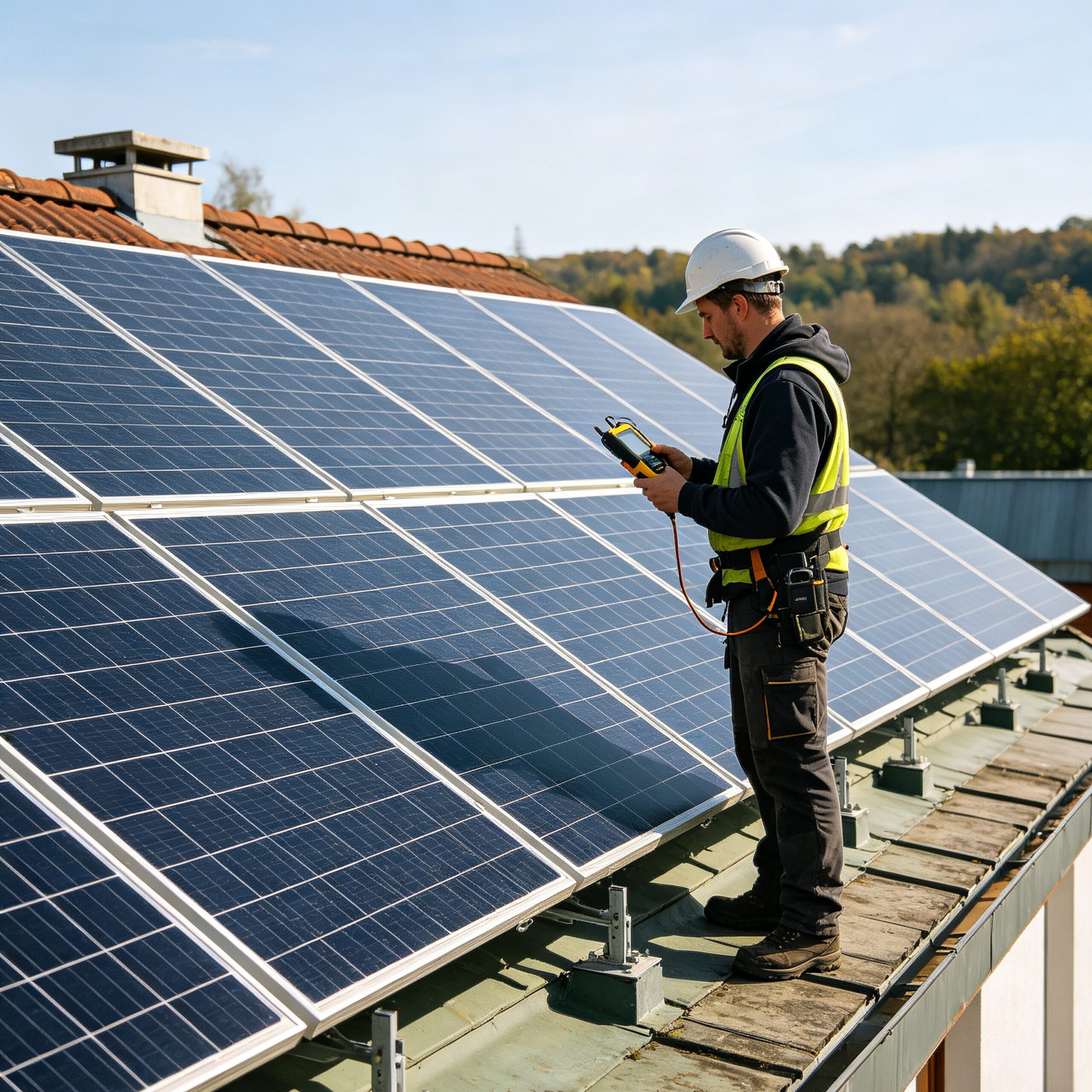
TL;DR: Community solar lets you subscribe to a share of a local solar farm and get a credit on your utility bill, with no panels on your property. The catch is what the discount applies to: a “10% saving” usually means 10% off the solar credit, not 10% off your whole bill, which works out closer to 5-7% of what you actually pay. Typical savings are 5-15% of the subscribed portion.
Community solar is sold as solar without a roof, and that is accurate. It is also sold as a discount on your electricity bill, and that part needs a closer look. The product is simple once you follow the money: you are buying bill credits at a discount, not generating power.
What You Are Actually Buying
A developer builds a solar farm and sells its output into the grid. Regulators let that output be allocated to subscribers as credits. You subscribe to a share sized to your annual usage, and the utility applies the credits to your account.
You are not buying panels. You are buying a contractual right to a stream of bill credits at less than face value. That distinction explains every term in the contract: the discount, the term, the rollover, the exit fee.
How the Credits Move
| Step | Who acts | What happens |
|---|---|---|
| 1 | You | Subscribe to a share, usually sized to your annual kWh |
| 2 | The farm | Generates power and feeds it into the grid |
| 3 | The utility | Applies a credit to your bill for your allocated share |
| 4 | You | Pay the provider for those credits, at a discount |
| 5 | You | Keep the difference between the credit and what you paid |
Step 5 is the entire product. Everything else is administration. If the discount is 10%, you pay $0.90 for every $1.00 of credit. Your saving is $0.10 per $1.00 of credit, not $0.10 per $1.00 of bill.
The Bill Math
Take a $150 monthly bill, split into $90 of supply (generation) and $60 of delivery (wires, fixed charges, taxes). Your subscription covers the supply portion.
| Line | Without community solar | With a 10% discount |
|---|---|---|
| Supply charge | $90 | $90 credit applied |
| Payment to provider | $0 | $81 |
| Delivery and fixed charges | $60 | $60 |
| Total you pay | $150 | $141 |
| Saving | – | $9, or 6% of the bill |
The headline says 10%. Your bill falls 6%. Both numbers are true, and the second one is the one that hits your bank account. When a salesperson quotes a percentage, ask: percentage of what?
Why the Discount Shrinks Further
- Fixed charges never move. The meter fee and customer charge are not part of the credit calculation.
- Delivery charges stay. You are still using the utility’s wires and paying for them.
- Credits can expire. If you generate more than you use, some programs roll the credit forward monthly, some annually, and some forfeit it at the end of the year.
- Usage changes. If you move out, add an EV or install a heat pump, the subscription no longer matches your consumption, and the mismatch can leave credits stranded.
That is why the same program can be a 10% saving for one household and a 4% saving for the neighbour. The discount rate is fixed; your consumption pattern is not.
The Four Contract Models
| Model | What you sign | Who owns the farm | Watch out for |
|---|---|---|---|
| Subscription | A contract for credits at a fixed discount | Developer | Term length, exit fee, escalation |
| Ownership | You buy panels in the farm | You, as a co-owner | Illiquidity, no control, resale difficulty |
| Utility-sponsored | Enrolment in a utility programme | Utility | Limited capacity, waiting lists |
| Non-profit or co-op | Membership | Members | Lower returns, governance rules |
Most residential subscribers sign the first row. Ownership looks appealing because it feels like owning an asset, but you cannot visit it, cannot sell it easily, and have no say in how it runs. For a household, the subscription is usually the cleaner product.
Community Solar vs Rooftop vs Green Tariff
| Community solar | Rooftop solar | Utility green tariff | |
|---|---|---|---|
| Upfront cost | None | $8,000-20,000 | None |
| Installation | None | Required | None |
| Ownership | No | Yes | No |
| Typical saving | 5-15% of subscribed portion | 50-80% of the bill, after payback | 0-5%, sometimes a premium |
| Control | Low | High | None |
| Best for | Renters, shaded or unsuitable roofs | Homeowners staying 8+ years | People who want no contract |
The comparison is not close on money. Rooftop solar, where it works, saves far more over 25 years. Community solar wins on access and effort: no capital, no roof, no maintenance, and you can move without dismantling anything.
What Happens If You Move
This is the question to ask before you sign, because the answer varies by program.
- Within the same utility territory: many programs let you transfer the subscription to a new address.
- Out of the territory: usually you must cancel, and the exit fee depends on the contract.
- Cancellation window: some contracts allow a free exit in the first 30-90 days, then charge a fee or the remaining contract value.
- Credits at exit: ask whether unused credits are paid out, transferred or forfeited.
If you rent and expect to move within two years, a contract with a long term and a real exit fee can cost more than it saves. Portable options are compared in solar panels for renters.
Who It Fits, and Who It Does Not
| Situation | Fit | Why |
|---|---|---|
| Renter or apartment resident | Good | No roof access, and the contract can move with you |
| Shaded or north-facing roof | Good | Rooftop output would be poor anyway |
| Good south roof, staying 8+ years | Poor | Rooftop solar captures a much larger share of the bill |
| Moving within two years | Depends | Only if the contract is portable and the exit is free |
| Usage about to change (EV, heat pump) | Poor | A fixed subscription mismatches the new load and strands credits |
| Wants to own an asset | Poor | A subscription is a contract, not ownership |
Eight Questions Before You Sign
- Is the discount a percentage of the credit or of my total bill?
- What percentage of my annual usage does the subscription cover?
- What is the contract term, and what is the exit fee?
- Do unused credits roll over, and do they expire?
- What happens if I move inside the utility territory, or outside it?
- Is there an annual escalator on the discount or the fee?
- Who is the counterparty, and what happens if the developer fails?
- Is the saving guaranteed in writing, or is it an estimate?
Question seven is the one people skip. A subscription is an unsecured contract with a project company. If the project underperforms or the developer runs into trouble, your credits are only as good as the company behind them.
Conclusion
Community solar is a real product and a sensible one for people who cannot use their roof. It is not a way to cut your bill in half. Expect 5-15% off the subscribed portion, which lands closer to 5-7% of the total bill, and read the term, the exit fee and the rollover rules before you sign.
If you want to compare it with generating your own power, start with net metering explained and how to read your electricity bill. If you rent and cannot wait for a program, the alternatives are in solar energy for apartments.
FAQ
Do you need to own a home to join community solar?
No. It is designed for renters, apartment residents and anyone who cannot install panels, though some programs still run a credit check.
How much can you save with community solar?
Usually 5-15% off the subscribed portion of your bill. That is often 5-7% of the total bill once fixed and delivery charges are included.
Is community solar available everywhere?
No. It depends on state rules and on whether a project serves your utility territory. Check availability before you compare prices.
Do community solar contracts have a long commitment?
Often 5-25 years, with an exit fee for early cancellation. Some allow a free exit in the first 30-90 days.
Does community solar put anything on my property?
No. The array is at a separate site. Nothing is installed on your home, and there is no maintenance.
What is a community solar credit?
A dollar or kWh credit applied to your utility bill for your share of the farm’s output. You buy the credit from the provider at a discount.
What happens to unused credits?
It depends on the program. Some roll over monthly, some annually, and some expire. Ask before you size the subscription.
Can I move with my community solar subscription?
Often within the same utility territory, rarely outside it. The contract should state the rule and any fee.
Is community solar cheaper than rooftop solar?
Monthly, yes. Over 25 years, no. Rooftop solar saves far more if you have a suitable roof and stay long enough to pay it back.
Does community solar affect my credit score?
Some providers run a credit check at signup, and a defaulted contract can be reported. Ask which bureau and whether it is a soft or hard check.
Is community solar worth it?
Yes if you cannot use your roof and the contract is short or portable. No if you have a good roof and plan to stay, or if the exit fee is large.
Related: Solar Panel Payback Period Explained