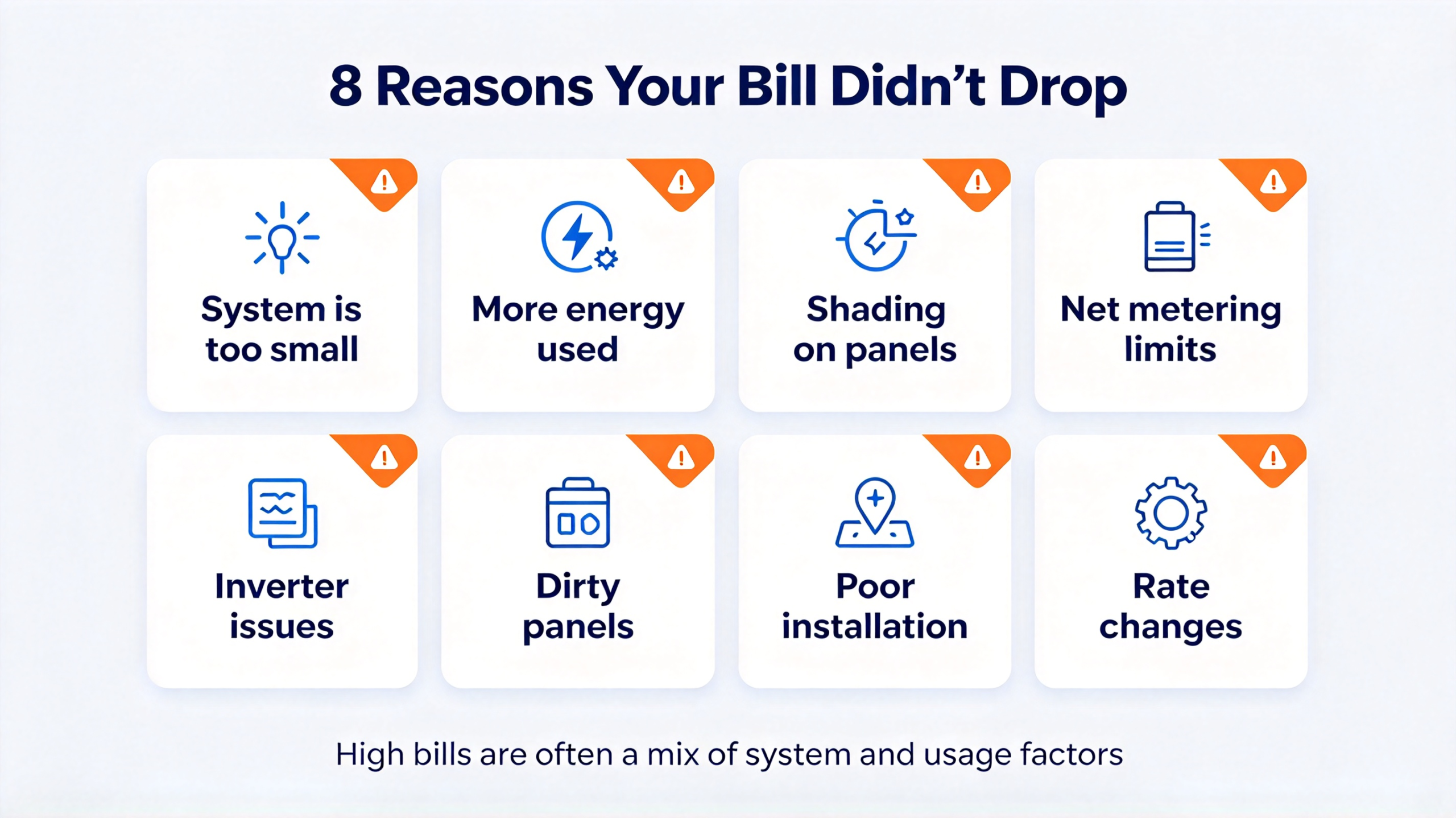
TL;DR: Why is my electric bill still high with solar panels? Because solar offsets energy, not every line on the bill – and in most cases the cause is one of eight things: fixed charges the panels cannot touch, changed net metering rules, time-of-use rates, a system sized around last year’s usage, shading or soiling, a quietly failed component, an annual true-up cycle, or rate increases that ate the savings.
Why Is My Electric Bill Still High With Solar Panels?
Because the panels are doing their job. The bill is doing something the panels were never designed to cover.
Solar produces kilowatt-hours. A utility bill is a mix of energy charges, fixed customer charges, delivery fees and taxes. Only the energy portion responds to your own production, and in many areas that portion is getting smaller. Two numbers explain almost every case: how much of your production the utility actually credits, and how much of your usage happens after the sun goes down.
1. Fixed Charges Solar Cannot Offset
Every home with a connection pays a monthly charge simply to have a meter. Those charges stay on the bill no matter how much you produce.
- Customer or meter charge, typically $10-$25 per month
- Distribution and transmission charges
- Taxes and public benefit fees
- Minimum bill amounts, common on net metering tariffs
If those lines add up to $30-$50 a month, that is the floor on your bill, even on a day when the array covers every kilowatt-hour the house uses. This is the single most common reason a system performs exactly as promised and the bill still does not go to zero.
2. Net Metering Changed To A Lower Export Rate
Older programs credited exported power at the full retail rate, so a kilowatt-hour sent to the grid cancelled a kilowatt-hour bought back later. Many utilities have moved to a lower export rate instead.
On those tariffs, exports are usually worth a fraction of retail – often $0.02-$0.06 per kWh against a retail rate of $0.14-$0.20 per kWh. The system still produces the same amount. What changed is the value of the electricity it sends away. The full picture is in our guide to net metering and how solar owners get paid for extra power.
3. Time-Of-Use Rates Rewrite The Maths
Under a time-of-use plan, the price per kilowatt-hour changes by the hour. Panels generate most heavily in the middle of the day, when rates are at their lowest and exports earn the least. Households then buy power back in the evening, when rates are at their highest.
The result is a system with excellent production and mediocre savings, unless something shifts the timing or stores the energy. That usually means a battery or moving flexible loads such as EV charging, laundry and the dishwasher into the cheap window. Our breakdown of time-of-use rates and solar covers which loads are worth moving.
4. The System Was Sized For Last Year’s Usage
A system is designed against a twelve-month history. Consumption that appears afterwards is not covered by it:
- An electric vehicle, which typically adds 3,000-4,000 kWh a year
- A heat pump or a second air conditioner
- A pool pump or a hot tub
- A home office that did not exist when the contract was signed
If usage went up by 20% and the array was sized at 100% of the old figure, the household is back to buying roughly a fifth of its power. The honest fix is more panels, not a change to how the system is run.
5. Shading, Soiling And Seasonal Losses
Production in July and production in January are not the same number. A winter month can run 30-50% below a summer month in most of the country, and the bill moves with it.
Slow losses are easy to miss as well. A tree that has grown since the install, a season of pollen, dust after nearby construction, or droppings along one row of panels can shave a noticeable slice off output without anything failing. If this month’s production is lower than the same month last year, that is a question worth asking before assuming the system is broken.
6. A Quiet Equipment Failure
Solar does not usually stop with a bang. A tripped breaker on one string, a rapid shutdown device that latched open, or an inverter that has gone into a fault state can take out part of the array while the rest keeps producing. Nothing on the wall looks wrong.
This is why monitoring matters more than the installer’s annual inspection. A production graph makes a partial failure obvious the same week it happens, while a monthly bill hides it for months.
7. Annual True-Up And Credit Banking
Some utilities do not settle export credits monthly. Credits accumulate on the account and are applied once a year, at a true-up date. Until that date, the monthly bill can look almost unchanged while a large credit balance is quietly building.
Read the tariff before assuming the savings are missing. On those plans the right question is what the balance is, not what this month’s bill says.
8. Rates Went Up While Production Stayed Flat
This one is invisible if the comparison is done in dollars. A utility raising its rate by 10% while the array produces the same kWh means the bill falls by less than expected – even though the system is performing to specification.
Compare kilowatt-hours, not dollars. If the kWh you bought from the grid fell by the amount the design predicted, the system is working. The dollars are a moving target that no array can control.
Quick Diagnosis Table
| What you are seeing | Most likely cause | What to do |
|---|---|---|
| Bill never drops below $30-$50 | Fixed charges and fees | Read the bill line by line and separate fixed from usage |
| Bill low in summer, high in winter | Seasonal production, not a fault | Compare year on year, not month on month |
| Production down, nothing looks broken | Shading, soiling or a partial failure | Check the monitoring graph, then clean and inspect |
| Big exports, small savings | Low export rate or time-of-use pricing | Review the tariff, shift loads, consider storage |
| Bill creeping up year after year | Rate increases, not system decline | Track kWh purchased instead of dollars |
| Credits building but bill unchanged | Annual true-up cycle | Ask the utility for the current credit balance |
How To Check Your Own Production
Ten minutes a month is enough to catch almost everything:
- Open the monitoring app and note the monthly kWh for the same month last year
- Compare it with the kWh billed by the utility for that month
- Look for a flat line, a missing string or a drop that starts on a specific day
- Check the inverter for fault codes, not just for a green light
- Log the numbers somewhere you will actually find them next year
Our walkthrough on tracking your system’s output explains what the different graphs mean and which ones indicate a real fault.
When To Call Your Installer
Call rather than wait if production falls sharply in a single month, if the app has been offline for more than a few days, if the inverter shows a fault code, or if the utility bill shows imports during hours when the array should be covering the house. Most equipment faults are covered by warranty, and early reports are easier to resolve than ones discovered a year later.
FAQ
Why is my electric bill still high with solar panels in the first month?
Billing cycles rarely line up with the switch-on date. The first invoice often covers part of a month with no production, plus fixed charges that were always going to remain. Two or three full months give a fair picture.
Should my bill be zero with solar panels?
Rarely. Fixed charges, delivery fees and taxes usually remain, and in most areas that is $20-$50 a month regardless of production. A zero bill is a marketing claim, not a normal outcome.
Does a high bill mean the panels are faulty?
Not usually. Compare kilowatt-hours produced against the original estimate and against the same month last year. If production is on target, the bill is being driven by charges, rates or new consumption rather than by the equipment.
How much of a drop should I actually expect?
A well-sized system typically removes most of the energy portion of the bill, and a reasonable planning range is a 50-90% reduction in the total bill depending on tariff design, fixed charges and how much usage happens after dark.
Can cleaning the panels really change the bill?
In dusty or high-pollen areas, sometimes. Heavier soiling can reduce output by a few percent, and cleaning is usually worth it once a year rather than monthly. It will not explain a bill that never moved at all.
Related: How to Read Your Electricity Bill Before Going Solar