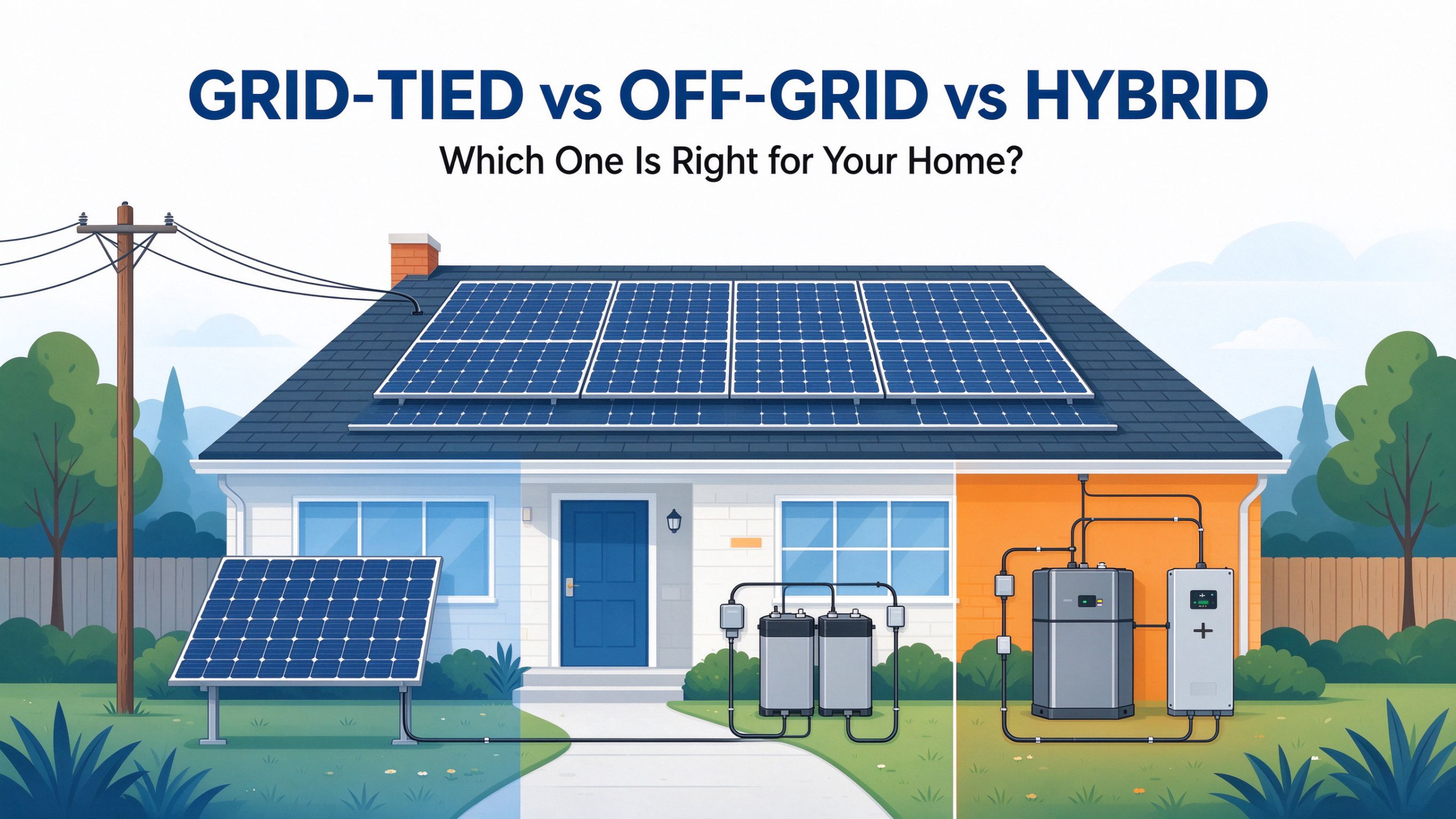
TL;DR: Grid-tied vs off-grid vs hybrid solar comes down to one question – does your house stay connected to the utility? Grid-tied is the cheapest and the default for most homes, off-grid gives full independence but costs two to three times more, and hybrid sits in the middle: grid power plus a battery, so the lights stay on when the grid fails.
What Each System Actually Does
All three systems start the same way. Panels on the roof make DC power, an inverter turns it into household AC, and the house uses what it needs.
The difference is what happens to the surplus and what happens when the grid goes down:
- Grid-tied: surplus flows to the utility, the grid supplies power at night, and the system shuts off during an outage
- Off-grid: nothing connects to the utility – surplus charges a battery bank that runs the house around the clock
- Hybrid: the grid stays connected as backup, and a battery covers outages and evening loads
That single difference drives almost everything else: the price, the equipment, the paperwork and how much of your bill disappears.
Grid-Tied Systems: The Standard Choice
A grid-tied system is panels, an inverter and a meter. No battery, no maintenance beyond an occasional clean, and the lowest cost per watt of the three.
The utility acts as your battery. Every kilowatt-hour you export is logged, and the credit is applied against the power you buy back at night. How much that credit is worth depends entirely on your utility’s rules – retail-rate credits under older arrangements, or a lower export rate under newer ones. Our explainer on net metering and export credits covers the difference, and it is the single biggest variable in whether a grid-tied system pays off quickly or slowly.
One thing surprises almost every new owner: a grid-tied array switches off within seconds of a blackout. It is not a fault. The inverter has to stop feeding the lines so it cannot electrocute a lineman working down the street. This is why solar panels do not run your house during a power outage unless a battery is part of the design.
Off-Grid Systems: Full Independence At A Price
An off-grid system has no utility connection at all. That means the array must cover your worst month, not your average one, and every kilowatt-hour you use on a cloudy week has to already be sitting in a battery.
The equipment list is longer:
- A larger array than a grid-tied home of the same size needs
- A battery bank sized for two to three days of autonomy, often 30-60 kWh
- Charge controllers, an off-grid inverter and a critical-loads panel
- Usually a backup generator for long stretches of bad weather
Off-grid makes sense where a utility connection is unavailable or would cost tens of thousands of dollars to bring in: remote land, cabins, farms, some island and rural properties. For a house that already has a meter, it is usually the most expensive of the three options by a wide margin.
Hybrid Systems: Grid Power Plus A Battery
A hybrid system keeps the utility connection and adds storage. You still export surplus, you still draw from the grid at night, and when the grid fails the battery takes over the circuits you have chosen to back up.
In practice most hybrid systems today are one hybrid inverter plus a lithium battery, sometimes with the existing grid-tied inverter left in place. The battery is usually wired to a sub-panel that carries the essentials: fridge, internet, a few lights, a well pump or a medical device. Whole-home backup needs a much bigger bank and, often, a main panel upgrade.
Typical residential batteries run 10-13.5 kWh, which covers an evening and a short outage comfortably and a multi-day outage only if you ration. If you are weighing storage against a generator, our comparison of solar panels with battery backup walks through what each one actually protects.
Side-By-Side Comparison
| Factor | Grid-tied | Off-grid | Hybrid |
|---|---|---|---|
| Utility connection | Yes | None | Yes |
| Battery | Usually none | Large, 30-60 kWh typical | 10-13.5 kWh typical |
| Works in an outage | No | Yes | Yes, on backed-up circuits |
| Exports surplus to the grid | Yes | No | Yes |
| Typical cost per watt | $2.50-$3.50 | $4-$8 | $3.50-$5.50 |
| Maintenance | Lowest | Highest | Moderate |
| Best for | Homes with a meter and decent utility rules | Properties with no practical grid access | Homes that want backup without leaving the grid |
What Each System Costs In 2026
Figures below are for an average US home using roughly 10,000-11,000 kWh a year, installed, before any federal or state incentives:
| System | Typical installed cost |
|---|---|
| Grid-tied, 8 kW, no battery | $20,000-$28,000 |
| Hybrid, 8 kW plus one 10-13.5 kWh battery | $27,000-$42,000 |
| Off-grid, 8-10 kW with a large battery bank | $35,000-$70,000 |
Incentive programs have been changing quickly in the last two years, and the rules differ by state and by utility. Confirm what currently applies in your area before comparing quotes – the numbers move more than most buyers expect.
Which One Fits Your Situation
- You want the lowest cost and your utility offers reasonable credits: grid-tied
- Your power goes out often and you want the fridge and internet to keep running: hybrid
- There is no practical way to connect to the grid: off-grid
- You already own a generator and only care about the bill: grid-tied
- You plan to add an EV or a heat pump within a few years: hybrid, and size the array for the future load
One more consideration that decides a lot of cases: if the utility connection already exists, the money you would spend on an off-grid battery bank usually buys far more value as a hybrid system plus a smaller battery.
What Most Homes In The US Actually Install
Grid-tied remains the majority of residential installs, because it is the cheapest way to cut a bill and most utilities still credit exports in some form. Hybrid systems have grown fastest of the three, driven by outage concerns and by batteries getting cheaper per kilowatt-hour. Off-grid stays a niche, concentrated in rural and remote properties where the alternative is a very expensive line extension.
FAQ
Can I add a battery to a grid-tied system later?
Usually yes. Most systems installed in the last few years can take a battery, though older inverters sometimes need replacing and the electrical panel may need work. Ask the installer to leave room for storage when the system is first designed.
Is off-grid cheaper than staying on the grid?
Almost never for a home that already has a meter. The oversized array, the large battery bank and the backup generator normally cost far more than years of utility bills. Off-grid wins on independence and on properties where connecting would cost $20,000 or more.
Do grid-tied solar panels work when the power goes out?
Not by default. The inverter shuts down during an outage to protect utility workers. Adding a battery with a backed-up sub-panel is what keeps selected circuits running.
Do I still need the utility with a hybrid system?
Yes, and that is the point. The grid keeps taking your surplus and supplying the house at night, while the battery handles outages and expensive peak hours. You get backup without giving up the credits.
How big a battery does a hybrid system need?
Most homes start at 10-13.5 kWh for essential circuits. Whole-home backup typically needs 20-40 kWh or more, and the honest answer depends on which appliances you are willing to run during an outage.
Related: Off-Grid Solar System Cost – What to Budget in 2026