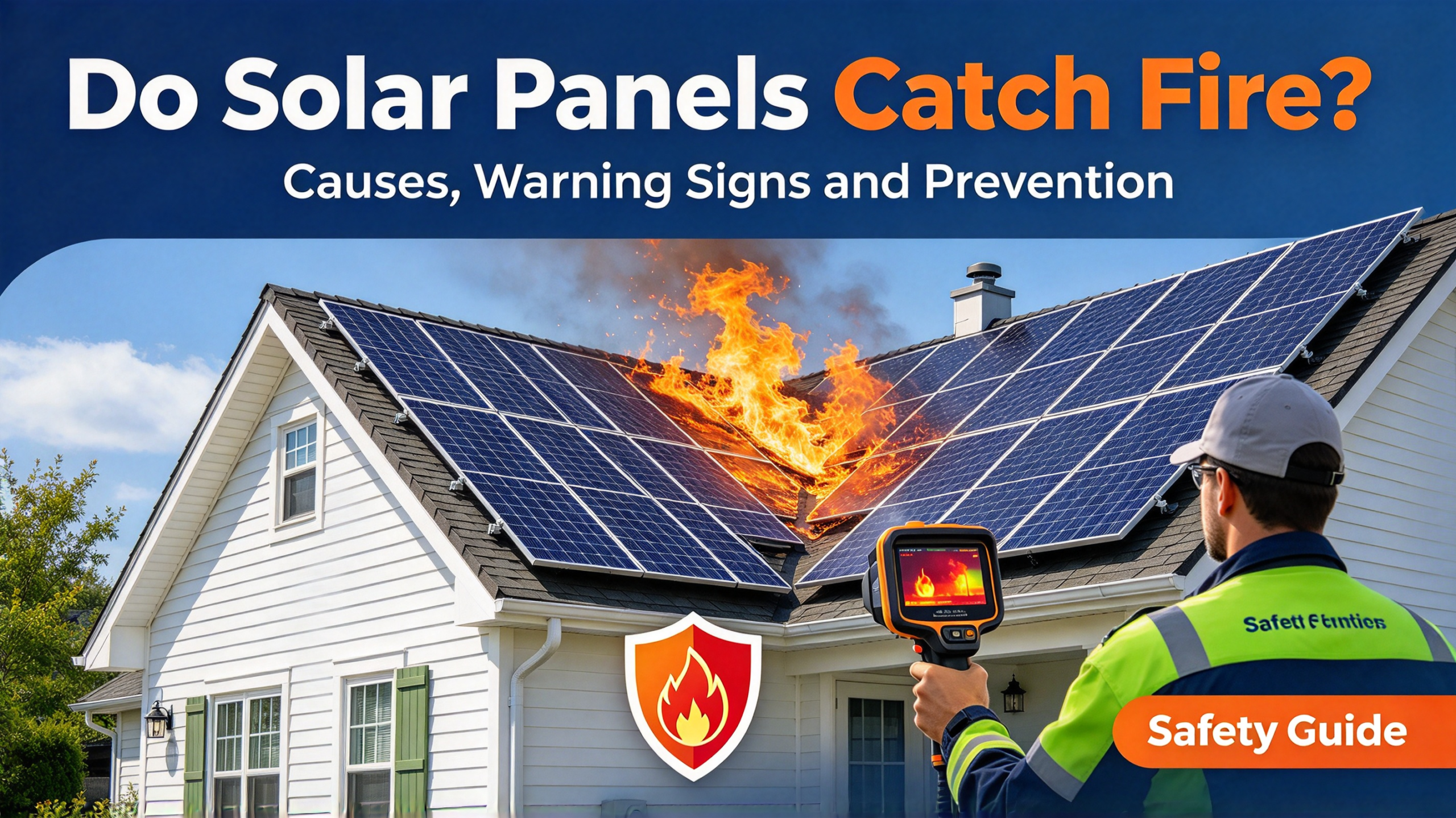
TL;DR: Do solar panels catch fire? Rarely, and when it happens the panel itself is almost never the source. The failure points are the wiring, the connectors and the workmanship: a loose DC joint, rodent-damaged cable, or a terminal that was never torqued properly. Modern systems add arc fault protection, and an annual look at the array catches most of it early.
Do Solar Panels Catch Fire?
In absolute terms, fires involving rooftop solar systems are uncommon – which is exactly why each one makes the news. What matters more than the frequency is where they start.
The panel is a glass and silicon assembly with no moving parts and no fuel inside it. The fire risk lives in everything connecting it: DC cables, connectors, junction boxes, isolators and inverters. Every one of those is installed by a person, and most failures trace back to that work.
How Many Things Can Actually Fail?
A residential array is not one device. It is a long chain of connections, and every link was made by hand.
- A typical 20-panel system has roughly 40-80 DC connectors, counting both ends of every cable run
- Plus terminal connections inside the junction box on each panel
- Plus the isolator terminals, the inverter input terminals and any pass-through boxes
- Plus every mounting point where a cable can chafe against a rail or a roof edge
Any one of those, if it is loose or mismatched, becomes a resistance. Resistance in a DC circuit is heat that never switches off, because the sun keeps the current flowing.
That is the honest way to think about solar fire risk: not “are panels dangerous”, but “how many hand-made joints are there on my roof, and when was anyone last up there looking at them”.
What Actually Starts A Solar Fire
- A loose or mismatched DC connector. A joint that is not fully seated, or that pairs a connector from one brand with a housing from another, develops resistance. Resistance means heat, and heat at a DC joint is the classic starting point
- Damaged DC cable. Rodents chew it, UV breaks it down, or it chafes against roof edges and rail ends until the conductor is exposed
- Water in a junction box. A poorly sealed box collects moisture, and corrosion over years turns a clean connection into a hot one
- Workmanship defects. Undersized terminals, a poorly torqued lug, a cable run crushed under a rail. None of it fails at the inspection, which is the problem
- Combustible debris under the array. Dry leaves and nesting material accumulate below the panels where nobody looks
- Equipment failure. An inverter or DC isolator can fail internally, and older systems may have no arc detection at all
Why DC Wiring Is The Weak Point
Household AC wiring has breakers and outlets that are inspected and replaced over time. The DC side of a solar system sits on a roof, out of sight, carrying current for twenty years with nobody looking at it.
A DC arc behaves differently from an AC arc too. It does not self-extinguish as the current crosses zero, so it keeps burning at the point of the fault. That single characteristic is why arc fault detection exists as a requirement in modern installations.
Does Your System Have Modern Protection?
Requirements changed over the last fifteen years, and older arrays were built to the rules of their time. In the United States, under the National Electrical Code:
- DC arc-fault protection has been required since 2011, with enforcement tightening in later editions
- Rapid shutdown – which reduces voltage on the roof conductors so firefighters can work – arrived in 2014 and was extended into the array in 2017
In practice, systems installed before roughly 2015 are the ones most likely to have neither, or to have arc detection that was never re-enabled after an inverter swap.
Standards differ outside the US, so the date matters less than the question: does my system have this protection, and is it switched on? An installer can answer both in a single visit.
The Protection Built Into Modern Systems
- Arc fault detection. Modern inverters and some module-level devices watch for the signature of a series arc and shut the circuit down
- Rapid shutdown. Required on new systems, it drops the voltage on the roof conductors so firefighters can work safely
- Proper grounding and bonding. Keeps fault current on the intended path rather than through the mounting frame
- Module-level electronics. Micro-inverters and optimisers work at lower DC voltage, which reduces the energy available at any one fault
Warning Signs To Watch For
Almost every serious failure gives notice first:
- A burning or hot-plastic smell near the inverter or the cable run
- Discoloured, brittle or scorched connectors and cable insulation
- Repeated inverter faults, especially arc or insulation errors – our guide to inverter error codes explains which ones deserve an immediate call
- A step change in production that is not explained by weather, visible in your system’s monitoring
- Buzzing or crackling at a junction box or isolator
- Rodent activity, droppings or chewed material under the array – the link between pests and damaged wiring is covered in our guide to keeping birds and pests out from under solar panels
What Actually Prevents A Fire
| Failure point | What goes wrong | Prevention |
|---|---|---|
| DC connectors | Loose or mismatched joint arcs and heats | Matched connector pairs, correct crimp, fully seated |
| DC cable | Rodent, UV or chafe damage exposes conductor | Cable management, conduit where needed, critter guard |
| Junction box | Water ingress corrodes the connection | Correct sealing, mounted out of the water path |
| Inverter and isolator | Component or terminal failure | Arc fault protection, periodic inspection |
| Under-array space | Dry debris and nesting material | Keep the gap clear, screen the perimeter |
The single highest-value step is a professional inspection every few years, because the failure points are all in places a homeowner cannot safely reach. DC circuits cannot be switched off at a wall switch, and they carry voltage whenever the sun is up.
Why The Installation Matters More Than The Panel Brand
Buyers spend weeks comparing panel brands and almost no time asking who will crimp the connectors. That is the wrong order of priorities. A mid-range panel installed carefully will outperform a premium panel installed badly, on safety as well as on production.
Three questions worth asking any installer:
- Which connector brand do you use, and are the pairs matched?
- Is arc fault protection active in the inverter, and will it be left enabled?
- What does your workmanship warranty cover on the DC side, and for how long?
That last question matters more than it looks, because the workmanship warranty lives with the installer – not the panel maker. If the company closes, the cover goes with it, which is what installer went out of business deals with.
If Something Looks Wrong: What To Do
- If there is smoke or visible flame, leave the building and call the fire service first
- If you smell burning but see nothing, shut the system down at the AC disconnect or the inverter if it is safe to reach, then call your installer
- Do not open junction boxes, pull connectors apart, or hose down an energized array
- Do not cover panels with a tarp to “isolate” them – the conductors remain live in daylight
- Document what you saw, with photos and a date, for the warranty conversation
If You Already Own A System
- Look at the monitoring app once a month for unexplained drops
- Walk the outside of the array twice a year and look for chewed cable, nests or storm debris
- Keep the roof clear of leaves near the array edges
- Ask for an inspection if the system is more than 8-10 years old and has never been checked
- Keep the installation paperwork, so a future inspection or claim is straightforward
FAQ
Do solar panels catch fire often?
Fires involving solar systems are rare relative to the number of systems installed, and the panels themselves are seldom the origin. When a fire does start, it is usually at a connection, a cable or a component rather than inside a module.
Can a solar panel overheat and ignite on its own?
Panels get hot in the sun, but heat alone does not ignite them – the materials are designed for decades outdoors. Hot spots and ignition come from a fault in the circuit, which is why connections and cable condition matter more than panel temperature.
What does a solar electrical fault smell like?
Burning plastic or an acrid electrical smell, often near the inverter or where cables enter the roof. Any such smell is a reason to shut the system down and call an installer rather than wait and see.
Does homeowners insurance cover a solar fire?
Fire damage to the home and system is typically covered under a standard homeowners policy, but condition and workmanship issues can complicate the claim. Confirm the current wording with your insurer rather than assuming. How claims are handled after storm damage is covered in solar panel hail damage.
Can I check my own system for fire risk?
You can watch production data, keep the area clear and look for visible damage from the ground. You should not open junction boxes, separate connectors or work on DC wiring, because those conductors stay energised whenever the array is in daylight.
How much does a solar inspection cost?
For a residential array, expect roughly $200-$500 for a full electrical inspection covering the DC side, connectors and inverter. That single visit addresses every failure point at once, which is why it is worth doing on any system more than 8-10 years old that has never been checked.
When did solar systems get arc fault protection?
In the US, DC arc-fault protection has been required under the National Electrical Code since 2011, and rapid shutdown since 2014. A system installed before roughly 2015 may have neither. Standards differ elsewhere, so check what your inverter actually supports rather than relying on the install date.
1 thought on “Do Solar Panels Catch Fire? Causes, Warning Signs and Prevention”