TL;DR: How many solar panels to run an air conditioner depends on the unit’s running watts, the sun hours and how long it runs. A 3-ton central unit often needs about 9-11 panels of 400 W just to carry the running load at midday, and 11-14 panels to cover six hours of daily running. If you want it running after sunset, the panels are not enough: you need a battery sized for the compressor’s surge and overnight energy.
Most online answers give one number and skip the hard part. An air conditioner is not a light bulb. It cycles, it has a startup surge, and it often runs into the evening when solar production is falling. The useful answer is a range, plus a clear statement of what the range covers.
How Many Solar Panels to Run an Air Conditioner? Short Answer
For a modern central air conditioner, a rough starting point is 4-6 panels for 1.5 tons, 6-8 for 2 tons, 9-11 for 3 tons, 12-15 for 4 tons and 15-19 for 5 tons. Those numbers use 400 W panels and a 0.8 derate for heat, wiring and inverter losses. They cover the running load while the sun is up. They do not cover the evening or a multi-day outage.
Tonnage Is Not Electricity
A ton is a measure of cooling capacity, not electrical input. One ton equals 12,000 BTU per hour. A 3-ton unit moves 36,000 BTU per hour, but its electrical draw depends on efficiency, compressor type, fan, refrigerant and operating conditions.
A 3-ton unit from 2005 and a 3-ton unit built this year can differ by more than a kilowatt while running. That is why the nameplate matters more than the tonnage. Look for running amps, watts, RLA (rated load amps), LRA (locked rotor amps) and MCA (minimum circuit ampacity). The LRA is the startup number that decides whether a battery or generator can carry the surge.
The Two Panel Counts
There are two different questions, and they produce different arrays.
- Instantaneous count: how many panels carry the compressor while it is running at midday.
- Daily-energy count: how many panels produce the kWh the unit uses over a full day.
The daily count is usually larger, because the air conditioner runs for hours and the panels do not produce at full power all day. If the unit only runs during sunny hours and the grid covers the rest, the instantaneous count may be enough. If you want the solar to cover the whole cooling load, use the daily count.
Panel Count by Air Conditioner Size
The table below assumes 400 W panels, five effective sun hours a day, and a 0.8 derate. It is a planning table, not a design. A hot climate, shade or a lower-output panel changes the result.
| AC size | Typical running watts | Panels to carry the load | Panels for 6 hours/day | Panels for 8 hours/day |
|---|---|---|---|---|
| 1.5 ton | 1,300-1,800 W | 5-6 | 5-7 | 7-9 |
| 2 ton | 1,800-2,400 W | 6-8 | 7-9 | 9-12 |
| 3 ton | 2,700-3,500 W | 9-11 | 11-14 | 14-18 |
| 4 ton | 3,600-4,600 W | 12-15 | 14-18 | 18-23 |
| 5 ton | 4,500-5,800 W | 15-19 | 17-22 | 23-29 |
The “panels to carry the load” column uses instantaneous watts divided by 400 W and then divided by 0.8. The daily columns multiply running watts by hours, then divide by the daily output of one panel. A 400 W panel at five sun hours and 0.8 derate produces about 1.6 kWh a day. That number is the bridge between power and energy.
The Formula
| Input | Where to find it | Example |
|---|---|---|
| Running watts | Nameplate, spec sheet, or volts x amps | 3,000 W |
| Panel wattage | Panel datasheet | 400 W |
| Derate factor | Heat, wiring, inverter and soiling losses | 0.8 |
| Sun hours | Local production data, not sunrise-to-sunset | 5 hours |
| Run hours | Summer duty cycle, not the thermostat setting | 6 hours |
| Daily energy | Running watts x run hours | 18 kWh |
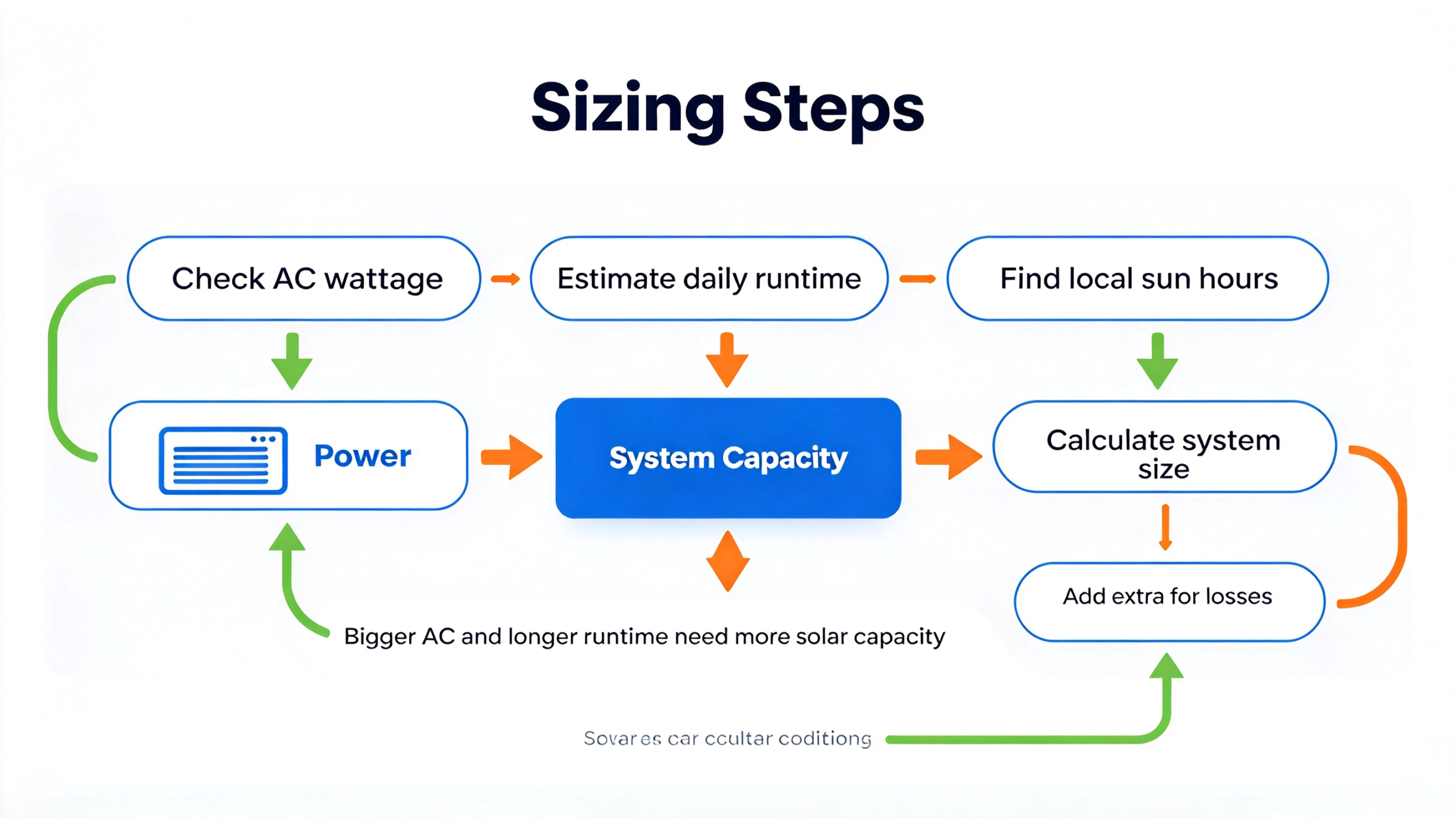
Instantaneous panels = running watts / (panel watts x 0.8). Daily panels = daily kWh / (panel watts x sun hours x 0.8). If the answer is 9.4, round up to 10; you cannot install 0.4 of a panel. Then check the inverter, wiring and roof space.
Example: A 3-Ton Unit
Assume 3,000 W running, six hours a day, 400 W panels, five sun hours and a 0.8 derate.
| Step | Calculation | Result |
|---|---|---|
| Instantaneous load | 3,000 / (400 x 0.8) | 9.4, so 10 panels |
| Daily energy | 3,000 x 6 | 18 kWh |
| Daily output per panel | 400 x 5 x 0.8 | 1.6 kWh |
| Daily-energy panels | 18 / 1.6 | 11.25, so 12 panels |
| Eight-hour day | 24 / 1.6 | 15 panels |
That is why the same 3-ton unit can be described as “10 panels” or “15 panels” and both answers can be honest. One covers the midday load; the other covers a longer daily run. The difference matters when you compare quotes. The whole-house sizing method is in how many solar panels do I need.
Startup Surge and Battery Size
A single-speed compressor can draw two to three times its running watts for a fraction of a second at startup. That surge is why a battery that runs the house lights may trip when the air conditioner starts. An inverter-driven unit ramps up gradually, with a surge closer to 1.2-1.5 times running watts. A soft-start kit can reduce the surge on an older unit.
| AC type | Typical startup surge | What it means for storage |
|---|---|---|
| Single-speed compressor | 2-3x running watts | Battery and inverter must carry a short, high peak |
| Inverter-driven AC or heat pump | About 1.2-1.5x | Easier to run on a battery; check the datasheet |
| Soft-start kit on an older unit | Lower than the original surge | Can reduce the required inverter size |
| Mini-split | Lower running load and gentler start | Often the easiest solar cooling load |
For overnight cooling, energy matters as much as surge. A 3-ton unit running at 3 kW for four hours uses 12 kWh, before efficiency losses and reserve. That is a large battery, and it leaves little capacity for the rest of the house. If the goal is outage cooling, a smaller mini-split on a critical-load panel is often more practical than carrying the central unit. See what a home battery can actually run.
Daytime vs Night: The Catch
Air conditioning is a daytime load with an evening habit. At 2 pm the array can carry the compressor and send surplus to the grid or battery. At 9 pm the array is producing nothing while the house is still hot. That power comes from the grid or from storage.
| Goal | What the panel count covers | What else is needed |
|---|---|---|
| Lower the daytime bill | Running load and part of the daily energy | Grid-tied inverter and net metering or self-consumption |
| Cover the full daily cooling load | Daily kWh, not just instantaneous watts | Enough roof space and a suitable inverter |
| Run at night | Panels alone cannot do it | Battery sized for surge and overnight kWh |
| Cool during an outage | Critical-load design | Battery, soft start or inverter AC, and load management |
A grid-tied system can be smaller than an off-grid system because the grid supplies the night. An off-grid system needs enough panels to recharge the battery and enough battery to get through the night and cloudy days. Those are different designs, not different panel-count rules. The storage trade-offs are in solar panels with battery backup.
Mini-Split and Window Units
A typical 12,000 BTU mini-split draws around 800-1,200 W. That is about 3-4 panels to carry the running load, and roughly 3-5 panels for a typical daily cooling load. A window unit often draws 500-1,500 W, or 2-4 panels. Both are much easier to support than a 3-5 ton central system.
If you are choosing equipment, an inverter-driven mini-split can reduce both the running watts and the startup surge. That often costs less than enlarging the solar array and battery to carry a large central unit. The efficiency labels are explained in solar panel efficiency ratings.
What Changes the Number
| Factor | Effect on panel count | What to do |
|---|---|---|
| Climate and run hours | Hotter climate means more kWh, not just more watts | Use local summer run hours |
| SEER / SEER2 rating | Higher efficiency lowers running watts | Compare the actual electrical input |
| Thermostat setting | A few degrees can add hours of runtime | Model the real setpoint |
| Duct leakage | Wastes cooling and increases runtime | Seal ducts before adding panels |
| Shade and orientation | Reduces panel output for the same wattage | Use a production model, not nameplate |
| Roof space | Limits how many panels fit | About 20-25 sq ft per 400 W panel |
| Panel degradation | Output falls slowly over time | Leave a small margin in the design |
Heat also reduces panel output at the same time it increases air-conditioning demand. That double effect is why a system designed on a cool spring day can disappoint in July. The details are in solar panels in hot climates, and the roof layout is covered in orientation and tilt.
Conclusion
How many solar panels to run an air conditioner is not one number. Start with running watts, not tonnage. Calculate the instantaneous load and the daily kWh separately. Then decide whether the grid or a battery covers the evening. A 3-ton unit may need about 10 panels to carry the midday load, 12-15 for a longer daily run, and a battery if you want it after sunset. Use the nameplate, the local sun hours and a real load calculation before you buy.
FAQ
How many solar panels do I need to run a 3-ton air conditioner?
About 9-11 panels of 400 W to carry the running load while the sun is up. For six hours of daily running, plan around 11-14 panels; for eight hours, 14-18. Night operation needs a battery.
How many solar panels for a 1.5-ton air conditioner?
About 5-6 panels of 400 W to carry the running load, and roughly 5-9 panels to cover six to eight hours of daily running, depending on climate and panel output.
Can solar panels run an air conditioner at night?
Not without storage. The panels stop producing at dusk while the air conditioner may keep running. Night cooling comes from the grid or from a battery sized for the compressor’s surge and overnight kWh.
Do I need a special inverter for air conditioning?
Not necessarily, but an inverter-driven air conditioner or a soft-start kit reduces the startup surge. That can reduce the battery or generator capacity needed to keep it running.
Is a mini-split easier to run on solar?
Yes. A 12,000 BTU mini-split often draws 800-1,200 W, so 3-4 panels can carry the running load. It also cools fewer rooms, which reduces daily kWh.
Can a 5 kW solar system run a 3-ton air conditioner?
A 5 kW array can carry a 3-ton unit at midday in good sun, but it may not cover all of the daily energy or the evening load. Check the actual production and the compressor’s running watts. The daily output comparison is in what a 5 kW system produces.
How many panels for a 4-ton air conditioner?
About 12-15 panels of 400 W to carry the running load, and 14-23 panels to cover six to eight hours of daily running. The exact number depends on the unit’s efficiency and local sun hours.
How many panels for a window air conditioner?
A 500-1,500 W window unit usually needs about 2-4 panels of 400 W to carry the running load. Add panels if you want to cover the daily kWh or other household loads.
Does SEER change the panel count?
Yes. A higher-efficiency unit uses fewer watts for the same cooling output, so it needs fewer panels. Compare the electrical input, not just the tonnage or the SEER label.
Why do installers give different panel counts?
They may be answering different questions: carrying the running load, covering daily energy, or covering the whole house. They may also use different panel wattages, sun hours or derate factors. Ask which assumptions are behind the number.
Can I add solar just for the air conditioner?
You can design a dedicated system, but it is often simpler and cheaper to connect the air conditioner to a whole-house array. A dedicated off-grid system still needs a battery and a transfer arrangement.
What is the biggest mistake when sizing for AC?
Using tonnage instead of running watts, and ignoring run hours. A 3-ton unit can use very different amounts of energy depending on climate, insulation, thermostat setting and duct condition.
Related: What a 5 kW Solar System Produces