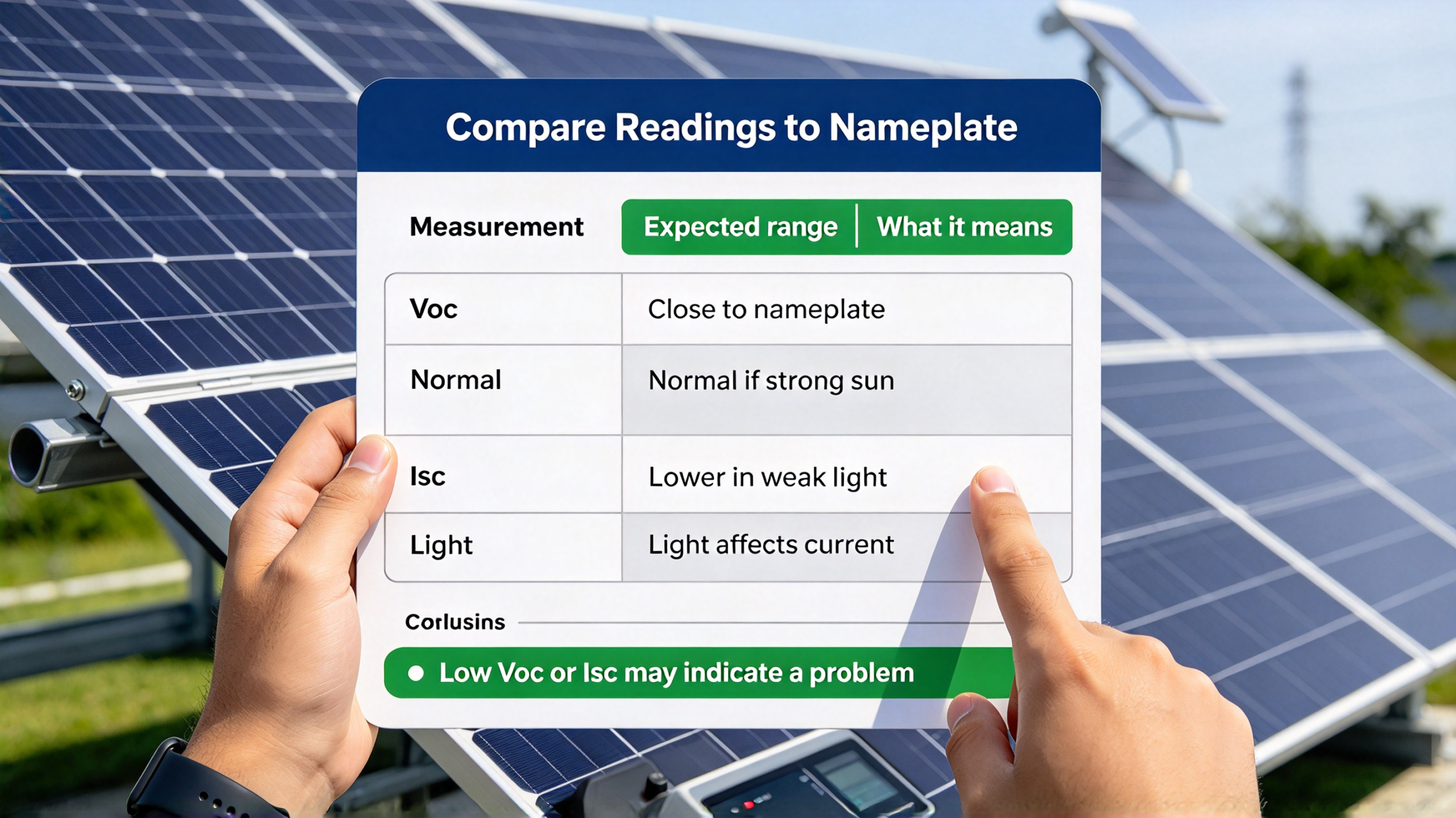
TL;DR: You can test a solar panel with a multimeter in about five minutes. Switch the meter to DC volts, touch the probes to the panel’s positive and negative leads, and read the open-circuit voltage (Voc). Then move to the 10A DC setting and read the short-circuit current (Isc). If both readings land within roughly 10% of the numbers on the panel’s label, the panel is working. If a reading is far off — or sits at zero — you are looking at a dead panel, a failed bypass diode, or a bad connection.
Multimeters are cheap, and they answer the one question monitoring apps cannot: is this single panel still doing its job? Solar monitoring only reports on the whole array, so one weak panel hides inside a healthy-looking total. A five-minute test at the junction box settles it.
What You Need Before You Start
- A digital multimeter rated for at least 600V DC and a 10A DC range. The 10A range matters — most home panels push 8-11 amps, and a meter capped at 200mA will blow its fuse the moment you test current.
- MC4 test leads or MC4-to-banana adapters. Poking the metal pins by hand is slow and easy to get wrong.
- Insulated gloves and safety glasses.
- Full, direct sunlight with no shade and no clouds.
- The panel’s datasheet, or the rating label stuck to its back.
How to Test a Solar Panel with a Multimeter: The 4 Steps
Step 1: Find the Rating Label
Every panel carries a label listing four numbers: Voc (open-circuit voltage), Isc (short-circuit current), Vmp (voltage at maximum power) and Imp (current at maximum power). You only need the first two for a health check. As an example, a 350W panel might list Voc 46.8V and Isc 9.6A.
Step 2: Measure Open-Circuit Voltage (Voc)
Disconnect the panel from everything else first. Turn the dial to DC volts — the V with a straight line above it. Touch the red probe to the positive lead and the black probe to the negative lead, then read the display.
In good sun you want a reading within about 5-10% of the label. Cell temperature shifts this number: cold panels read a little high, hot panels read a little low, roughly 0.3% per degree. A reading of zero means an open circuit somewhere — check the leads and the junction box before you write the panel off.
Step 3: Measure Short-Circuit Current (Isc)
Move the red probe to the 10A socket. This is a separate jack on almost every meter, and forgetting to move it is the number one reason people get a false zero. Turn the dial to 10A DC, then touch the two probes to the panel’s two leads.
Yes, this deliberately shorts the panel. That is safe for one panel, because a solar panel simply collapses to zero volts rather than pushing unlimited current. Never do it on a battery, and never on a full string. Keep the test under ten seconds so nothing heats up, and if your panel’s Isc is above 10 amps, use a clamp meter instead of a multimeter.
Step 4: Read the Numbers
- Voc and Isc both within 10% of the label: the panel is healthy.
- Voc normal, Isc low: usually shade, dirt, or one failing cell string.
- Voc low, Isc low: the classic dead-panel signature, often a cracked cell or a failed bypass diode.
- Voc at zero: an open connection. Check leads, fuses and MC4 contacts first.
- Both readings jump around: a loose MC4 contact or water in the connector.
Testing a Panel That Is Already Installed
You can test a roof-mounted panel without taking it down, but it has to come out of the string first. Otherwise the other panels feed voltage back through your meter and every reading is meaningless. Switch off the DC isolator, wait for the inverter to go quiet, then unplug that one panel’s MC4 connectors.
If you live somewhere hot, do this in the early morning or evening. A live string in full sun can sit above 600V DC, which is not a number you want on a hand-held meter.
Common Mistakes That Give False Readings
- Testing in shade or at sunset. Panel output tracks sunlight almost linearly, so a shaded panel always looks broken.
- Leaving the red probe in the voltage jack while testing current. You will read zero and blame the panel.
- Ignoring a blown 10A fuse. If every panel reads zero amps, check the fuse before buying replacements.
- Measuring at the inverter instead of at the panel. The inverter’s MPPT circuit constantly changes the voltage it sees.
- Testing while the panel is still wired into the string.
When a Multimeter Is Not Enough
A multimeter measures volts and amps separately; it cannot measure watts under load. To get true power you have to run the panel into a load and measure both values at the same moment, or use a dedicated panel tester. If a panel passes both the Voc and Isc checks but the array still underperforms, the cause is usually something a multimeter cannot see — gradual degradation, a failing junction box, or string mismatch. Start with solar panel degradation to confirm the rate is normal, then work through common solar panel problems.
If the numbers are fine but you still suspect a quiet underperformer, compare today’s reading against your normal output using your system monitoring history — that is where a slow drop shows up first.
FAQ
Can I test a solar panel with a multimeter in the shade?
You can read Voc in moderate light, but Isc will sit far below the label. Always compare readings taken in full, direct sun, or the test tells you nothing useful.
What should the voltage be on a 100W solar panel?
Most 100W panels are 12V class and list a Voc around 21-22V and a Vmp around 17-18V. A reading near 20V in good sun is normal.
Why does my multimeter show 0 volts on a solar panel?
Either the panel is broken internally, a bypass diode has failed open, or your probes are not making contact. Re-check the leads and the junction box before you replace the panel.
Can I test a solar panel without disconnecting it?
No. Any panel still wired into a string carries the rest of the array’s voltage, so your meter reads the string, not the panel. Disconnect it first.
How many amps does a 400W solar panel put out?
A typical 400W residential panel produces about 9-11 amps at maximum power, which is exactly why you need a meter with a 10A DC range or a clamp meter.