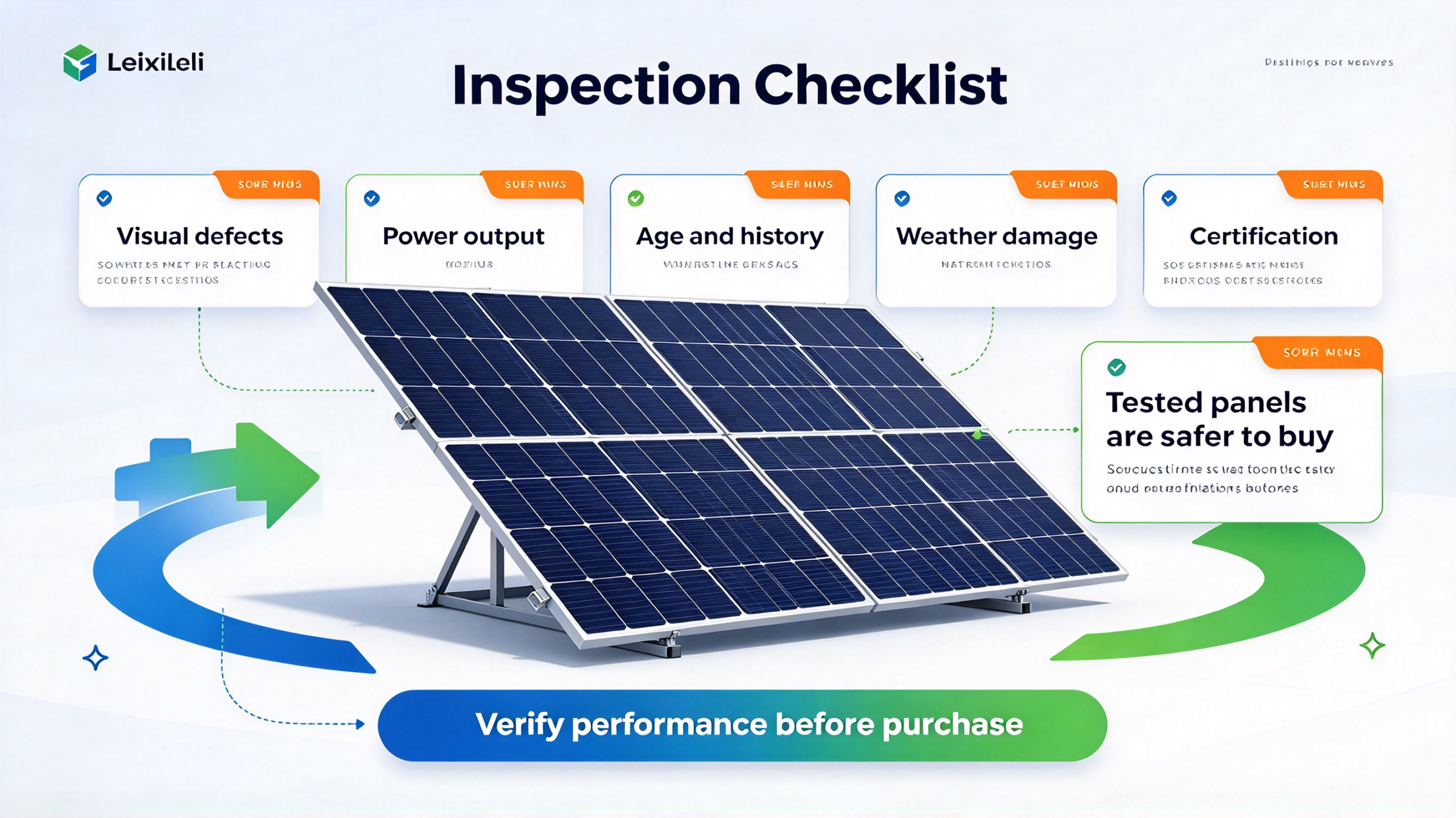
TL;DR: Used solar panels can be an excellent deal for an off-grid cabin, a shed, or a DIY project, and a bad idea for a permitted rooftop system on your house. You give up three things when you buy secondhand: a warranty, documented history, and usually the UL listing that inspectors and insurers want to see. The three things you must test before handing over money are output against the label, physical condition, and whether the panel’s electrical specs match the rest of your system.
Used panels show up constantly — on marketplace listings, at solar installers clearing out old stock, and from commercial arrays being decommissioned. Some of them are genuinely good buys. Others are the reason the seller is getting rid of them. Here is how to tell the difference.
Why Used Panels Are So Cheap
The core reason is simple: solar panels are difficult and expensive to move and recycle, and installers clearing a job site just want them gone. A pallet of 300W modules that cost thousands new may sell for a fraction of that simply because nobody has the space to store them.
Cheap is not the same as good, though. A panel has likely been removed for one of four reasons:
- Decommissioned commercial array. Often 10-15 years old and still working, but with real degradation behind it.
- New old stock. Surplus modules from a cancelled or over-ordered project. These are usually the best category — never installed, still in the crate.
- Warranty or insurance replacement. A mixed bag. Sometimes a perfectly good panel was swapped out as part of a batch claim.
- Storm or defect removal. The category to walk away from. Cracks and internal damage are often invisible from the front.
What You Give Up
Before you compare prices, understand the three things that come with every new panel and rarely come with a used one:
- Warranty. The manufacturer’s power and product warranties almost never transfer to a second owner, and they are void on anything sold as surplus. Solar panel warranties explained shows what you are giving up.
- A UL listing that inspectors accept. This is the big one. Rooftop systems need permits and inspections, and some used panels lack current certification. If the module is not listed, it can fail inspection, and your homeowner’s insurer may refuse to cover it.
- Rapid shutdown compliance. Newer code versions require module-level rapid shutdown on rooftop arrays. An older used panel may not be compatible with the required equipment, which can kill a rooftop install entirely.
None of that matters for a ground-mounted off-grid system that nobody inspects. All of it matters for a permitted roof.
The Three Tests Before You Buy
1. Test the Output
Bring a multimeter and test in full, direct sun. Read the open-circuit voltage and compare it against the label, then check the short-circuit current the same way. A panel reading within about 5-10% of its label in good sun is behaving like a healthy module. Count on the panel’s rated power dropping roughly 0.5% per year of age — the solar panel degradation rate explains what normal decline looks like.
2. Inspect the Physical Condition
- Cracks: any crack through a cell, not just the glass, is a walk-away.
- Browning or discoloration: moisture has entered the laminate. Permanent output loss.
- Snail trails: thin silver-grey lines across the cells. Usually cosmetic, but they point to stress and moisture exposure.
- Junction box and connectors: cracked plastic, corrosion, or missing MC4 connectors mean more money and work.
- Frame: bent corners, deep scratches, or white rust on the anodizing.
3. Check the Specs Match
This is the mistake that costs people real output. Panels in one string need closely matched voltage and current. Mixing a used 250W panel with new 400W panels drags the entire string down to the weakest module. Aim for Vmp and Imp within about 5% across every panel in a string, ideally the exact same model.
One exception: adding used panels of the matching model to an existing array is one of the best uses of the used market. You extend the array without introducing mismatch.
Where Used Panels Make Sense
- Off-grid cabins and sheds with no utility involvement, no permit, and no inspection.
- DIY experiments and teaching setups. Cheap enough to burn one.
- Exact-match expansion of an existing array.
- Ground mounts where roof load, code, and rapid shutdown rules do not apply.
If you are building your own small system, used modules cut the biggest line item — DIY solar panel installation covers what you can and cannot legally do yourself.
Where Used Panels Do Not Make Sense
- Permitted rooftop systems that need listed equipment and inspection sign-off.
- Financed systems. Lenders generally require new, warrantied equipment.
- Insurance-backed installations where the carrier wants to see certified modules.
- Anything with visible cell damage. No discount is worth a hot spot on your roof.
How to Inspect in Person
- Go in the middle of a sunny day, never at dusk.
- Bring a multimeter and test every panel, not just a sample.
- Look at the panel from a low angle — glass cracks and browning are easier to see at a slant.
- Write down the exact model number and look up its datasheet before you commit.
- Ask why they were removed, and treat a vague answer as a red flag.
- Buy the whole lot or none of it if matching matters to you. Picking through a mixed pile is where mismatch starts.
What Used Panels Should Cost
Pricing varies enormously by region and supply, but used modules commonly sell for a fraction of their original retail price — often in the range of 25-50% of new, with new old stock at the high end and damaged or very old panels near free. The best strategy is to price three lots before buying one, and to compare against the current cost of new panels. If new panels are already cheap in your market, the used discount may not be worth the lost warranty.
FAQ
Are used solar panels worth it?
Yes for off-grid, DIY, ground-mount, and exact-match expansion projects. No for permitted rooftop systems where inspection, insurance, and financing all expect certified new equipment.
Do used solar panels still work?
Most do. A working panel degrades roughly 0.5% per year, so a 10-year-old module typically still produces around 90-95% of its original output — assuming it was not physically damaged.
Can I put used solar panels on my house?
Sometimes, but expect obstacles. Many jurisdictions require listed and labeled modules, and older panels may not meet current rapid shutdown requirements. Check with your local permitting office before you buy.
Do used solar panels come with a warranty?
Rarely. Manufacturer warranties generally do not transfer to a second owner, and surplus or salvaged modules usually carry no warranty at all. Budget on the assumption that you have none.
How long will used solar panels last?
Panels are typically rated for 25-30 years of production. If a used panel is 10 years old and undamaged, expect another 15-20 years of useful output, at slightly reduced power.
Related
Next up: Best Solar Panel Brands 2026: 7 Reliable Options Compared