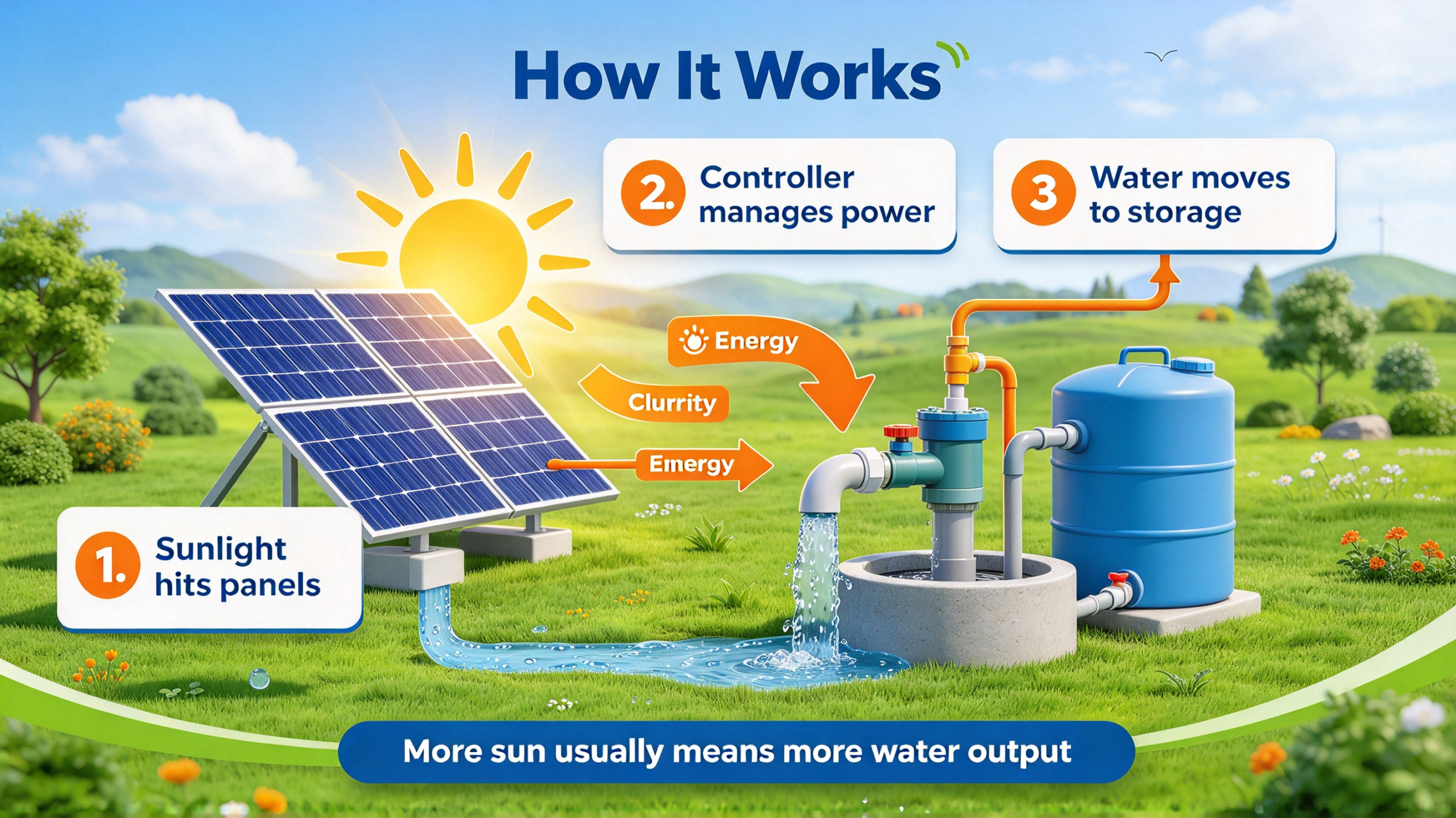
TL;DR: A solar water pump usually runs with no battery at all. The pump speed simply follows the sun, and any water you do not need right away goes into a storage tank instead of into a battery. Storing water is far cheaper than storing electricity, which is why a solar pump system costs a fraction of a full off-grid power system. Size the pump by head and flow first, then size the panels around it.
Water pumping is one of the best fits for solar power anywhere, because you rarely need water delivered at a specific second. A tank absorbs the timing difference. That single idea removes the most expensive part of most solar systems.
Why a Solar Water Pump Usually Runs Without a Battery
Solar panels produce the most power at midday. A pump can use that power the moment it appears, as long as you do not care whether the water arrives at noon or at four in the afternoon. So the standard design is a “daylight-only” system: panels, a pump controller, the pump, and a tank.
- Store water, not electricity. A 1,000-gallon tank costs a fraction of a battery bank with the same usable energy, and it lasts decades longer.
- No inverter needed. Most solar pump controllers accept panel DC directly and drive the pump motor themselves.
- Simple controls. A float switch or a pressure switch turns the pump off when the tank is full, so nobody has to watch it.
The exception is a property that needs water at night or through long cloudy stretches. In that case the answer is usually a bigger tank, not a battery. If you truly need power around the clock, a battery system makes more sense — see off-grid solar for sheds and tiny homes for how that is built.
The Two Types of Solar Water Pump
Surface Pumps
A surface pump sits above ground and pulls water up through a suction pipe. Because atmospheric pressure is doing the lifting, the practical limit is about 20 feet of suction lift regardless of how big the pump is. Surface pumps work well for shallow wells, cisterns, ponds, creeks, and irrigation from a tank.
Submersible Pumps
A submersible pump hangs inside the well, below the water line, and pushes water up instead of pulling it. That is why it can handle 100 feet, 300 feet, or more of lift. Submersibles cost more and are harder to service, but they are the only realistic option for a deep well.
Which One You Need
- Water within 20 feet of the surface: surface pump — cheaper, easier to replace.
- Deep well or borehole: submersible pump, matched to the well casing diameter (most are built for a 4-inch casing).
- Pond or creek with seasonal flow: surface pump with a screen, plus a dry-run cutoff.
The Three Numbers to Measure Before You Buy Anything
- Total head. This is the vertical lift from the water level to the highest point the water must reach, plus friction losses in the pipe. A practical shortcut: add about 1 foot of head for every 10 feet of horizontal pipe. A tank 15 feet up a hill with 100 feet of pipe run counts as roughly 25 feet of head.
- Daily water volume. Gallons per day you actually need — household use, livestock, or irrigation. Add a real margin; needs grow.
- Peak flow rate. Gallons per minute you want at the tap or the emitter. This decides the pipe size and often the pump model.
How to Size the Array (Simple Method)
Use this as a sanity check, then confirm against the pump’s published performance curve, because every pump model behaves differently.
A rough working rule: in a real system with normal losses, about 1 watt-hour of electricity lifts one gallon of water roughly 60 feet. So for 500 gallons a day at 100 feet of total head:
- Energy needed per day: 500 gallons × (100 ÷ 60) ≈ 830 watt-hours
- Productive sun hours: about 4 in a decent location
- Array size: 830 ÷ 4 ≈ 210 watts
Round up hard. Pump efficiency varies, wire runs lose voltage, and panels age. A 400-watt array is a realistic starting point for that example, not 210 watts. Solar pump controllers are also worth understanding before you commit — choosing the right solar charge controller covers the MPPT versus PWM tradeoff that affects how much of your panel power actually reaches the motor.
Store Water, Not Electricity
Tank size is really a question of how many sunless days you want to ride out. A day of buffer is the minimum for most homes; three to five days is comfortable for a farm or an off-grid property.
- 500 gallons is about one day for a small household with normal use.
- 1,000-2,500 gallons covers several days plus outdoor use.
- Elevated tanks give you gravity pressure at the tap, which removes the need for a pressure pump entirely.
Fill control is what makes this work unattended. A float switch in the tank stops the pump when it is full, and an overflow pipe protects the tank if the switch ever sticks.
Field Details That Decide Whether It Lasts
- Dry-run protection. Never run a solar pump dry. If the well level drops below the pump, the motor overheats in minutes. Most controllers include a dry-run cutoff — take it seriously.
- Surge protection. A submersible pump in a well is a very long wire in a very good lightning target. Add surge protection at the controller.
- Voltage drop. Long DC runs lose voltage quickly. Keep the array near the well if you can, or step up the wire gauge.
- Freeze protection. Above-ground pipe and the pressure switch need draining or insulation in cold climates. The pump itself, sitting below the frost line, does not.
What a Solar Water Pump Costs
Real numbers vary with well depth and how much water you need, but the ranges are stable:
- Surface pump kit with controller: $300-$1,000
- Submersible pump with controller: $800-$3,000
- Storage tank: $500-$2,000
- Panels and mounting: separate, and the smallest line item in most builds
A typical small property system lands somewhere between $1,500 and $6,000 all in, before any well drilling. For comparison against a system that has to power a whole house, see off-grid solar system cost — the gap is large, and the tank is what closes it.
Winter, Clouds, and the Worst Month
Always size the array using your lowest-sun month, not the annual average. A system that is perfect in July can come up short in December in northern states, where production may fall to around a third of summer output. If winter water matters, either oversize the array or oversize the tank and accept slower pumping.
Cloudy weather does not stop a solar pump — it just slows it. The pump will run at reduced speed and pump less water, which is exactly what you want it to do rather than shutdown entirely.
FAQ
Can a solar water pump run at night?
Not without a battery or another power source. Standard solar pump systems are daylight-only, which is why the storage tank matters so much.
Does a solar water pump need a battery?
Usually no. Storing water in a tank is cheaper, simpler, and far longer-lived than storing electricity in a battery. Add a battery only if you truly need water after dark.
How many solar panels does a water pump need?
It depends on total head and daily gallons, not on a fixed number. As a starting point, 500 gallons a day at 100 feet of head needs roughly 830 watt-hours, which points to a 400-watt array once real-world losses are included.
How deep a well can a solar pump handle?
It depends entirely on the pump model. Many submersible solar pumps handle 200-500 feet of head, but the deeper you go, the more panel wattage the same flow requires.
Do solar water pumps work in cloudy weather?
Yes, at reduced output. The controller slows the pump to match available power, so you get less water rather than no water.