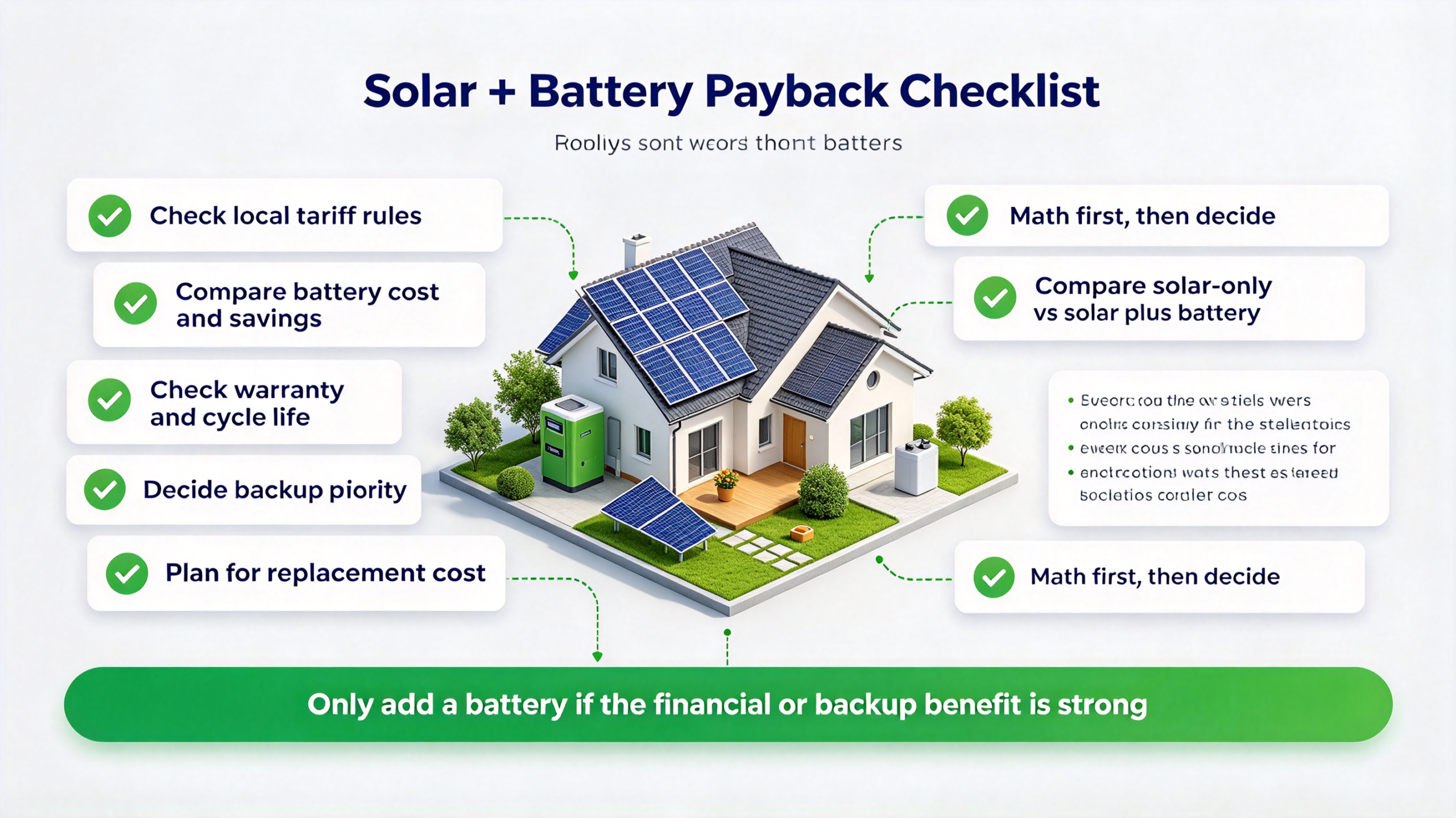
TL;DR: Solar payback with battery is two calculations, not one. The solar array has its own payback; the battery is an incremental investment that saves money only when it shifts cheap energy to expensive hours, reduces demand charges or avoids an outage cost. Under strong 1:1 net metering, the battery’s bill savings are often small and backup is the main reason to buy. Under a low export rate or a wide time-of-use spread, the battery can improve the math.
A combined payback number can hide a bad battery purchase. If the solar array pays back in 10 years and the battery takes 35, the combined system may look acceptable while the battery itself never earns its cost. Separate the two before you decide.
Solar Payback With Battery: Short Answer
Calculate the solar system’s net cost and annual savings first. Then calculate the battery’s extra cost and the extra annual savings it creates: time-of-use arbitrage, lower export losses, demand charges or outage avoidance. Divide each by its own annual benefit. If the battery’s simple payback is longer than its warranty life, it is a backup purchase, not a financial investment.
The Battery Is a Separate Investment
Solar panels reduce the electricity you buy. A battery changes when you buy it. It does not create a second solar resource, and under strong net metering it may not lower the annual bill much at all. The battery’s value comes from the spread between what you pay for imports and what you receive for exports, plus the value you assign to backup.
| Item | Solar alone | Solar plus battery |
|---|---|---|
| Main job | Generate energy | Shift energy and provide backup |
| Up-front cost | Lower | Higher by the battery and electrical work |
| Bill savings | Generation and export credit | Generation plus time-shifting and lower exports |
| Backup | None | Selected circuits or whole-home |
| Replacement cycle | Inverter around year 10-15 | Inverter and battery |
| Main risk | Rate and export changes | Rate changes plus battery degradation |
The Formula
Use simple payback first: net cost divided by annual savings. Then stress-test it with a lower savings estimate and a higher cost estimate. For the battery, use only the incremental cost and the incremental savings. Do not count the solar savings twice.
| Calculation | Formula | What to include |
|---|---|---|
| Solar payback | Solar net cost / annual solar savings | Generation, export credit, fixed charges |
| Battery incremental payback | Battery net cost / annual battery savings | TOU arbitrage, export losses avoided, demand charges |
| Combined payback | Total net cost / total annual savings | Both, but do not double-count |
| Backup value | Separate value, not cash savings | Outage comfort, medical needs, lost work |
Three Rate Cases
| Rate case | Battery bill benefit | What drives it |
|---|---|---|
| Strong 1:1 net metering | Low | The grid already banks exports at retail; the battery mainly adds backup |
| Net billing with a low export rate | Moderate to high | Storing midday surplus avoids buying at retail later |
| Time-of-use with a wide peak spread | Moderate to high | Charge cheap, discharge expensive |
| Demand charges | Can be high | Reducing the monthly peak can save more than kWh arbitrage |
| Frequent outages | Hard to price | Backup and comfort may justify the cost |
Under classic net metering, a battery does not create a second retail credit for the same kWh. It changes the timing. Under net billing, the spread between the retail import rate and the lower export rate is the battery’s opportunity. The policy detail is in net metering explained.
A 10 kWh Example
Assume a solar system costs $20,000 net and saves $1,800 a year. A 10 kWh battery adds $12,000 and shifts 8 kWh a day, 300 days a year, with a $0.15 spread. The battery saves $360 a year before degradation.
| Case | Net cost | Annual savings | Simple payback |
|---|---|---|---|
| Solar alone | $20,000 | $1,800 | About 11 years |
| Battery incremental | $12,000 | $360 | About 33 years |
| Combined, moderate spread | $32,000 | $2,160 | About 15 years |
| Battery with high TOU spread | $12,000 | $840 | About 14 years |
| Combined, high spread | $32,000 | $2,640 | About 12 years |
The moderate-spread battery does not pay back within a typical 10-15 year warranty. The high-spread case is much closer. The difference is not the battery brand; it is the rate spread and the number of useful cycles. The battery cost breakdown is in solar panels with battery backup.
What Backup Is Worth
Backup is real value, but it is not the same as cash savings. A battery that keeps the fridge, internet and medical equipment running during an outage may be worth more than its bill savings to that household. Another household with a reliable grid may assign it almost no value.
| Value | Can you count it as savings? | How to treat it |
|---|---|---|
| Lower TOU bill | Yes | Use actual rate data |
| Lower export losses | Yes | Compare import and export rates |
| Demand charge reduction | Yes, if billed | Model the monthly peak |
| Outage comfort | No, not cash | Assign a personal value, separate from payback |
| Medical or work continuity | No, not cash | Treat as insurance, not ROI |
| Incentives | Yes, if confirmed | Use current written terms |
A backup system is closer to insurance than to an investment. That is not a reason to avoid it; it is a reason not to pretend the payback is shorter than it is. If outages are frequent or medical equipment is involved, the decision may be justified even when the simple payback is long. The alternative is compared in home battery vs standby generator.
Incentives and Replacement
Incentives can change the answer, but they are location- and year-specific. Do not assume a federal, state or utility rebate will still exist when the system is installed. Ask for the current written terms and verify them with the administrator. A battery that only works with an expired incentive is not a good deal.
Also include replacement in the lifecycle cost. A battery may last 10-15 years, and a second battery may be needed during the solar array’s life. If the simple payback is 14 years and the battery lasts 12, the replacement cost erases the result. Battery lifespan is covered in how long solar batteries last, and the current payback update is in solar panel payback 2026.
When a Battery Improves Payback
- A wide time-of-use spread. Cheap off-peak charging and expensive peak discharge create real savings.
- A low export rate. Storing surplus instead of selling it cheaply avoids buying at retail later.
- Demand charges. A commercial-style rate can make peak reduction valuable.
- Frequent, long outages. The backup value may justify a long financial payback.
- Export limits. A battery can store energy that would otherwise be curtailed, depending on the architecture.
- Confirmed incentives. A rebate can shorten the incremental payback.
When It Doesn’t
- Strong 1:1 net metering. The grid already stores the credit; the battery mostly adds backup.
- Reliable grid and no TOU spread. There is little bill savings to capture.
- Small battery, large evening load. The battery empties before the expensive period ends.
- Battery too large for the load. You pay for capacity that never cycles.
- Short warranty or low throughput. The replacement cost arrives before the savings compound.
- Expired or uncertain incentives. The math only works on paper.
Conclusion
Solar payback with battery only makes sense when the battery has its own cash-flow case or a backup value you are willing to pay for. Calculate the solar payback first, then the battery’s incremental payback. Under strong net metering, expect the battery to be mostly a backup purchase. Under a low export rate or a wide time-of-use spread, it can improve the math. Use current incentives, include degradation and replacement, and do not count comfort as cash.
FAQ
Does a battery shorten solar payback?
It can, if it shifts cheap energy to expensive hours or reduces export losses. Under strong 1:1 net metering, the bill savings are often small and the battery mainly adds backup.
What is a good payback for a home battery?
There is no universal number. Compare the battery’s incremental payback with its warranty life. If the payback is longer than the warranty, the financial case is weak unless backup has real value to you.
How do I calculate battery payback?
Divide the battery’s net installed cost by its annual bill savings. Use only the incremental savings: TOU arbitrage, avoided export losses, demand charges or confirmed incentives.
Is a battery worth it with net metering?
Usually not for bill savings alone under strong 1:1 net metering. It can still be worth it for backup, medical needs or if the utility changes to a lower export rate.
How much can a battery save per year?
It depends on usable kWh, cycles and the rate spread. A 10 kWh battery with 8 kWh usable and a $0.15 spread over 300 cycles saves about $360 a year before degradation.
Does battery degradation matter in the payback?
Yes. Capacity falls over time, and the warranty may cap throughput. A payback calculated on year-one savings can look better than the real result.
Should I count backup power as savings?
Not as cash savings. Assign it a personal value separately, then decide whether the total is worth it. Medical needs and frequent outages can justify a long financial payback.
Do incentives change the payback?
Yes, but only use current, written incentive terms. Do not base the decision on a programme that may expire before installation.
Is it cheaper to add a battery later?
Sometimes, but it can require a new inverter or electrical work. Adding it during the original install may be cheaper, but only if the battery has a clear use case.
What is the difference between solar payback and battery payback?
Solar payback is the array’s net cost divided by its annual savings. Battery payback is the battery’s extra cost divided by the extra savings it creates. Do not double-count the solar savings.
Does a battery increase solar production?
It does not create more sunlight. It shifts production to another time, and in some DC-coupled designs it can use energy that would otherwise be clipped. The array’s output is still limited by the roof and weather.
What is the biggest mistake in battery payback math?
Counting backup as cash, assuming a perfect rate spread, or ignoring degradation and replacement. Use conservative assumptions and compare the result with the warranty life.
Related: Solar Panel Payback Period