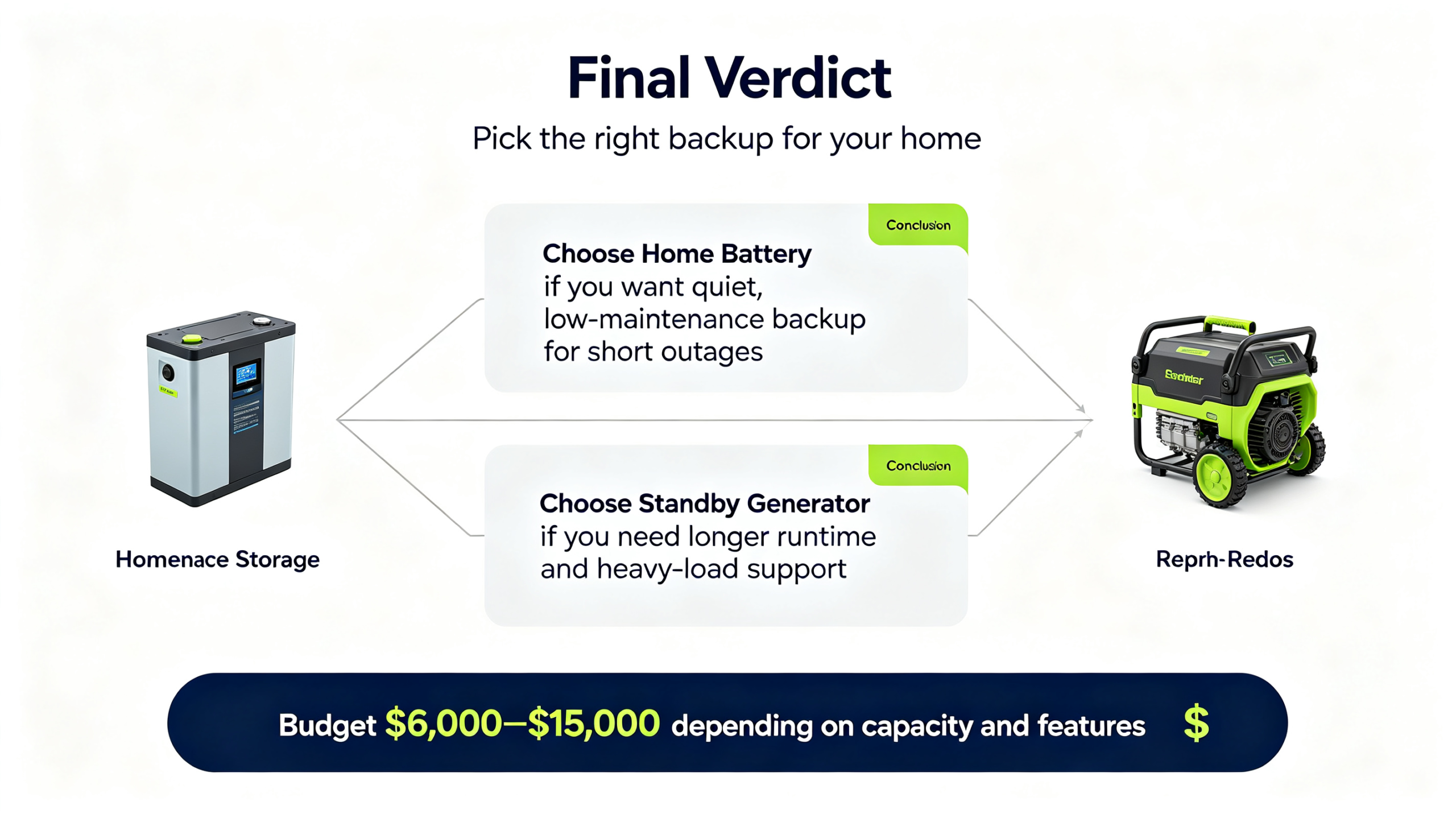
TL;DR: Home battery vs standby generator comes down to two things: how long the outage lasts and how much noise you can live with. A home battery is silent, starts instantly and costs nothing to run, but it is limited by what it has stored – usually 8 to 12 hours for essentials on a 10kWh unit. A standby generator costs $5,000 to $15,000 installed and runs indefinitely on natural gas, but it is loud, needs annual servicing and burns roughly $150 to $200 of fuel per day of continuous use.
Both systems keep the lights on when the grid goes down, but they solve the problem in completely different ways. One stores energy, the other makes it. Understanding that difference is what makes the decision easy.
Here is how the two compare on cost, runtime, noise, maintenance, and the practical question most buyers forget to ask: what happens on day three of an outage?
The Core Difference: Storage vs Generation
A home battery holds electricity that was generated earlier, either from your solar panels or from the grid when rates were cheap. When the power fails, it discharges that stored energy into your home.
A standby generator makes electricity on demand by burning propane or natural gas. As long as fuel keeps arriving, it keeps producing.
That single distinction explains almost every other difference on this page. Storage is silent, instant and free to run, but finite. Generation is loud, mechanical and fuel-hungry, but effectively unlimited while the supply holds.
Home Battery vs Standby Generator: Cost Comparison
| Home battery | Standby generator | |
|---|---|---|
| Equipment and installation | $8,000-$15,000 typical | $5,000-$15,000 for 7-22kW |
| Running cost | None, once installed | $150-$200 per day of continuous running on propane |
| Ongoing servicing | Almost none | Annual service, oil and filters |
| Expected lifespan | 10-15 years | 15-20 years with good maintenance |
| Noise level | Silent | 60-70 dB, similar to a lawnmower |
| Runtime | Hours to a few days | Unlimited on natural gas |
Two details are easy to miss. First, a battery installed without solar still charges from the grid, which means it can only recharge when the grid is up – not much help in a widespread outage. Second, generator prices climb quickly with capacity, and a unit large enough to run central air conditioning can double the install cost once you add the transfer switch and gas line work.
How Long Can Each One Actually Run?
This is where the two systems separate in real life, and it depends entirely on what you choose to power.
A 10kWh battery running essential circuits – fridge, lights, internet, phone charging, a few outlets – typically lasts 8 to 12 hours. A 20kWh system can stretch to a day or two. Whole-home batteries in the 30kWh range can carry a house for two to three days, but only if the sun comes back to recharge them. During a multi-day storm with heavy cloud, a solar-charged battery may not recover much at all.
A standby generator does not care about weather. On natural gas it can run continuously for as long as the gas supply holds, which in most suburban areas means indefinitely. On propane, a typical 500-gallon tank supports one to three days of continuous running, depending on load.
That is the honest trade-off: batteries win on the first twelve hours, generators win on day three.
Running Costs Over Ten Years
Battery owners mostly spend nothing after installation. There is no fuel, no oil and no filter to change. If the battery is paired with solar, it recharges for free every sunny day.
Generator owners pay twice: once for fuel and once for maintenance. An annual service runs roughly $200 to $400. Fuel is the variable that surprises people, because a generator running continuously through a three-day outage can burn $450 to $600 of propane, and that is on top of what you already spent on the machine.
Over a decade, a battery usually costs less to own. The catch is that it may not cover the scenario you bought it for.
Noise, Space and Permits
- Noise: a standby generator sits at 60-70 dB, about the same as a running lawnmower, and it runs at night too. A battery makes no sound at all.
- Space: generators need a poured pad, clearance from windows and doors, and a gas line. A battery is wall-mounted and takes roughly the space of a small water heater.
- Permits: both need electrical permits. Generators usually need additional gas and mechanical permits, plus a noise ordinance check in some cities.
Which One Fits Your House?
A home battery is usually the better fit if:
- You already have solar, so the battery recharges for free
- Your outages are short, frequent events rather than multi-day disasters
- You want backup without noise, fuel storage or annual servicing
- You also want to shift cheap overnight power to expensive peak hours
A standby generator is usually the better fit if:
- Your area sees long outages after storms, ice or grid failures
- You need to run central air conditioning, a well pump or medical equipment for days
- You have natural gas at the property, so fuel supply is not a limitation
- You do not mind the noise and the annual maintenance routine
If the honest answer is “both”, that combination is worth considering. Some homeowners install a battery for instant, silent coverage of the first hours and a smaller generator for extended outages. It costs more, but it removes the weakness of each system.
If you are still deciding on the battery side, our guide to solar panels with battery backup covers sizing and what to expect from installation. For smaller, portable backup, see portable solar generators vs gas generators.
FAQ
Can a home battery run a whole house?
Yes, if it is sized for it. A whole-home battery setup usually needs 20kWh to 30kWh of storage plus a smart panel that manages large loads. Most households start with essential circuits instead, which cuts the cost significantly.
Does a standby generator need to run every week?
Most units self-test for about ten minutes a week to confirm they will start when needed. That short run keeps the engine lubricated and the battery charged, and it uses very little fuel.
Can a battery work without solar panels?
It can, but it charges from the grid. In a widespread outage the grid is down, so the battery cannot refill. Pairing it with solar is what makes it genuinely independent.
Which is cheaper over ten years?
A home battery usually is, because there is no fuel and no servicing. A generator can still be the better buy if your priority is covering a three-day outage, because no typical residential battery can do that without sun.
Can I install both a battery and a generator?
Yes, and it is a sensible combination in outage-prone areas. The battery handles short outages silently, and the generator takes over for long ones. Expect to pay for two systems and a coordinated transfer setup.
Related: Solar Panels During a Power Outage – Do They Still Work?
1 thought on “Home Battery vs Standby Generator – Which Backup Power Is Better?”