TL;DR: Most common solar panel problems come from dirt, new shade, or loose outdoor connections – not from the panels themselves. Clean the glass gently, walk the array looking for new shadows, and check external wiring first. If output drops to nothing at all, work through the breakers, the charge controller and the battery in that order. Internal wiring, hot spots and deep glass cracks are the ones to hand to a technician.
Panel Output Is Lower Than Expected
This is the problem behind most of the others. Before you assume something has failed, rule out the two boring causes.
Dirt and Soiling
Dust, pollen, bird droppings and leaves block light before it reaches the cells. A visible film of soiling typically costs somewhere between 5% and 25% of output depending on how heavy it is and how long it has been building.
The fix is gentle: soft cloth or a soft brush with plain water. Never a pressure washer, never an abrasive pad. How often panels actually need cleaning covers the climate-by-climate answer.
New Shade You Did Not Have Before
Trees grow. Buildings appear. Both add shade that was not there when the system was designed.
The important part is how much a small shadow costs. Panels are wired in series, so the weakest panel sets the current for the whole string. A single shaded panel can hold back three unshaded ones with it. Walk the array from a few angles a couple of times a year, ideally in the morning and late afternoon when shadows are longest.
Cracked Glass and Cracked Cells
Two different things, often confused:
- Cracked glass – from hail, debris or impact. Visible, and mostly a moisture problem rather than an immediate electrical one
- Cracked cells – hairline fractures inside the laminate. Invisible from outside, and the ones that matter, because a cracked cell creates resistance and heat
Hairline cracks in the glass rarely kill output on day one. They let moisture in, and months later you are looking at corrosion inside the frame and a slow fall in production. Deep cracks, or glass that has gone cloudy around the break, mean the panel needs replacing rather than patching – DIY repairs let in more water than they keep out.
If output keeps sliding after a hailstorm, the array is worth a closer look. Repair or replace covers how that decision usually goes.
Hot Spots: The Problem That Actually Damages Things
This one deserves its own section, because it is the failure mode that turns a small problem into an expensive one.
When part of a cell stops conducting – a crack, a bad solder joint, soiling concentrated on one spot – the current from the rest of the string has to go around it. The bypass diode handles whole cell groups, not a single bad cell. So the current pushes through a resistance instead, and resistance plus current means heat.
That is a hot spot: a small area running tens of degrees hotter than the rest of the panel. In mild cases it costs output. In bad cases it damages the encapsulant and backsheet, and it is one of the few solar failure modes with a genuine fire risk.
You cannot see a hot spot from the ground. What you see is the symptom – one panel consistently running a few percent below its neighbours, or a step change after a hailstorm.
Loose and Corroded Connections
Wind, thermal cycling and age work connectors loose, and moisture corrodes them.
- What you can check yourself: external cabling and plug-in connectors. Random power drops that come and go usually point here
- What you must not touch: anything inside a junction box or along the DC side of the circuit. That work belongs to a licensed electrician, for safety and for your warranty
White-green crust on a connector is corrosion. It raises resistance, which means heat, which means a worse connection. Weather-sealed connectors slow this down but do not stop it forever.
When The System Produces Nothing At All
Work through it in this order, and stop when output returns:
- Look at the panels. Snow, a tarp, leaves, a new antenna – total cover is the most common cause of total zero
- Check breakers and fuses. Both the AC and DC side, if you have separate ones
- Check the charge controller or inverter display. Fault codes here narrow things down fast
- Check the battery, if you have one. A dead or disconnected battery can shut the whole system down
- Then call a technician. If none of the above changed anything, the fault is inside equipment you should not open
The Inverter: The Part With A Real Service Life
Panels usually outlive everything else in the system. The inverter does not.
String inverters typically last 10-15 years, which means most systems will replace one before the panels are done. Microinverters last longer but fail individually. If your output falls across the whole array at once rather than on one panel, the inverter is the first thing to suspect – not the panels.
How To Tell Normal From Serious
This is the section that saves you money, because panic replacing panels is expensive.
- Normal degradation is around 0.5% a year. A twelve-year-old panel producing about 6% less than new is behaving correctly
- A panel running 3-8% below its neighbours under identical conditions is worth investigating
- A sudden step change is never normal. Something happened – storm, shade, connection, failure
- A new fault code from the inverter is information, not noise. Log it
None of this is visible by standing in the yard. Compare this month against the same month last year, and compare one panel against its neighbours – system monitoring is what makes that possible, and it is the cheapest early warning you will ever buy.
For context on what “normal” looks like over two decades, see panel degradation.
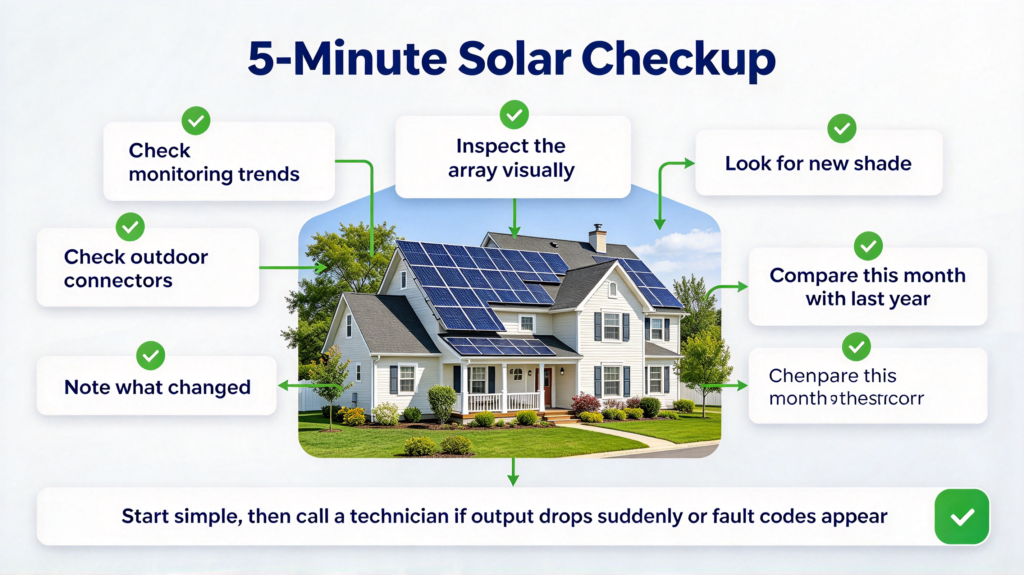
What To Do First: A Five-Minute Routine
- Glance at the monitoring app – compare with the same month last year
- Walk outside and look at the array from the ground. Cracks, discolouration, anything resting on the glass
- Look at what has grown or been built nearby since last year
- Check the outdoor connectors for white-green crust
- Write down anything that changed. A dated note is what turns a guess into a diagnosis
That is the whole routine. Solar panel maintenance tips for beginners has the rest of it, including what not to do.
FAQ
Why is my solar panel producing less power than before?
The usual causes are dirt and debris on the glass, new shade from growing trees or new buildings, or loose outdoor connections. Clean the panels and inspect for new shadows first, then compare this month against the same month last year before assuming equipment failure.
Can I fix a cracked solar panel myself?
No. Don’t try to patch the glass – bad DIY fixes let in more moisture than they keep out. Monitor output, and replace the panel if the crack is deep, the glass is cloudy around the break, or output keeps dropping.
How often should I clean my solar panels?
About twice a year is enough for most homes. Clean more often if you live in a dusty area, near construction, or under trees and a busy bird population – and rarely at all if you get regular rain and see no visible film.
What should I check first when my solar system stops working?
Look at the panels for total cover, then check the circuit breakers and fuses on both the AC and DC side. If nothing changes, check the controller display and then the battery. If all of that is normal, the fault is internal and a technician needs to look at it.
Is it safe to fix solar panel wiring myself?
Only external cabling and plug-in connectors. Never open a junction box or work on the DC side of the circuit unless you are a licensed electrician – and remember that unlicensed work can void your warranty as well as being dangerous.
When should I call a professional?
For burnt or corroded connectors you cannot reach safely, anything inside the junction boxes, deep glass cracks, a hot spot found on a thermal scan, or any problem that does not improve after the basic checks above.
What are the most common solar panel problems for beginners?
In rough order of how often they show up: soiling, new shade dragging down a whole string, an inverter failing somewhere around year 10-15, damage from hail or a careless installer, corrosion on outdoor connectors, and hot spots from a cracked cell. Most of the expensive ones arrive quietly, which is why monitoring matters more than a visual check.
What problems can a solar panel run into?
Panels themselves rarely fail outright. What you meet in practice: cracked cells from hail, handling or someone walking on the array; hot spots; delamination of the backsheet; a failed junction box or bypass diode; and shaded or mismatched panels quietly limiting a string. The inverter and the wiring carry most of the rest.
How do I know if a problem is serious or normal?
Look at the trend, not the day. Normal degradation is around 0.5% a year. A panel running 3-8% below its neighbours under the same conditions is worth investigating. A sudden step change, a new fault code, or a hot spot showing on a thermal scan are the ones that need action.
4 thoughts on “Common Solar Panel Problems for Beginners (and How to Fix Them”