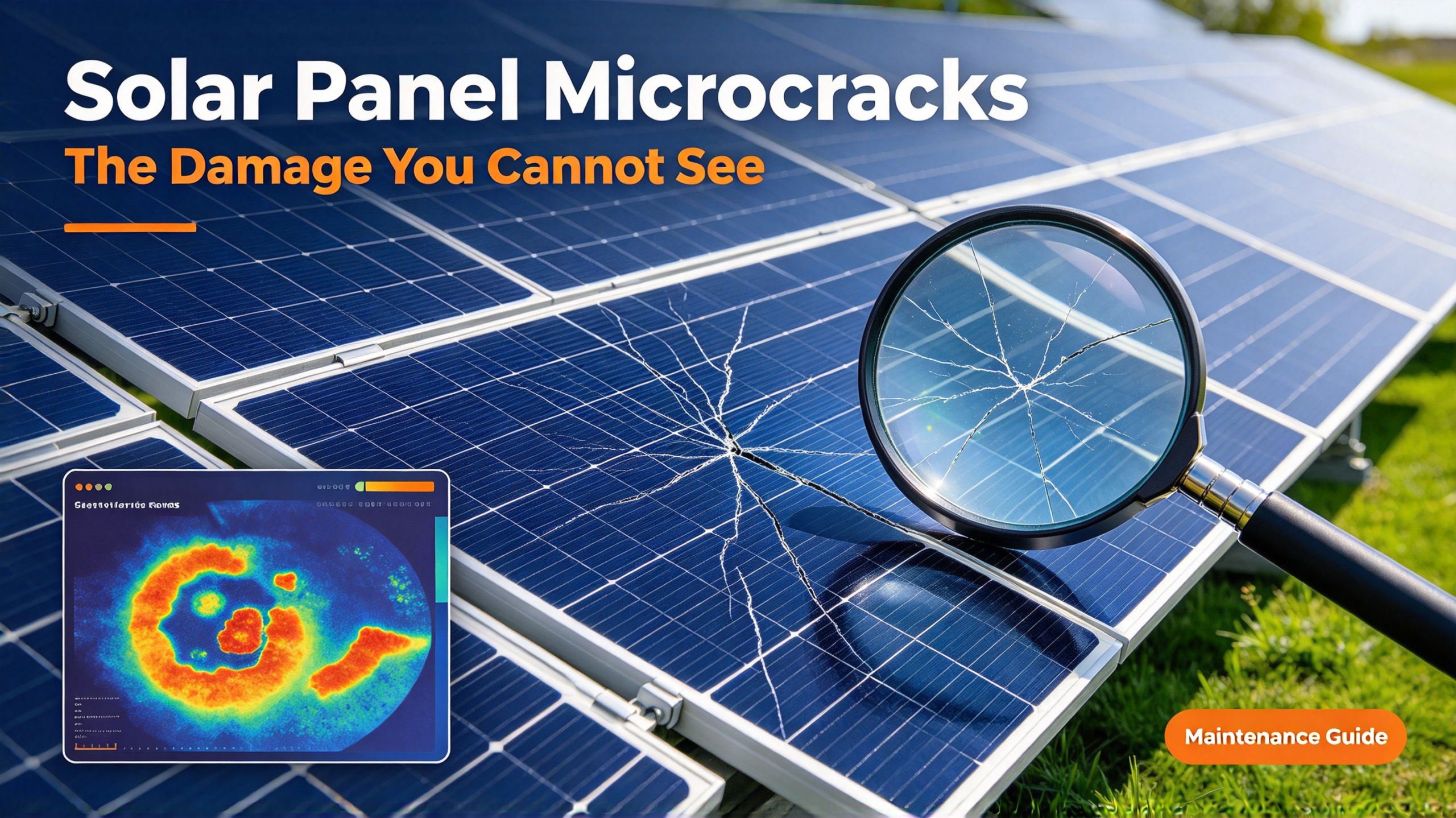
TL;DR: Solar panel microcracks are fractures inside the silicon cells, not in the glass above them. The panel can look perfect from the ground while one cell slowly loses output or develops a hot spot. They cannot be repaired, but they can be detected with module-level monitoring, a thermal camera or electroluminescence imaging. Most are treated as handling or impact damage, so installation-day photos matter.
Microcracks are one of the most misunderstood failure modes in residential solar. A crack in the glass is obvious. A crack in the cell is hidden under glass, encapsulant and a backsheet, and it may produce no visible change at all. The useful question is not “is there a crack?” It is “is this crack costing output or creating heat?”
Solar Panel Microcracks: Short Answer
A microcrack is a hairline fracture in the silicon wafer inside a panel. It can be caused by handling, shipping, hail, foot traffic, thermal cycling or a manufacturing defect. Many microcracked panels keep working for years with only a small loss. A minority develop a hot spot, which is the case that needs action.
What a Microcrack Actually Is
A solar panel is a laminate: tempered glass, encapsulant, silicon cells, another encapsulant layer and a backsheet. The glass is strong. The silicon underneath is thin and brittle. A microcrack is a fracture through that wafer, often thinner than a human hair and sometimes not continuous.
The cell can still conduct, so the panel still produces power. The crack may simply add resistance or isolate a small part of the cell. That is why the symptom is usually a slow underperformance, not a dead panel.
What Causes Microcracks
| Cause | How it happens | How to reduce the risk |
|---|---|---|
| Handling and shipping | A corner bump, a careless lift or flexing the middle of the panel | Two-person lift, upright transport, no pressure on the glass |
| Hail | Impact transfers shock through the glass to the cells | Inspect after severe hail; use a thermal scan if output drops |
| Foot traffic | A person’s weight concentrated on one spot | Walk on the rails, never on the glass |
| Thermal cycling | Daily expansion and contraction stress the cells and solder joints | Good mounting and airflow; avoid unnecessary thermal stress |
| Installation stress | Clamps over-tightened or placed outside the allowed zone | Follow the clamp map and torque spec |
| Manufacturing defect | A wafer or solder joint was already stressed | Buy from a manufacturer with a real product warranty |
Why They Are Hard to Find
You are looking through textured, anti-reflective tempered glass. The crack can be a fraction of a millimetre wide, at an angle, and invisible beyond a metre. It does not change the colour of the cell the way a burned area or browning encapsulant does.
This is why a visual inspection from the ground tells you very little. A cracked glass pane is actually easier: at least it is visible. A microcrack is a diagnostic problem, not a visual one. The difference between damage types is covered in cracked solar panel repair or replace.
How Microcracks Show Up in the Numbers
| Pattern | What it suggests | What to do |
|---|---|---|
| One panel 3-8% below its neighbours | A local cell or connection problem | Check module-level monitoring and inspect |
| Slow decline that does not match weather | Degradation, soiling or a developing fault | Compare the same month year over year |
| One string always lower than another | A module, connector or bypass-diode issue | Compare string data and test the modules |
| Sudden step change | A fault, not normal ageing | Check the inverter code and wiring first |
| No change for years | The crack is not affecting the circuit much | Monitor; do not replace just because a scan found it |
Normal degradation is roughly 0.5% a year. A panel falling 3% in one year is telling you something specific happened. A panel that is consistently below its neighbours in the same conditions is a stronger signal than a single bad day. The baseline is explained in solar panel degradation rate.
Microcracks vs Snail Trails vs Cracked Glass
| Finding | What it is | How serious? |
|---|---|---|
| Microcrack | A fracture in the silicon cell, usually invisible | Can be harmless or lead to a hot spot |
| Snail trail | A silver or dark line on the cell surface, often cosmetic | Usually cosmetic, but inspect if output drops |
| Cracked glass | A visible break in the top glass | Needs inspection; water ingress and safety risk |
| Hot spot | A local area running much hotter than the rest | Act; can damage the backsheet |
| Browning or delamination | Encapsulant or backsheet degradation | Inspect; may be a warranty issue |
Snail trails are not automatically microcracks. They are discolouration along busbars or cell edges and are often cosmetic. A thermal scan or EL image is the way to separate a cosmetic mark from a real cell fracture. Do not replace a panel on appearance alone.
The Real Risk Is a Hot Spot
When part of a cell stops conducting, the current from the rest of the string has to go around it. A bypass diode can protect a group of cells, but it does not bypass a single cracked cell inside that group. The cracked area becomes a resistance carrying full current, and resistance produces heat.
A hot spot can cost output, damage the encapsulant and, in serious cases, damage the backsheet. It is uncommon, but it is the reason a thermal scan matters. A panel that is visibly hotter than its neighbours, or has a burn mark or browned area, should be isolated and inspected.
How Microcracks Are Detected
| Method | What it finds | Limits |
|---|---|---|
| Module-level monitoring | One panel underperforming its neighbours | Does not identify the crack itself |
| Thermal camera | Hot spots and some cell defects | Does not image every microcrack |
| Electroluminescence (EL) | Cracks, inactive areas and cell damage | Needs dark conditions and special equipment |
| IV curve tracing | Electrical performance versus the datasheet | More equipment and time |
| Visual inspection | Cracked glass, burn marks, delamination | Cannot see most microcracks |
EL is the definitive method: current is fed into the panel in darkness and cracked areas appear dark. Thermal imaging is the practical field check for a hot spot. IV tracing tells you how much performance is missing. Start with monitoring, then use the right test for the symptom. The monitoring setup is in solar panel monitoring.
What You Can Do Yourself
- Watch for the outlier. With per-panel monitoring, look for the panel consistently below its neighbours.
- Compare like months. This July against last July, not July against December.
- Look from a low angle in strong, low sunlight. Early or late sun can reveal surface marks that a midday view hides.
- Book a thermal scan after hail, roof work or a sudden output drop. It is a targeted inspection, not an annual ritual.
- Do not walk on the array. Use the rails and foam pads if roof access is unavoidable.
Can a Microcrack Be Repaired?
No. The cell is sealed inside the laminate. There is no way to reach the crack without destroying the panel, and there is no adhesive repair that restores the silicon. The decision is whether to leave it, isolate it with module-level electronics or replace the module.
A few percent of loss may be tolerable. A hot spot, burn mark or cracked glass is not. Replace when the module is unsafe, when it drags down a string, or when the repair cost approaches the value of the remaining output. The decision matrix is in repair or replace a cracked panel.
Is It Covered by Warranty?
| Situation | Likely warranty outcome | What you need |
|---|---|---|
| Crack present at installation | Possible defect claim | Install-day photos, serial numbers, commissioning report |
| Crack after hail | Usually impact damage, not a defect | Hail date, photos, insurance report |
| Crack after foot traffic | Usually denied | Document the cause; installer liability may apply |
| Crack with no event and low output | Possible manufacturing defect | EL image, IV curve, installation records |
| Hot spot or burn mark | Depends on cause | Thermal image and a professional inspection |
Most microcracks are classified as handling or impact damage, which is not a manufacturing defect. If you cannot show the crack was present before installation, the claim is difficult. That is why install-day photos and serial numbers matter. The warranty process is covered in solar panel warranties explained and what voids a solar panel warranty.
Prevention Checklist
| Stage | Action | Why |
|---|---|---|
| Delivery | Inspect pallets and frames before signing | Hidden shipping damage is hard to prove later |
| Lifting | Two people, upright, no pressure on the glass | Flexing the module is a common cause |
| Mounting | Follow the clamp zones and torque spec | Over-tightening stresses the frame and cells |
| Roof work | Walk on rails, not glass | Concentrated weight causes cracks |
| After hail | Photograph and monitor; thermal scan if output drops | Glass can look fine while cells are cracked |
| Commissioning | Record serials, photos and baseline output | Gives you evidence for a future claim |
Hail is a special case: the glass may be intact while the cells below are damaged. If a storm was severe and one panel is now below its neighbours, a thermal scan is more useful than another visual inspection. Hail claim steps are in solar panel hail damage.
Conclusion
Solar panel microcracks are hidden cell fractures that may cost a few percent of output or develop into a hot spot. They cannot be repaired, and most are treated as impact or handling damage rather than a manufacturing defect. Watch for the outlier panel, compare the same month year over year, and use a thermal scan or EL imaging when the data justifies it. Document the array on installation day; that is the evidence that turns a hidden crack into a supportable claim.
FAQ
What are solar panel microcracks?
Hairline fractures inside the silicon cells of a panel, usually caused by handling, hail, impact, foot traffic or thermal stress. The glass on top can remain intact, so the damage is invisible from outside.
Can you see microcracks with the naked eye?
Almost never from a normal distance. Detecting them properly needs electroluminescence imaging or a thermal camera, because the crack is inside the laminate and does not change the cell’s visible colour.
Do microcracks reduce solar panel output?
Usually slightly, and sometimes not at all. Output loss often appears as one panel running a few percent below its neighbours. The bigger concern is the minority that develop into hot spots.
Can microcracks cause a fire?
They can contribute to one. A cracked cell creates local resistance and heat, and sustained heating can damage the encapsulant and backsheet. It is uncommon, but a hot spot should not be ignored.
Are microcracks covered by the warranty?
Rarely. Warranties cover manufacturing defects, while microcracks are usually classified as handling or impact damage. Without installation-day documentation, a claim is difficult.
What causes microcracks in solar panels?
Handling and shipping damage, hail, walking on the glass, over-tightened clamps, thermal cycling and, less often, a manufacturing defect. Most are mechanical, not electrical.
How do I know if my panel has a microcrack?
You usually do not see it. Look for one panel consistently below its neighbours, a slow unexplained decline, or a hot spot on a thermal scan. EL imaging is the definitive test.
Are snail trails the same as microcracks?
No. Snail trails are silver or dark lines on the cell surface and are often cosmetic. A microcrack is a fracture inside the silicon. If output is falling, inspect rather than assume.
Can a microcrack be repaired?
No. The cell is sealed inside the laminate. The options are to monitor it, isolate it with module-level electronics or replace the module.
Should I replace a panel with a microcrack?
Not automatically. A small loss may be tolerable. Replace if there is a hot spot, burn mark, cracked glass or a meaningful string loss. Compare the cost with the remaining output.
Can a thermal camera find every microcrack?
No. It finds hot spots and temperature differences, not every fracture. EL imaging is better for the crack itself; thermal imaging is better for the consequence.
How can I prevent microcracks?
Handle panels with two people, never walk on the glass, follow the clamp and torque instructions, inspect after hail and record installation-day photos and serial numbers.
Related: Cracked Solar Panel Repair or Replace
3 thoughts on “Solar Panel Microcracks: The Damage You Cannot See”