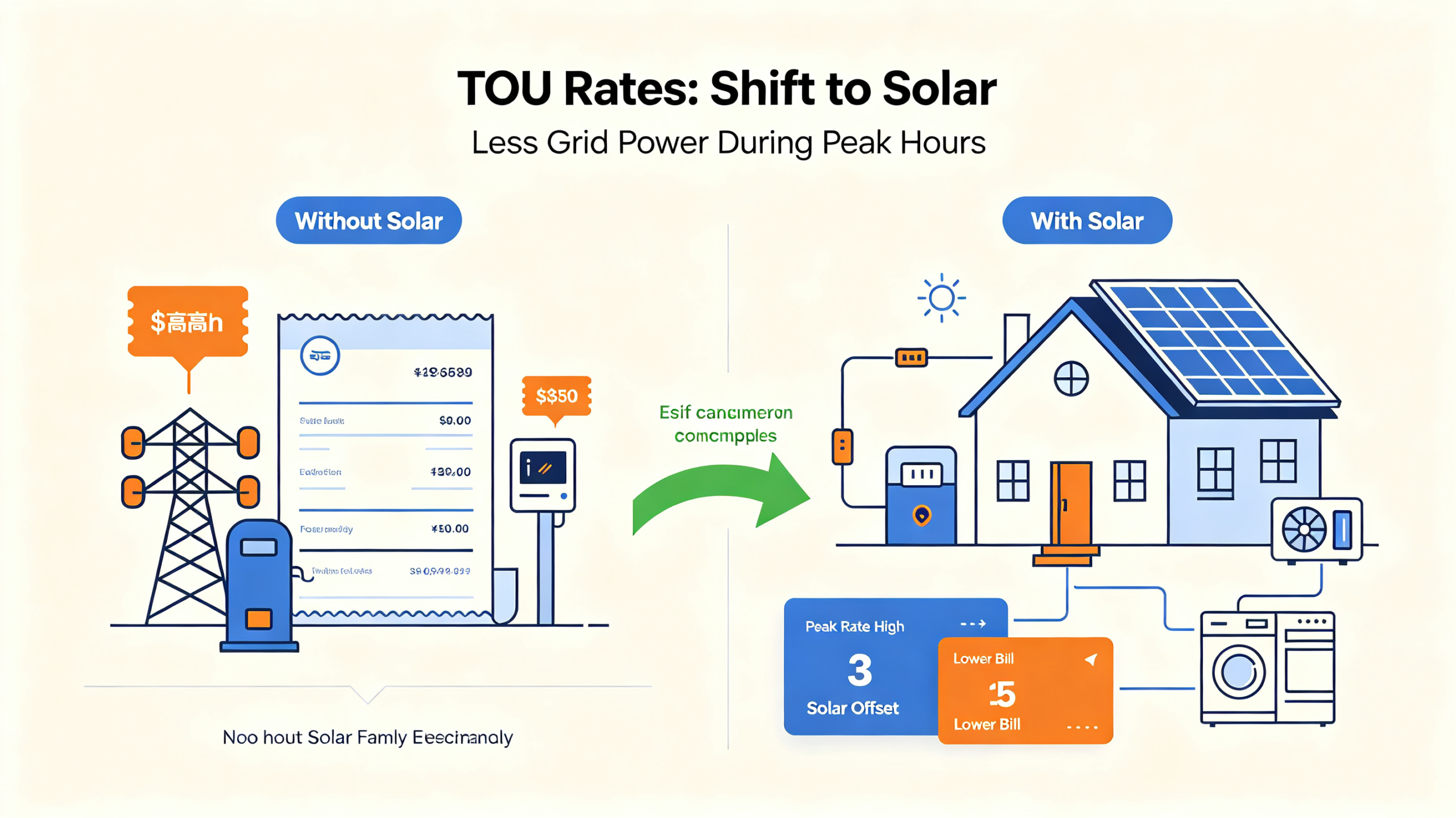
TL;DR: Time-of-use rates and solar are a natural match: panels generate the most power during cheap or mid-peak hours, and a battery lets you avoid expensive evening peak rates. Without a battery, you still save by running heavy appliances and EV charging during the day. Check your rate plan before and after installing solar.
If your utility charges different prices at different times of day, your solar savings depend on more than how many panels you have. Here’s how time-of-use pricing works with solar, and how to structure your system and habits to pay as little as possible.
What Time-of-Use Pricing Means
Time-of-use (TOU) rates split the day into periods with different electricity prices:
- Off-peak: cheapest, usually overnight and sometimes midday
- Mid-peak: moderate, often morning and afternoon
- Peak: most expensive, commonly late afternoon and evening (for example 4-9 pm)
During peak hours, electricity can cost two to three times the off-peak rate — which is exactly when solar production is falling and household demand rises.
How Solar Fits Into a TOU Plan
Solar panels produce most of their power in the middle of the day. On many TOU plans, that’s mid-peak or even off-peak — meaning the power you generate is worth less at the moment you make it.
That doesn’t make solar pointless. It changes the strategy:
- Use power as it’s generated, instead of exporting it for a low credit
- Shift flexible loads to the middle of the day
- Store surplus power to avoid paying peak rates later
Strategy 1: Shift Your Usage to Daytime
If you don’t have a battery, timing is your main tool:
- Run the dishwasher, washing machine and dryer during the day
- Charge your electric car during solar hours
- Heat water or run pool pumps midday where possible
- Pre-cool the house with air conditioning before peak starts
These shifts can cut peak-hour consumption substantially, without any extra equipment.
Strategy 2: Add a Battery to Beat Peak Rates
A battery lets you store cheap solar power and use it during peak hours. Under some TOU plans, that means every stored kilowatt-hour avoids the most expensive rate on your bill.
Battery economics on TOU rates depend on:
- The price gap between peak and off-peak rates
- How much peak-hour usage you can shift
- Whether your battery can specifically target peak hours
In places where peak rates are very high, battery payback can be shorter than in flat-rate markets.
Strategy 3: Choose the Right Rate Plan
Once you install solar, your usage pattern changes — and the plan that was best before solar may not be best after. Ask your utility about:
- Standard vs TOU plans, and how each handles exported solar
- EV-specific rate plans if you charge a car at home
- Whether exports are credited at retail or wholesale rates
- Any seasonal differences in peak windows
A rate plan comparison can be worth more than adding a panel or two.
Conclusion
Time-of-use rates and solar reward planning, not just hardware. Panels cut your daytime costs, a battery shifts that power into expensive hours, and shifting your habits captures savings for free. Start by checking your rate plan and your actual hourly usage before deciding on a battery.
FAQ
Does solar still save money on a time-of-use plan?
Yes. Panels cut the cost of the power you use during the day, and a battery lets you avoid expensive peak-hour rates. The savings depend on the price gap and how much usage you can shift.
Do I need a battery with a TOU plan?
Not always. Shifting heavy appliances and EV charging to daylight hours captures much of the benefit without storage. A battery adds the ability to avoid evening peak rates.
What are typical peak hours?
Many utilities set peak hours in the late afternoon and evening — commonly 4 pm to 9 pm — when demand is highest and solar production is dropping.
Is it better to export solar power or store it?
That depends on how your utility credits exports. If export credits are low and peak rates are high, storing power for evening use is often worth more than exporting it.
Should I change my rate plan after installing solar?
Often yes. Solar changes when you use and export power, so the cheapest plan before solar may not be the cheapest after. Compare options with a year of usage data.
Related: How to Read Your Electricity Bill Before Going Solar
1 thought on “Time-of-Use Rates and Solar – How to Cut Peak-Hour Costs”