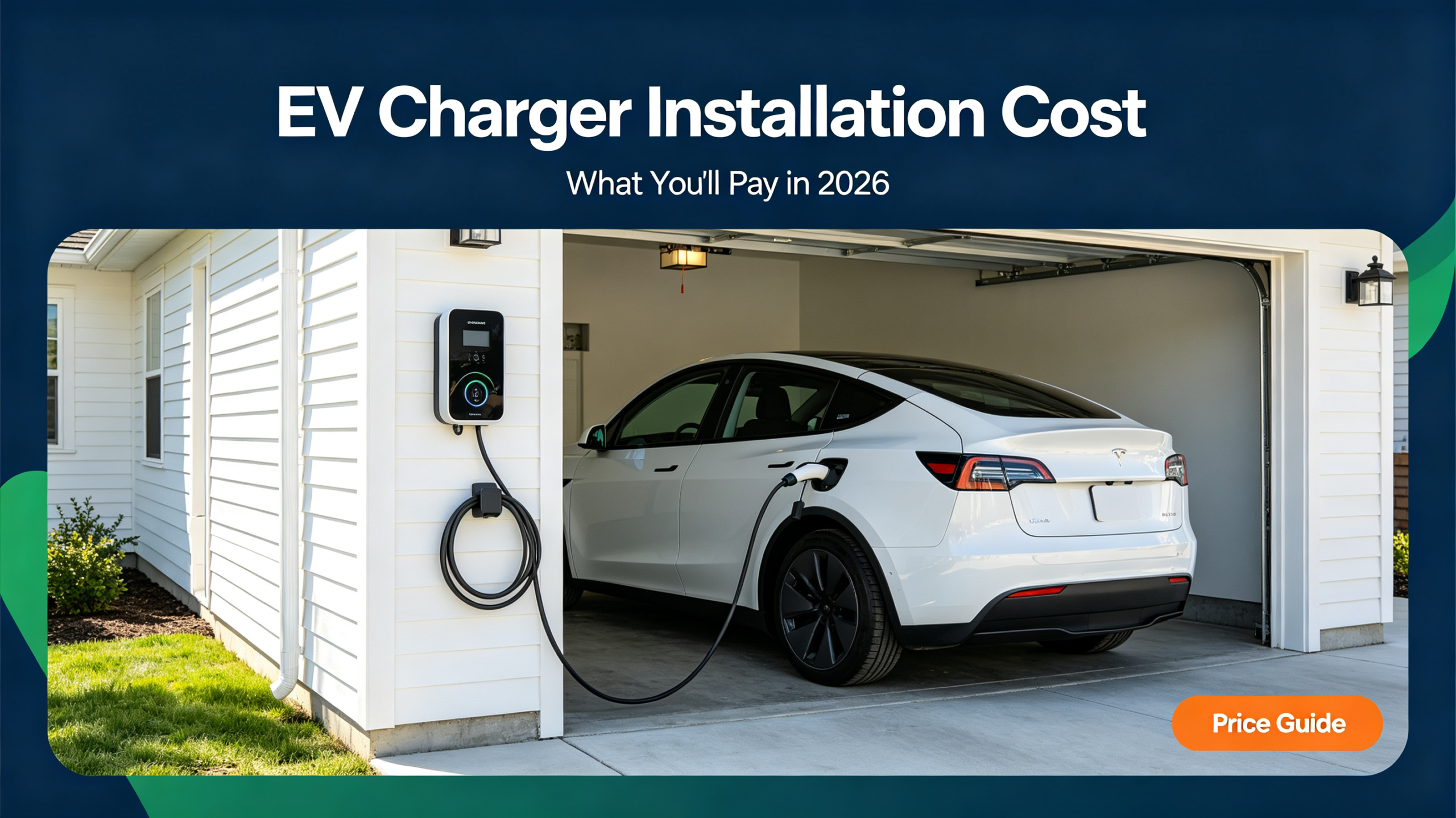
TL;DR: EV charger installation cost usually lands between $1,200 and $2,500 for a typical home, made up of $400 to $800 for the Level 2 charger and $600 to $1,800 for the electrical work. The single biggest variable is how far the charger sits from your electrical panel – a long conduit run can double the labour. If your panel needs an upgrade, add $1,500 to $4,000. Many utilities and some states still offer rebates, so check before you buy.
Charging at home is the reason most people buy an electric car in the first place. It is also the part nobody quotes you at the dealership, because the price depends entirely on your house rather than on the vehicle.
Here is what the work actually involves, where the money goes, and why the answer changes if you also have solar.
The Two Separate Costs
People usually talk about “the charger” as one thing. It is two: the hardware, and the electrical work to install it.
The Charger Itself
A Level 2 charger, the kind that adds 25 to 40 miles of range per hour, typically costs $400 to $800. Hardwired units sit at the top of that range, and smart chargers with load management cost more again.
Before buying one, check what came with your car. Many EVs ship with a Level 1 cable that plugs into a standard outlet, which is slow but free. Some manufacturers also include a Level 2 unit or offer a credit toward one.
The Installation
Labour is where the numbers spread out. A charger mounted on the garage wall directly behind the electrical panel can be installed in a few hours. A charger on the far side of a detached garage needs a trench, conduit and a much longer day.
Expect $600 to $1,800 for the electrical work in a straightforward installation, and more if the route is difficult.
What Drives the Price
- Distance from the panel. This is the biggest single factor. Conduit runs commonly cost $10 to $25 per foot installed, so a 60-foot run can add $600 to $1,500 on its own.
- Available panel capacity. Your electrical panel needs spare capacity for a 40 to 50 amp circuit. If it is full, you either upgrade the panel or install a load management device that pauses charging when the house is drawing heavily.
- Panel upgrade. A new panel runs $1,500 to $4,000, including permit and inspection.
- Hardwired or plug-in. A plug-in unit using an existing outlet is cheapest. A hardwired install is more robust and usually required for the fastest charging speeds.
- Indoor or outdoor. Outdoor installations need weather-rated equipment and GFCI protection.
- Permits and inspection. Typically $100 to $400, and required in most jurisdictions.
Realistic Totals
| Scenario | Typical total |
|---|---|
| Panel nearby, capacity available, garage install | $800-$1,500 |
| Typical install with a 30-50 foot run | $1,200-$2,500 |
| Long run, outdoor mount, or load management needed | $2,000-$3,500 |
| Electrical panel upgrade required | $3,000-$6,000+ |
Those figures are for the charger and its wiring only. If you are adding solar or a battery at the same time, the electrician is already on site, which usually reduces the incremental cost of the charger work significantly.
How Solar Changes the Maths
This is the part worth thinking through before you sign anything, because doing these two projects separately usually costs more than doing them together.
An average EV driving 12,000 miles a year uses roughly 3,000 to 4,000 kWh. That is a meaningful addition to a household’s consumption, and it is the reason an EV often pushes a home into needing a larger solar array than originally planned.
Charging from your own roof instead of the grid changes the running cost completely. It also pairs well with time-of-use rates, because most utilities charge the least overnight, which is exactly when the car sits in the driveway. If you already have solar, the combination of time-of-use rates and solar is usually where the real savings appear.
If you are planning both projects, it is worth reading our guide to charging an EV from home solar before you size either system.
Do You Need a Permit?
In most of the United States, yes. A new 240 volt circuit requires an electrical permit and an inspection. Skipping it is a bad trade: unpermitted electrical work can void insurance coverage for a related fire, and it usually surfaces when you sell the house.
The permit cost is small compared with the risk. Ask the electrician to include it in the quote rather than leaving it to you.
How to Keep the Cost Down
- Mount the charger as close to the panel as the parking position allows
- Ask about load management devices instead of a full panel upgrade, which can save thousands
- Bundle the charger with solar or a battery install so the electrician only mobilises once
- Check your utility’s rebate list and your state’s incentive programs before buying hardware
- See whether your car manufacturer includes a charger or a credit
- Get two or three quotes, and compare the conduit route each one proposes – not just the total
If a panel upgrade is being quoted, it is worth understanding what else that upgrade enables. A new panel is often the same project that makes a battery install possible later, which is covered in our guide to solar panels with battery backup.
FAQ
How much does it cost to install a Level 2 charger?
Most homeowners pay $1,200 to $2,500 including the charger and the electrical work. The range widens quickly if the panel is far from the parking spot or the panel itself needs upgrading.
Can I install an EV charger myself?
The wiring is not a DIY job in most jurisdictions, because it needs a permit, an inspection and a new dedicated circuit. Mounting the unit and running the cable through an existing conduit is sometimes possible, but the connection to the panel should be done by a licensed electrician.
Do I need a 240 volt outlet or a hardwired charger?
A 240 volt outlet works and is cheaper upfront. Hardwiring is better for the highest charging speeds and is often required for chargers drawing more than 40 amps continuously.
Will an EV charger increase my electricity bill much?
The charger itself does not, but the car does. Expect roughly 3,000 to 4,000 kWh a year for average driving, which at typical rates is several hundred dollars annually unless you are charging from solar.
Are there rebates for EV charger installation?
Often yes, from utilities, states and sometimes manufacturers, and the programs change frequently. Check your utility’s current list and your state energy office before buying hardware, because some rebates require pre-approval.
Related: Solar Panels and Electric Cars – Can You Charge at Home