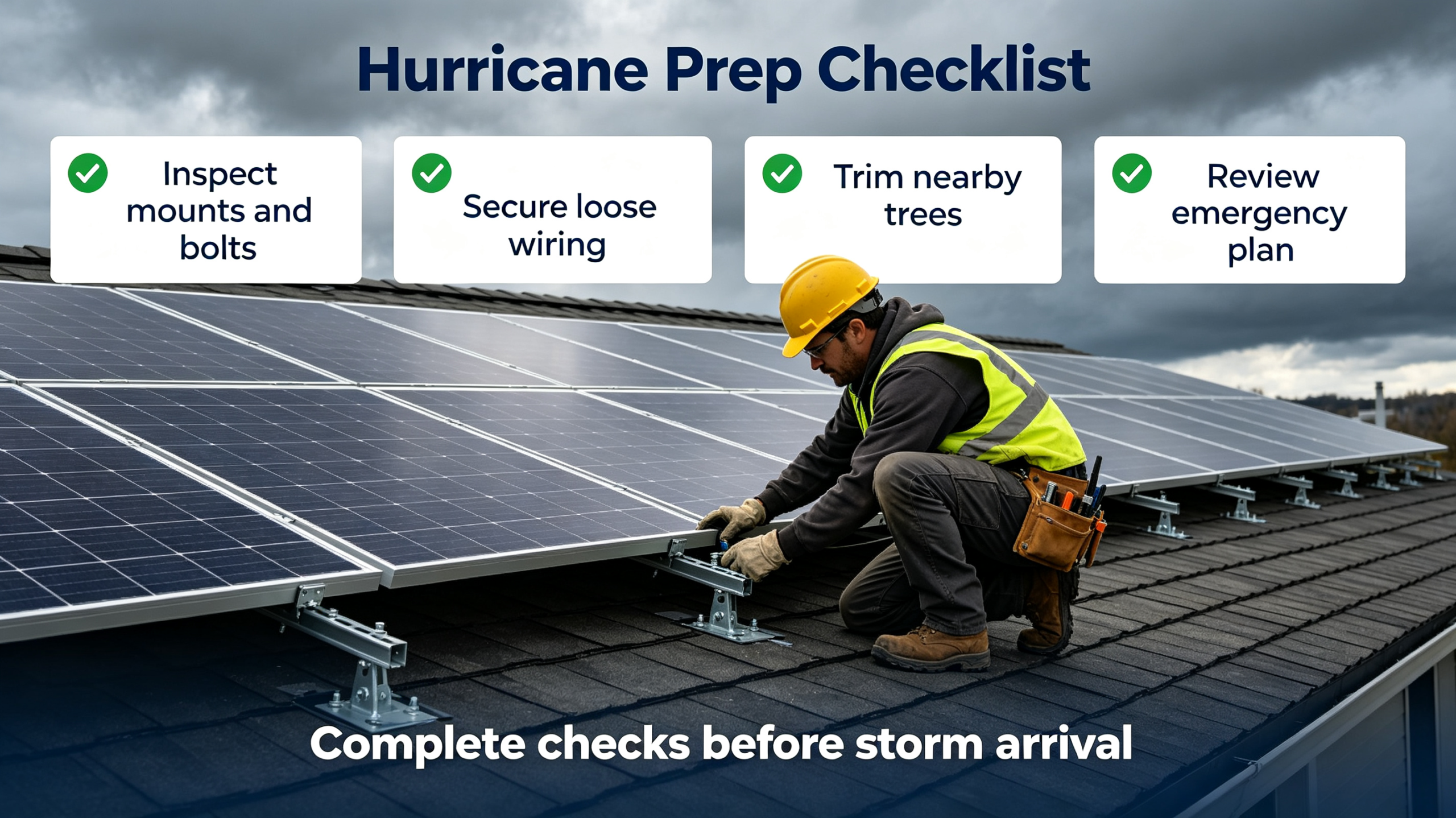
TL;DR: Are solar panels hurricane proof? Mostly, up to a point. Most residential panels are rated for winds around 140 mph when they are correctly mounted, and the panels themselves rarely fail first. The weak points are the racking, the roof attachments and the roof itself. Flying debris is what usually breaks glass. Before a storm, do not cover or remove the panels – inspect the mounting and check your hurricane deductible instead.
Every hurricane season, homeowners with rooftop solar ask the same question, and the honest answer has two parts. The panels are tougher than people expect. The system around them is where the risk sits.
Here is how the ratings actually work, what to check before a storm makes landfall, and what happens if your array is damaged.
How Solar Panel Wind Ratings Work
Solar panels are tested to withstand pressure, not just wind speed. Manufacturers publish a wind load rating, and most modern residential panels are rated to around 140 mph when they are mounted correctly. That rating covers two forces at once: the push of wind against the panel face, and the lift trying to pull the panel off the roof.
Two things about that rating matter in practice.
First, the rating assumes a proper mounting system. A panel rated to 140 mph on a correctly engineered rack is not rated to 140 mph on a rack that was installed with fewer attachments than the drawing called for.
Second, wind speed at your roof is not the number the weather reporter quotes. Gusts, updrafts at roof edges and the venturi effect between roof planes can push local forces far above the headline figure.
Where Solar Systems Actually Fail
When a solar array is damaged in a storm, the failure is almost never the panel’s engineering. It is one of these:
- Loose or corroded racking. Fasteners back out over years of thermal cycling, and a rack that has never been re-torqued is the most common failure point.
- Undersized attachment spacing. Panels lifted off a roof in a storm usually reveal too few lag bolts or anchors set into decking rather than rafters.
- Roof failure underneath. If the roof covering peels away, the array goes with it, no matter how well the panels are built.
- Flying debris. Impact is the real killer. A palm frond, a tile or a piece of someone else’s roof takes out glass at wind speeds well below the panel’s rating.
- Edge panels. The panels at the corners and outer edges of an array take the highest uplift loads.
What to Do Before a Storm
- Visually check the racking, the panel edges and the roof for anything already loose, cracked or lifted
- Take photos and video of the array from several angles, including close-ups of the mounting hardware
- Clear gutters, and move loose objects like furniture, bins and garden tools away from the house
- Charge any home battery to full, and confirm your backup circuits are set how you want them
- Check your hurricane deductible and whether your policy covers the array under dwelling coverage
- Save your installer’s contact details and system documents somewhere you can reach without power
What Not to Do
Several popular storm preparations do more harm than good.
- Do not cover the panels with plywood or tarps. A sheet of plywood turns into a sail on a sloped roof, and it can lift or shatter the very panels it was meant to protect.
- Do not remove or unbolt panels. A partly disassembled array is far more vulnerable than a complete one, and the electrical side of that work is not a homeowner job.
- Do not assume that switching the system off at the breaker protects it. Turning the system off changes nothing about the physical loads on the mounting.
- Do not wait until the storm is a day out to call your installer. Every solar company in the region is booked solid at that point.
After the Storm: What to Inspect
Wait until conditions are safe, and stay off a wet roof. From the ground, look for panels that are out of line, tilted, or sitting at a different angle from their neighbours. On the way, check for cracked glass, missing trim and gutter damage.
Inside the house, look for new water stains on ceilings under the array, which point to flashing or penetration damage.
Then check production. A storm is a good reason to compare this week’s output with the same period last year, because micro cracks and partial string failures show up as a gradual loss rather than an obvious fault. Our guide to solar panel monitoring explains how to read that data. If anything looks physically wrong, keep everyone off the roof and call your installer for a professional inspection.
Does Insurance Cover Storm Damage to Solar Panels?
Rooftop solar is normally covered as part of the dwelling on a standard homeowner’s policy, so wind and hurricane damage is usually claimable. The detail that decides whether a claim is worth filing is the deductible.
Many coastal states allow insurers to apply a separate hurricane deductible, expressed as a percentage of your dwelling coverage rather than a flat amount. A 2% deductible on a $450,000 home is $9,000, which you pay before the insurer contributes anything. That number decides whether a small repair is worth claiming, and it is worth knowing before the storm rather than after.
Documentation is the other half. Photos taken before and after the storm, plus a written inspection report, are what turn a claim into a payment. For background on how equipment is treated under a standard policy, see our article on solar panel insurance.
Can Solar Panels Power Your Home During a Hurricane Outage?
This surprises most new owners. A standard grid-tied system shuts down automatically during a power cut, because feeding live power into a line that utility crews believe is dead puts them in danger.
With a battery, the system can run in island mode and keep selected circuits alive. That is the setup that matters in a hurricane, and it is worth checking how long your battery will last with the loads you have assigned to it. The mechanics are covered in solar panels during a power outage.
FAQ
Can solar panels survive a Category 3 hurricane?
Many can, because a Category 3 storm carries sustained winds around 111 to 129 mph and the panels themselves are typically rated higher. Whether your system survives depends far more on the mounting, the roof and the debris flying around than on the panels.
Should I have my panels removed before a hurricane?
No. Removal is expensive, takes days, and leaves the roof penetrations open. A complete, properly torqued array is much safer than a partially dismantled one.
What wind speed can solar panels handle?
Most residential panels carry a wind load rating around 140 mph when mounted to specification. The racking and roof attachments normally have lower effective limits than the panel itself.
Will my insurance pay if the panels are damaged?
Usually yes, under dwelling coverage, subject to your deductible. Coastal policies often apply a separate hurricane deductible calculated as a percentage of your dwelling limit, which can be several thousand dollars.
Do solar panels make my roof more likely to fail in high wind?
Only if the mounting was done badly. A correctly installed array adds little load and can protect the roof covering underneath. Poorly anchored racking, or missing fasteners, is what causes trouble.
Related: Solar Panel Insurance – Do You Need It and What Does It Cover