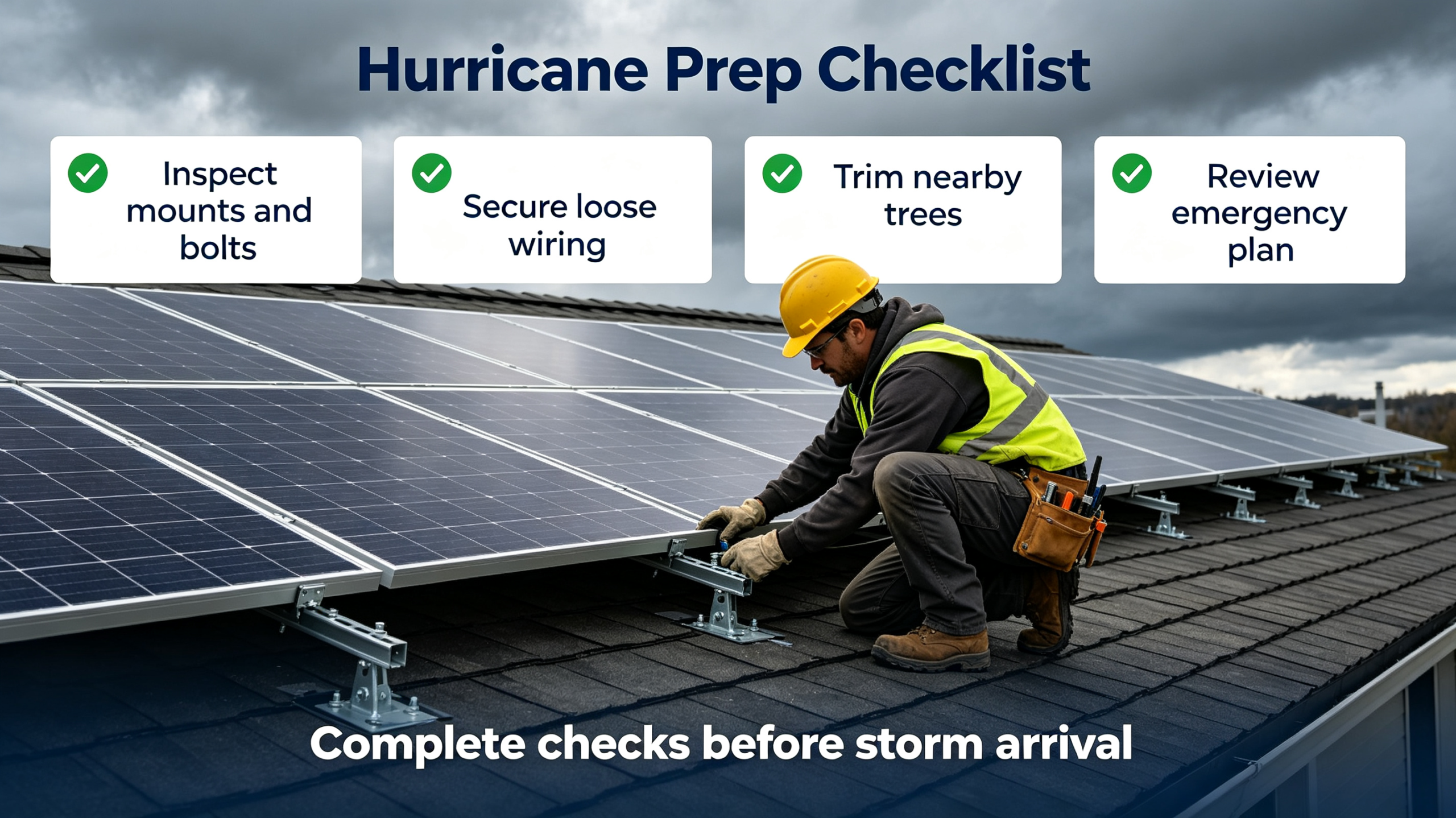
TL;DR: Are solar panels hurricane proof? Mostly up to a point. Many residential panels carry a wind rating around 140 mph equivalent when they are mounted to the manufacturer’s design, but that is not a guarantee for every roof. The racking, roof attachments, roof structure and flying debris decide survival more than the panel label. Before a storm, inspect and document the array; do not cover or remove it.
A hurricane is not a uniform wind tunnel. Gusts, roof-edge uplift, rain and debris create local loads that can exceed the number on a datasheet. The useful question is not “can the panel survive 140 mph?” It is “is the whole assembly attached well enough for this roof, and what happens when something hits the glass?”
Are Solar Panels Hurricane Proof? Short Answer
The panels themselves are tougher than most people expect. The weak points are usually the racking, the fasteners, the roof covering and the debris. A complete, correctly torqued array is much safer than a partially dismantled one, and a panel rated for high wind is not automatically safe on a roof with missing anchors or an aged deck.
How Wind Ratings Work
A solar panel is tested for pressure, not just a single wind speed. The manufacturer publishes a design load, and the mounting system has its own engineering. The panel rating assumes the approved clamp positions, rail spacing, fasteners and roof attachments. Change any of those, and the number no longer describes your installation.
Wind creates two forces: pressure pushing on the panel face and lift trying to pull it off the roof. The lift is often the bigger problem. Roof edges and corners see higher uplift than the middle, which is why the outer panels and the first row deserve a closer look.
Hurricane Categories and Panel Ratings
| Hurricane category | Sustained wind | What it means for a solar array |
|---|---|---|
| Category 1 | 74-95 mph | Many systems are designed for this; debris still breaks glass |
| Category 2 | 96-110 mph | Mounting and roof condition become the limiting factors |
| Category 3 | 111-129 mph | Panels may be rated for it; roof and debris risk rise sharply |
| Category 4 | 130-156 mph | Above many residential design assumptions; expect damage |
| Category 5 | 157 mph or higher | Survival depends on the whole building, not the panel |
These categories use sustained wind, not gusts. A Category 3 storm can produce higher local gusts at roof edges, and a Category 2 can still throw a tile or branch through a panel. The category is a planning input, not a guarantee that a system will survive.
What Actually Fails First
| Failure point | Why it happens | What to inspect |
|---|---|---|
| Racking and fasteners | Thermal cycling loosens bolts; corrosion weakens hardware | Loose rails, missing bolts, rust at joints |
| Roof attachments | Too few anchors, or anchors into decking instead of framing | Lift at the feet, cracked sealant, movement |
| Roof covering | Shingles or membrane peel away and take the array | Lifted edges, missing shingles, soft decking |
| Glass and cells | Windborne debris impact | Cracked glass, dark patches, broken frames |
| Edge and corner panels | Higher uplift at the perimeter | Panels out of line or lifted at the edge |
| Electrical connections | Water, vibration or pulled cables | Hanging conduit, damaged connectors, fault codes |
A panel that survives the wind but loses its roof attachment is still a failure. A roof that peels away takes the array with it. And a panel that stays bolted but takes a debris hit may crack the glass or the cells underneath. That is why the inspection has to cover the whole assembly, not just the module surface.
Wind Rating vs the Real Roof
| Layer | What the rating assumes | What can differ on your house |
|---|---|---|
| Panel | Approved clamp zones and torque | Wrong clamps, over-tightening or damaged frame |
| Racking | Correct rail spacing and fasteners | Missing bolts, corrosion, undersized rails |
| Roof attachment | Anchors into structure, proper flashing | Deck-only anchors, poor sealing, aged deck |
| Roof structure | A sound deck and framing | Rotten wood, previous leaks, older construction |
| Debris | Not part of the panel rating | Branches, tiles and neighbouring roof material |
The installation quality is the part you can actually verify. A torque wrench, the approved clamp map and a photo record are more useful than a brochure claim. If your roof is old or has had leaks, fix that before adding more load. The installation sequence is covered in solar panel installation process.
Before the Storm
| Task | Why it matters |
|---|---|
| Inspect racking and panel edges from the ground | Catches a loose bolt or lifted panel before the wind does |
| Photograph and video the array | Creates a pre-storm condition record for insurance |
| Clear gutters and loose objects | Reduces debris and water backup |
| Charge the home battery | Preserves backup power if the grid fails |
| Check the hurricane deductible | Tells you whether a small repair is worth claiming |
| Save installer and insurer contacts offline | You may not have internet or power after the storm |
| Confirm backup circuits | Ensures the battery powers what you expect |
Do this days before landfall, not the afternoon before. Solar companies and insurers are fully booked once a storm is on the forecast cone. The battery and outage plan are covered in solar panels with battery backup.
What Not to Do
- Do not cover the array with plywood or a tarp. It becomes a sail and can lift or break the panels.
- Do not remove or unbolt panels. A partial array is more vulnerable, and the DC side is live.
- Do not assume the breaker protects the mounting. Switching off does not reduce wind load.
- Do not climb on a wet roof. The fall risk is greater than the output loss.
- Do not touch damaged wiring after the storm. The array can be energised in daylight.
After the Storm
| Check | What to look for | Action |
|---|---|---|
| Array alignment | Panels out of line, tilted or lifted | Keep people away; call the installer |
| Glass and frames | Cracks, dark patches, bent frames | Photograph from the ground; do not touch |
| Roof and gutters | Missing shingles, lifted flashing, debris | Document; call a roofer if water is entering |
| Ceilings and walls | New water stains under the array | Photograph; check the penetration detail |
| Monitoring | Output lower than the same period last year | Export data; ask for a professional inspection |
| Inverter | Fault code, repeated shutdown, water intrusion | Record the code; do not open the unit |
A damaged array may still be electrically live. Do not stand on the roof, pull cables or try to straighten a panel. Take photos from the ground and call the installer. Monitoring helps separate a physical break from a grid outage; the routine is in solar panel monitoring.
Insurance and Deductibles
| Item | Typical treatment | What to confirm |
|---|---|---|
| Rooftop array | Often part of dwelling coverage | Is the system listed at replacement cost? |
| Hurricane deductible | May be a percentage of the dwelling limit | What is the percentage and trigger? |
| Wind damage | Usually covered, subject to deductible | Is there a separate wind/hail deductible? |
| Flood | Usually excluded from a standard policy | Do you have separate flood coverage? |
| Debris removal | May have a sub-limit | What is the removal limit? |
| Lost output | Not automatically covered | Ask specifically; keep monitoring data |
A 2% hurricane deductible on a $450,000 home is $9,000 before the insurer pays anything. That changes the maths for a small repair. Photos, invoices and a written inspection report are what turn a claim into a payment. The policy details are in solar panel insurance.
Power During an Outage
A standard grid-tied inverter shuts down when the grid fails, because feeding power into a line that utility crews believe is dead is dangerous. A battery with island-mode capability can keep selected circuits running. A generator can do the same, but only with a proper transfer switch and outdoor placement.
Do not backfeed a house with a double-ended cord. Decide in advance which circuits the battery will carry and how long they will last. The outage behaviour is explained in solar panels during a power outage.
Conclusion
Are solar panels hurricane proof? The modules often are, up to their rated design pressure, but the system is only as strong as the racking, roof attachments and roof beneath it. Debris can break glass at wind speeds below the panel rating, and a Category 4 or 5 storm can exceed the assumptions of a residential design. Inspect and document before the storm, stay off the roof, and let a professional assess damage. Do not cover, remove or partially dismantle the array.
FAQ
Can solar panels survive a Category 3 hurricane?
Many can, because Category 3 winds are around 111-129 mph and many panels are rated higher. Survival still depends on the mounting, roof condition and debris, not the panel label alone.
What wind speed can solar panels handle?
Many residential panels carry a wind rating around 140 mph equivalent when mounted to the manufacturer’s design. The racking, roof attachments and roof structure may have lower effective limits.
Should I remove my panels before a hurricane?
No. Removal is expensive, takes time and leaves the roof penetrations open. A complete, properly torqued array is safer than a partly dismantled one.
Should I cover my solar panels with plywood?
No. Plywood or a tarp can become a sail, lift the array or break the glass. It also traps debris and water against the panels.
Do solar panels make my roof more likely to fail?
Only if the mounting is inadequate or the roof is already weak. A correctly engineered system adds load but should not cause the roof to fail. Poor anchors and missing fasteners are the real problem.
Will insurance cover hurricane damage to solar panels?
Rooftop solar is often covered under dwelling coverage, subject to the deductible. Coastal policies may apply a separate percentage hurricane deductible. Flood is usually excluded unless you have separate coverage.
Does a solar array protect the roof during a hurricane?
It can shield the covering underneath from some debris, but it is not a structural upgrade. The roof deck, framing and attachments still have to be sound.
Can I turn off the system to protect it?
You can shut down the inverter if the manufacturer’s procedure allows it, but that does not reduce wind load. Do not open electrical enclosures or work on the DC side.
What should I check after the storm?
From the ground, look for panels out of line, lifted edges, cracked glass, missing roof pieces and water stains inside. Check monitoring and call the installer if anything looks wrong.
Can damaged solar panels still be live?
Yes. Modules produce voltage in daylight even if the inverter is off. Do not touch damaged wiring, connectors or glass; keep people away and call a professional.
Will solar panels power my house during a hurricane outage?
A standard grid-tied system shuts down. A battery with island mode can power selected circuits. A generator can also work, but only with a transfer switch and outdoor placement.
What is the biggest hurricane risk to a solar array?
Flying debris and roof attachment failure are the biggest risks. The panel’s wind rating matters, but it does not cover a tile hitting the glass or a roof deck peeling away.
Related: Solar Panel Insurance