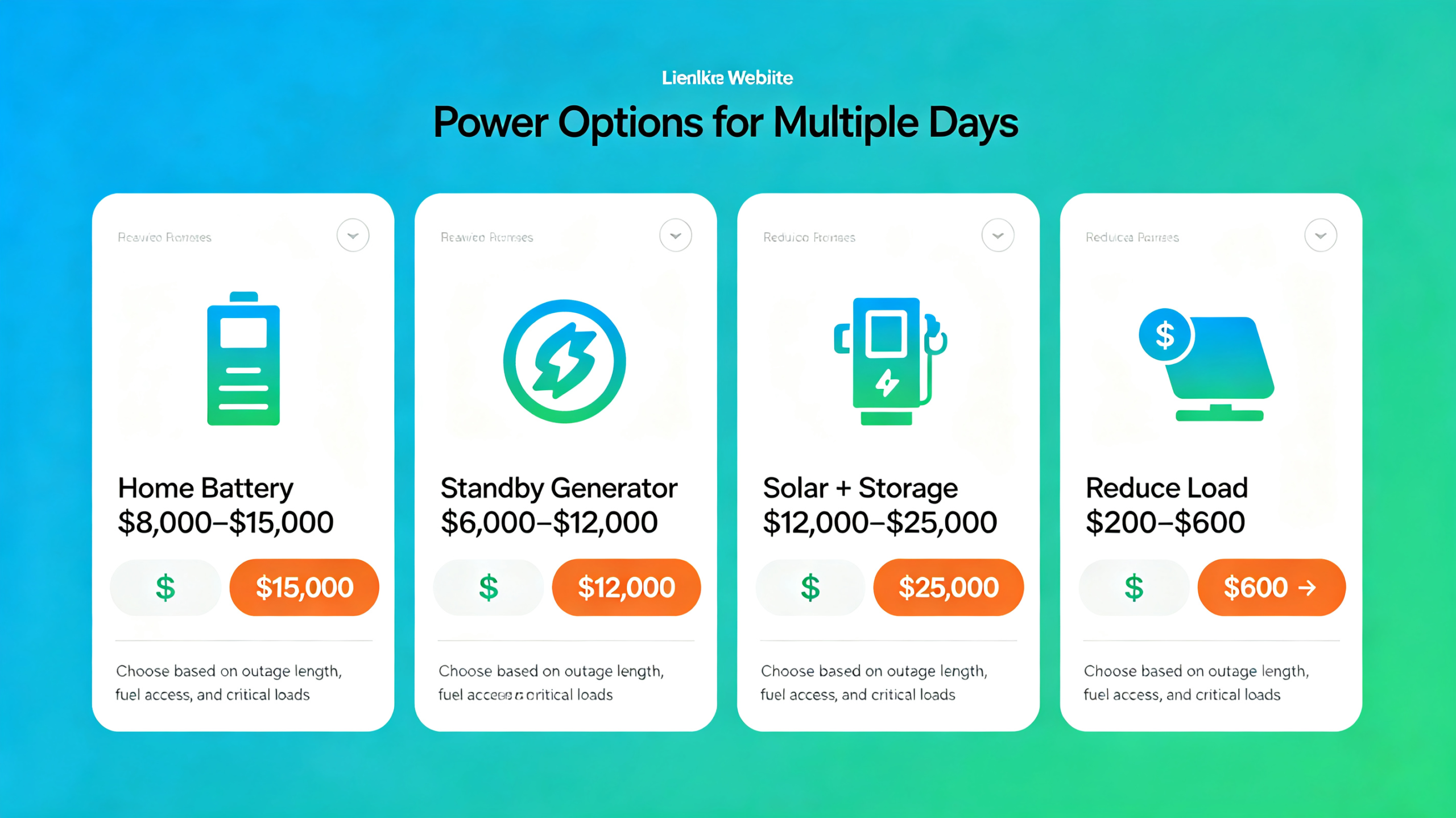
TL;DR: A public safety power shutoff is different from a normal outage in two ways: you usually get 24 to 48 hours of warning, and it can last several days rather than several hours. That changes what you need. A grid-tied solar system without storage produces nothing during a shutoff, because the inverter disconnects when the grid goes down. A battery covers essentials for 8 to 12 hours per charge, and only a battery paired with solar can keep recharging itself through a multi-day event – unless wildfire smoke cuts production. A generator still wins on runtime.
Utilities in high fire-risk areas now cut power deliberately when conditions turn dangerous: strong winds, dry vegetation, low humidity. The goal is to stop a downed line from starting a wildfire. The trade-off is that tens of thousands of homes lose electricity at once, sometimes for days, and the outage is planned rather than accidental.
That planning cuts both ways. It is disruptive, but it gives you something a storm never does – warning.
How a Public Safety Power Shutoff Differs From a Normal Outage
| Storm outage | Public safety power shutoff | |
|---|---|---|
| Warning | None, or minutes | Usually 24-48 hours |
| Typical duration | Hours | One to five days, and it can repeat |
| Cause | Damage to the grid | Deliberate de-energising before damage happens |
| What helps most | Instant backup | Multi-day storage plus a plan |
If you are preparing for hours, a battery is excellent. If you are preparing for four days, the question is not just whether you have backup, but whether that backup can refill itself.
The Misconception That Catches Most Owners
Panels on the roof do not mean power in the house during a shutoff. A standard grid-tied inverter is required to shut down when the grid goes down, so that crews working on lines are not exposed to live current from your roof.
This is normal, and it is the single most common surprise for new solar owners. Without a battery and the right transfer equipment, your system is off for the whole event. The mechanics are covered in solar panels during a power outage.
What Actually Keeps a Home Running for Days
A Battery on Its Own
A home battery running essential circuits – fridge, lights, internet, phone charging – typically lasts 8 to 12 hours per charge on a 10kWh unit. That handles a short outage comfortably and a multi-day shutoff badly, because there is no grid to recharge from.
A Battery Plus Solar
This is the combination built for multi-day events. During the day the panels refill the battery, and at night the house draws it back down. In clear weather, a reasonably sized system can cycle this way almost indefinitely.
There is a catch worth understanding before you rely on it: wildfire smoke. Heavy smoke reduces solar production significantly, and a shutoff often happens during exactly that weather. A system that cycles comfortably in July may barely keep up in October with ash haze overhead. Oversizing the array slightly relative to the battery is the usual protection.
A Standby Generator
A generator still wins on one metric: runtime. On natural gas it can run for the duration, and on propane it runs until the tank empties. The costs are noise, annual servicing, and fuel consumption that adds up fast over several days. Our comparison of a home battery versus a standby generator sets out the numbers.
A Portable Power Station
For renters, apartments, or a household that only needs phones, laptops and a few lights, a portable unit is far cheaper than a home battery and needs no installation. It will not run a fridge for a week, but it covers the essentials that matter most.
How to Prepare Before the Season
- Work out which circuits you actually need, and make sure they are the ones wired to backup power
- Charge the battery to full before the fire weather arrives, not when the notice lands
- Keep fuel on hand if you rely on a generator, and check the oil before the season
- Have a plan for medical equipment and refrigerated medication that does not depend on one device
- Keep phones, laptops and power banks topped up when a shutoff is forecast
- Write down your utility’s outage map and notification sign-up, so you get the warning early
- Check your electric vehicle charge level – an EV can act as a large emergency power source if your setup supports it
What to Do When the Notice Arrives
- Charge everything: car, power banks, laptop, backup batteries
- Set your battery to a conservative reserve level so it does not drain overnight on non-essential loads
- Turn your fridge and freezer to their coldest setting so they hold temperature longer
- Fill containers with water if you are on a well pump, because that pump runs on electricity
- Confirm your sump pump or well has backup power if it matters in your area
What Not to Expect
- Grid-tied solar producing power during the shutoff without a battery
- A battery carrying central air conditioning for several days
- Fast refills at public charging points, which are on the same grid
- Panels clearing smoke haze – production drops, and there is nothing to clean off
If you are sizing a system and a shutoff-prone area is part of your decision, our guide to solar panels with battery backup covers how to choose capacity around real loads rather than showroom numbers.
FAQ
Will my solar panels work during a public safety power shutoff?
Not without a battery. Grid-tied inverters shut down automatically when the grid goes down, for the safety of line crews. With a battery and the right transfer equipment, the system can run in island mode and keep selected circuits powered.
How long will a home battery last in a multi-day shutoff?
Roughly 8 to 12 hours per charge for essential circuits on a 10kWh unit, and one to three days for a larger whole-home system. With solar attached, it can cycle daily and keep going – unless heavy smoke cuts production.
Does wildfire smoke reduce solar output?
Yes, and noticeably. Heavy smoke haze blocks direct sunlight, so production can fall well below normal even though the panels themselves are fine. If you live in a shutoff-prone area, this is a reason to size the array a little larger relative to the battery.
Is a generator better than a battery during a shutoff?
Only on runtime. A generator running on natural gas can last as long as the event, while a battery needs sun to refill. A battery is silent, needs no fuel and starts instantly, which is why many households choose it first.
Do I need a special inverter to run my home during a shutoff?
You need one with backup capability, along with a battery and a critical-loads panel or a smart panel. A standard string inverter alone cannot keep the house energised during an outage.
Related: Solar Panels During a Power Outage – Do They Still Work?