TL;DR: Solar panel snow removal is usually unnecessary. Panels are dark, they absorb heat, and most arrays clear themselves within a day or two of sunshine. If you do want to clear them, use a soft foam snow rake from the ground – never a metal shovel, an ice scraper or hot water, all of which scratch the glass and can void your warranty. Snow typically costs only 1-5% of annual production in snowy states, and most of that loss falls in the months when output is lowest anyway.
Every first winter, a new solar owner looks at a white roof and assumes they are losing money. Usually they are not losing much, and the bigger risk is the person on the roof with a tool in their hand.
Here is what actually happens to a snowy array, which tools are safe, and what will permanently damage the panels.
Do You Actually Need To Clear Snow Off Panels?
Most of the time, no. Three things work in your favour:
- Dark panels absorb heat. Even on a cold day, sunlight warms the glass, and melt begins underneath the snow layer rather than on top of it
- Snow slides on glass. Panel surfaces are smooth and mounted at an angle, so once a thin layer of water forms, the whole sheet releases and falls
- Most decks clear within a day or two. Unless you are in a heavy lake-effect snow belt, the array is usually producing again within 48 hours of the storm ending
The exception is a long stretch of cold, cloudy weather after a heavy dump. Then snow can sit for a week or more, and that is the case where clearing is worth considering.
How Much Output Does Snow Actually Cost?
Less than most people fear – typically 1-5% of annual production in snowy states, and rarely above 10% even in heavy lake-effect belts. Two reasons:
- Timing. Snow sits on the array during the shortest, weakest days of the year. Losing a week of December output is not the same as losing a week of June output
- Duration. The panels rarely stay covered for long
So a bad winter might cost you a few percent of your yearly total, not the 20 or 30 percent owners sometimes assume. What a winter month looks like in the monitoring data is covered in how much solar panels produce in winter.
If that sounds low, it is worth checking your own numbers rather than estimating. Comparing this winter’s production against last winter’s, week by week, is the only way to know whether snow is genuinely costing you anything. Our guide to solar panel monitoring shows how to read that data.
What To Use If You Do Clear Them
If you decide to clear the array, the tool matters more than the technique.
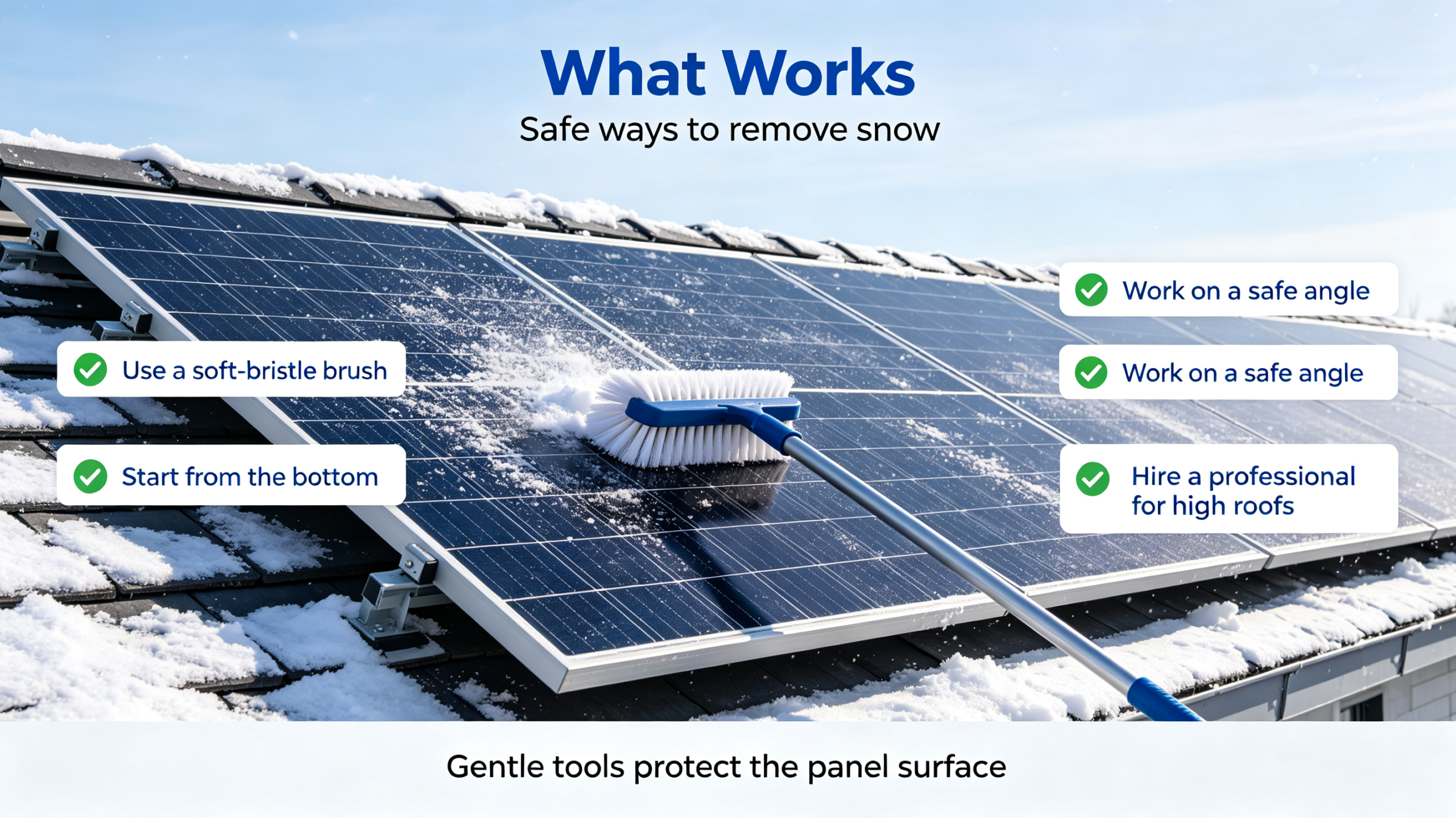
- A soft foam snow rake with an extension handle, used from the ground. The foam head is designed not to scratch glass, and standing on the ground removes the fall risk entirely
- Pull the snow off the lower edge of the array, not the surface. You are trying to break the bond so the rest slides, not scrape the glass clean
- A soft-bristled broom, and only on the frame, never the glass. Even soft bristles leave micro scratches if you press hard enough
In practice, most experienced owners simply clear the bottom edge and let gravity do the rest.
What Will Permanently Damage The Panels
This list is short and absolute. Every item on it causes damage that is invisible at first and permanent later.
- Metal shovels and ice scrapers. They scratch the anti-reflective coating. The scratch itself costs very little output, but the exposed area collects dirt and the damage is visible to any inspector
- Hot water. Pouring warm water on cold glass can cause thermal shock and crack a panel outright. It also refreezes as ice at the bottom edge
- Salt or de-icing chemicals. They can attack the aluminium frame and the sealant around the cells
- Walking on the panels. This is the fastest way to create microcracks in the cells, which reduce output gradually and are not covered by warranty
- Hard-bristled brushes and pressure washers. Same problem as metal tools, with the added risk of forcing water past the frame seals
Worth knowing: most panel warranties exclude damage caused by improper cleaning or snow removal, so a scratched or cracked array is usually your cost, not the manufacturer’s.
Ice Is Not Snow: The Advice Flips
Ice behaves differently, and there is no safe way for a homeowner to deal with it.
Snow is soft and releases in sheets. Ice bonds directly to the glass, and every method you might reach for damages the panel: scraping takes the anti-reflective coating with it, and impact takes the glass.
So the rule for an iced-over array is simply to wait. It will melt from the underside on the next sunny day, the same way snow does. Nothing done from the ground makes it faster, and the ice itself does not damage the panels.
The Safety Rules
- Never go onto a snowy or icy roof. The panels themselves are the least of your risks up there
- Never use a ladder on snow or ice, even for a single panel
- Never stand under the lower edge of the array when snow is releasing, because a sliding sheet of snow is heavy
- If your array is on a steep second-storey roof, hire a professional rather than improvising
A damaged panel costs a few hundred dollars. A fall costs far more.
Snow Guards: The Trade-Off
Snow guards are small brackets fitted above doorways and driveways to stop the whole snow sheet from sliding off at once. They exist for good reason – a sliding sheet can dent a car or block an entrance.
But there is a catch. Snow guards hold snow on the roof longer, which means they hold snow on your panels longer as well. Homeowners who fit them usually accept slightly lower winter production in exchange for not having snow avalanches landing at their front door.
If your array is above a walkway or a parking spot, guards are usually the right call. If it is over open garden, they are often unnecessary.
Clear It Or Leave It: The Short Version
Clear the lower edge only if:
- The forecast shows several more cold, cloudy days, so the array will not clear itself
- You are off-grid or running on battery through the winter, where every kilowatt hour matters
- Snow has sat on the array for more than a week with no production at all
Leave it if:
- The forecast shows sun within a day or two
- The array is high, steep, or hard to reach safely
- You have no foam rake and would be improvising with something else
- Your monitoring shows production returning as normal after each storm
For most owners in most winters, waiting costs a few dollars of output. Attempting an improvised removal risks a few hundred dollars of damage.
Winter also brings its own maintenance questions beyond snow, which our guide to solar panel maintenance in winter covers in more detail.
FAQ
Do I need to remove snow from my solar panels?
Usually not. Panels are dark and mounted at an angle, so most arrays clear within a day or two of sunshine. Clear the bottom edge with a foam rake from the ground if you want to speed it up, and leave the rest alone.
Can snow damage solar panels?
The snow itself rarely does. Panels are built to carry a snow load, and tempered glass handles it well. The damage usually comes from how people remove it – metal tools, hot water, or walking on the array.
What is the best tool for removing snow from solar panels?
Only a soft foam rake, and only from the ground, working on the lower edge rather than the glass surface. Metal or hard plastic rakes will scratch the coating. There is no safe homeowner tool for ice.
Do solar panels produce anything when covered in snow?
Almost nothing while they are fully covered. As soon as a gap opens at the bottom edge, production restarts on the uncovered section, which is why clearing just the bottom edge of the array works.
Why does snow slide off solar panels?
Panel glass is smooth and the array is mounted at an angle, so once sunlight warms the glass underneath and a thin film of water forms, the whole sheet loses its grip and releases at once. That is why a sliding sheet is heavy and worth standing clear of – and why snow guards exist above doorways and driveways.
What does snow on solar panels cost in lost output?
In snowy states, typically 1-5% of annual production, and rarely above 10% even in heavy lake-effect belts. The reason it stays low is timing: snow sits on the array during the shortest, weakest days of the year, and most decks clear within a day or two of sunshine.
Does snow on the ground help solar production?
It can. A bright day with snow on the ground often produces slightly more than the same day without snow, because the snow reflects extra light onto the array. The effect is small, though, and it does not offset the days when the array itself is buried.
2 thoughts on “Solar Panel Snow Removal – What Works and What Ruins Panels”