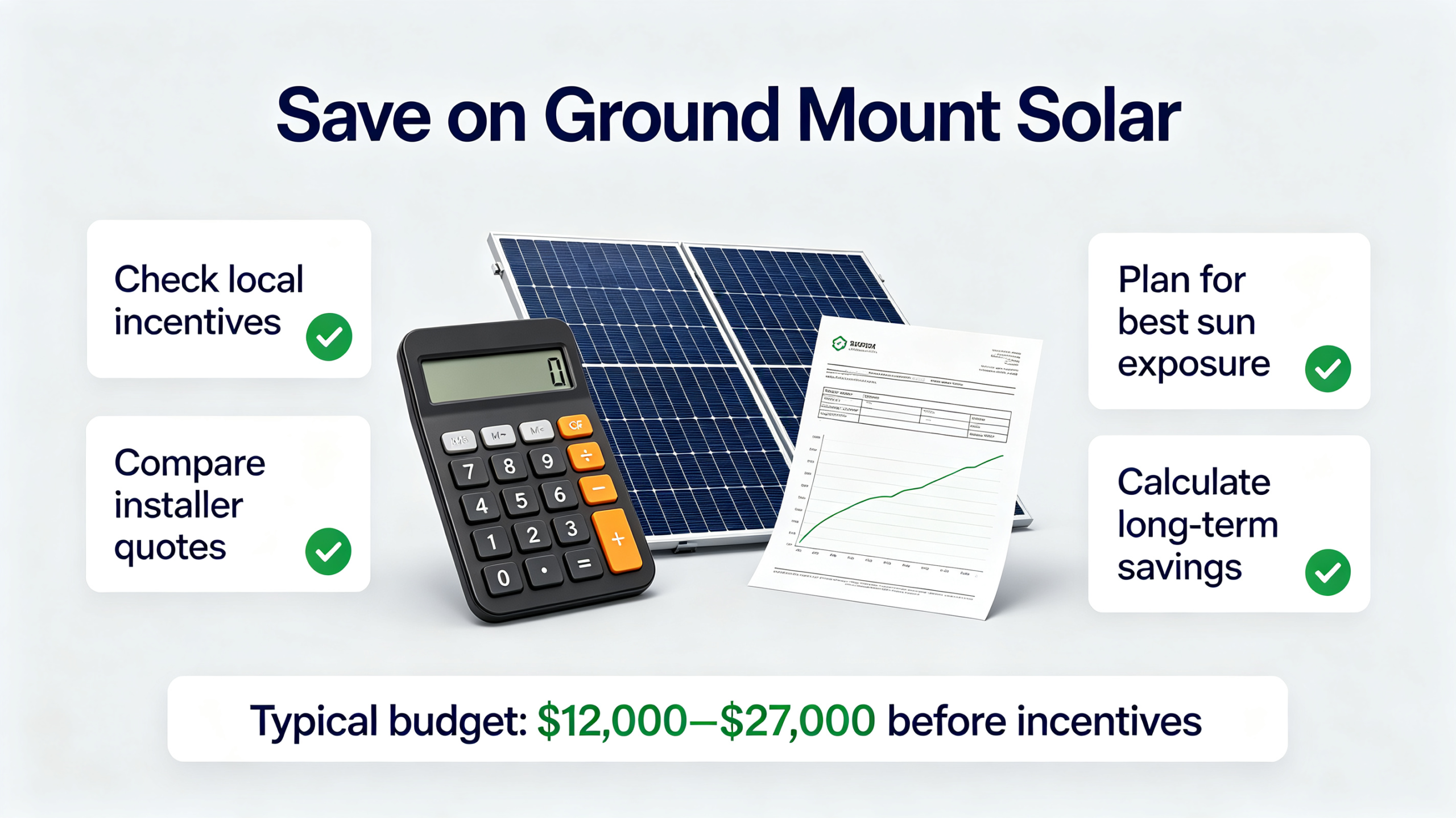
TL;DR: Ground mounted solar cost usually runs $3.00 to $4.50 per watt installed, against roughly $2.50 to $3.50 for the same system on a roof. The difference comes from three things: the racking structure, the trench and conduit run back to your electrical panel, and engineering plus permits, because a ground array is treated as a permanent structure. Ground mounts make sense when the roof is old, shaded or too small, and they win on maintenance and expansion.
For a homeowner whose roof is a poor fit for solar, a ground-mounted array solves the problem outright. There is no compromise on tilt, no shading from chimneys, no roof penetrations, and no future re-roofing that requires taking the panels off.
The trade is money. A ground mount costs more per watt, and most of that difference lands in two line items: steel and dirt.
Why a Ground Mount Costs More
Three parts of the project do not exist in a rooftop installation.
The racking structure. On a roof, the mounting system is relatively light because the building carries the load. On the ground, the steel frame has to hold the array against wind uplift on its own, which means heavier members and a designed foundation.
The trench and the conduit run. The array has to reach your electrical panel, and on a ground mount that usually means digging. Distance is the variable that hurts most, because the cost scales with every foot.
Engineering and permits. A ground array is a structure. Many jurisdictions require stamped structural drawings, wind and snow load calculations, and a building permit in addition to the electrical permit.
Cost Breakdown
| Item | Typical cost |
|---|---|
| Rooftop system, installed | $2.50-$3.50 per watt |
| Ground-mounted system, installed | $3.00-$4.50 per watt |
| Racking and steel structure | $0.20-$0.50 per watt |
| Trenching and conduit | $800-$3,000 typically, more on long or paved runs |
| Concrete footings or helical piles | $500-$2,000 |
| Engineering and stamped drawings | $500-$2,000 |
| Building and electrical permits | $200-$1,000 |
For reference, an 8kW ground-mounted system commonly lands somewhere in the $24,000 to $36,000 range installed, against roughly $20,000 to $28,000 for the same capacity on a roof.
What Drives the Price Up
- Distance to the electrical panel. This is the single biggest variable. A short run from a nearby outbuilding is cheap; 200 feet across a finished lawn is not
- What the trench crosses. Lawn digs easily. Driveways, patios, retaining walls and established trees add cost quickly, and hard surfaces often need to be cut and restored
- Soil and slope. Rocky ground requires different excavation equipment. A sloping site needs longer footings on the downhill side
- Wind and snow load. Coastal and high-wind zones, and heavy-snow regions, require heavier steel and deeper foundations
- Fixed tilt or tracking. A fixed array at one angle is the standard choice. Trackers add cost and moving parts, and rarely pay back on a residential system
- Land preparation. Clearing brush, grading, or removing a tree to eliminate shade are all real line items
Ground Mount Versus Rooftop: The Honest Trade-Off
| Rooftop | Ground mount | |
|---|---|---|
| Cost per watt | Lower | Higher |
| Use of land | None | Requires usable space |
| Tilt and orientation | Limited by the roof | Set to the ideal angle |
| Cleaning and snow | Harder, needs roof access | Easy, at ground level |
| Roof penetrations | Yes | None |
| Expansion later | Often limited | Simple |
| Re-roofing conflict | Panels must come off | No conflict |
The decision usually comes down to one question: is your roof good enough to keep for the next 25 years? If the answer is no, the ground mount premium is often cheaper than re-roofing first. Our article on whether to replace your roof before installing solar walks through that test.
Where a Ground Mount Earns Back the Difference
The higher price is not pure loss. There are four places it comes back.
- Better tilt and orientation. An array set at the ideal angle for your latitude will usually out-produce a roof array that has to follow the roof pitch. If the roof is shaded or faces the wrong way, the gap gets wider
- Easier maintenance. Cleaning, inspecting and clearing snow all happen at ground level, with no ladder involved
- No interference with the roof. Nothing has to be removed when the roof is eventually replaced, and there is no flashing to leak
- Simple expansion. Adding panels later means adding racking, not re-engineering a roof layout
If you were considering a covered structure anyway, the economics change again, because the mounting structure does double duty. That version is covered in our breakdown of solar carport cost.
Permits, Zoning and Setbacks
Ground mounts attract more paperwork than roof mounts, for a simple reason: they are structures, and structures have rules.
- A building permit is normally required in addition to the electrical permit
- Many jurisdictions require a setback from property lines, often a few feet, and some treat the array like an accessory structure with a height limit
- Homeowner association rules may restrict visible structures even where the state protects your right to solar
- If you are in a flood zone or a protected area, additional review may apply
Ask your installer which permits they handle and which ones fall to you, and get that in writing before signing. Permit surprises are the most common reason a ground mount project slips by a month.
How To Compare Two Ground Mount Quotes
Ground mount quotes are hard to compare because the panels are the same and everything else is not. Ask each installer to break the quote into five separate lines:
- Racking and steel, priced on its own
- Trenching, with the distance stated in feet
- Conduit and cable
- Engineering and stamped drawings
- Permits, split into building and electrical
Once they are separated, the gap between two quotes usually stops being mysterious: one is assuming forty feet of trench and the other two hundred. That is the number worth arguing about – not the total. An installer who will not itemise is telling you something about how the project will go.
Where You Put The Inverter Changes The Cost
On a ground mount, the distance back to the house is the expensive part – and how you handle it moves the budget more than the panel choice does.
- Long DC run: the array feeds a string inverter on the house wall. Cheap equipment, but you are running DC cable the whole distance, with the voltage drop, the thicker conductor and the extra code requirements that come with the DC side
- AC at the array: microinverters, or a string inverter mounted at the array itself, so only an AC line runs back. You then use standard electrical gear, rapid shutdown requirements are easier to satisfy, and voltage drop is easier to manage over distance
Once the run gets past roughly 100 to 150 feet, AC at the array is often the cheaper install and the better long-term choice. It has a second benefit: everything lives at ground level, where you can reach it without a ladder.
The trade-off is heat. An inverter mounted outdoors at the array runs hotter in summer than one on a shaded wall, and that shortens its life a little. Microinverters are built for that environment; a wall-mount string inverter is not. If the run is long and you want the simplest electrical design, AC at the array with microinverters is usually the answer.
Is a Ground Mount Worth It?
Run the numbers this way: take the extra cost of the ground mount over a rooftop quote, and compare it against the value of the additional production, plus whatever you avoid in future roof work.
If the ground mount produces meaningfully more because it can be angled properly, and your roof would otherwise need replacing within a decade, the ground mount often wins on total cost of ownership even though it loses on the sticker price. If your roof is new and unshaded, the rooftop system is the better buy.
The components inside the quote are the same either way, which is why it helps to know what drives solar panel installation cost before you compare a ground quote against a roof quote. And once you have a total, the next question is how long until it pays for itself – which is where the ground mount’s better production starts to matter. Ongoing running costs are covered in annual solar maintenance cost.
FAQ
How much more does a ground mount cost than rooftop solar?
Typically $0.50 to $1.50 per watt more, which on an 8kW system is roughly $4,000 to $12,000. Most of that sits in the racking, the trench and the engineering requirements.
How much does trenching cost for a ground mount?
It depends almost entirely on the run and what it crosses. Short runs through lawn are inexpensive; long runs under driveways or paving commonly push the trench line item into the thousands.
Is a ground mount more efficient than rooftop panels?
It can be, because the array can be set at the ideal tilt and orientation rather than following your roof pitch. The gain is small on a well-oriented roof and significant on a shaded or badly angled one.
Do I need a permit for a ground-mounted solar array?
Yes, usually two: a building permit for the structure and an electrical permit for the connection. Setback and height rules often apply as well, so check with your local building department early.
Can I install a ground mount myself?
The racking and panels are within reach for a capable DIY homeowner, but the trench, the grounding, the electrical connection and the engineering sign-off are not. Most owners who go this route hire a contractor for the electrical side and the inspections.
How much do ground-mounted solar panels cost?
Plan on $3.00 to $4.50 per watt installed, against $2.50 to $3.50 for the same capacity on a roof. The spread is wide because the trench and the steel dominate the price – two projects of identical size can differ by thousands depending on the distance to the panel and what the trench crosses.
Does a ground mount need more maintenance than a rooftop system?
Less, for the panels themselves, because everything is reachable at ground level without a ladder. What you add is ground management: keeping vegetation clear of the array, checking the footings after a hard winter, and inspecting the conduit where it enters the ground.
Related: Ground-Mounted vs Roof-Mounted Solar Panels – Which Is Better