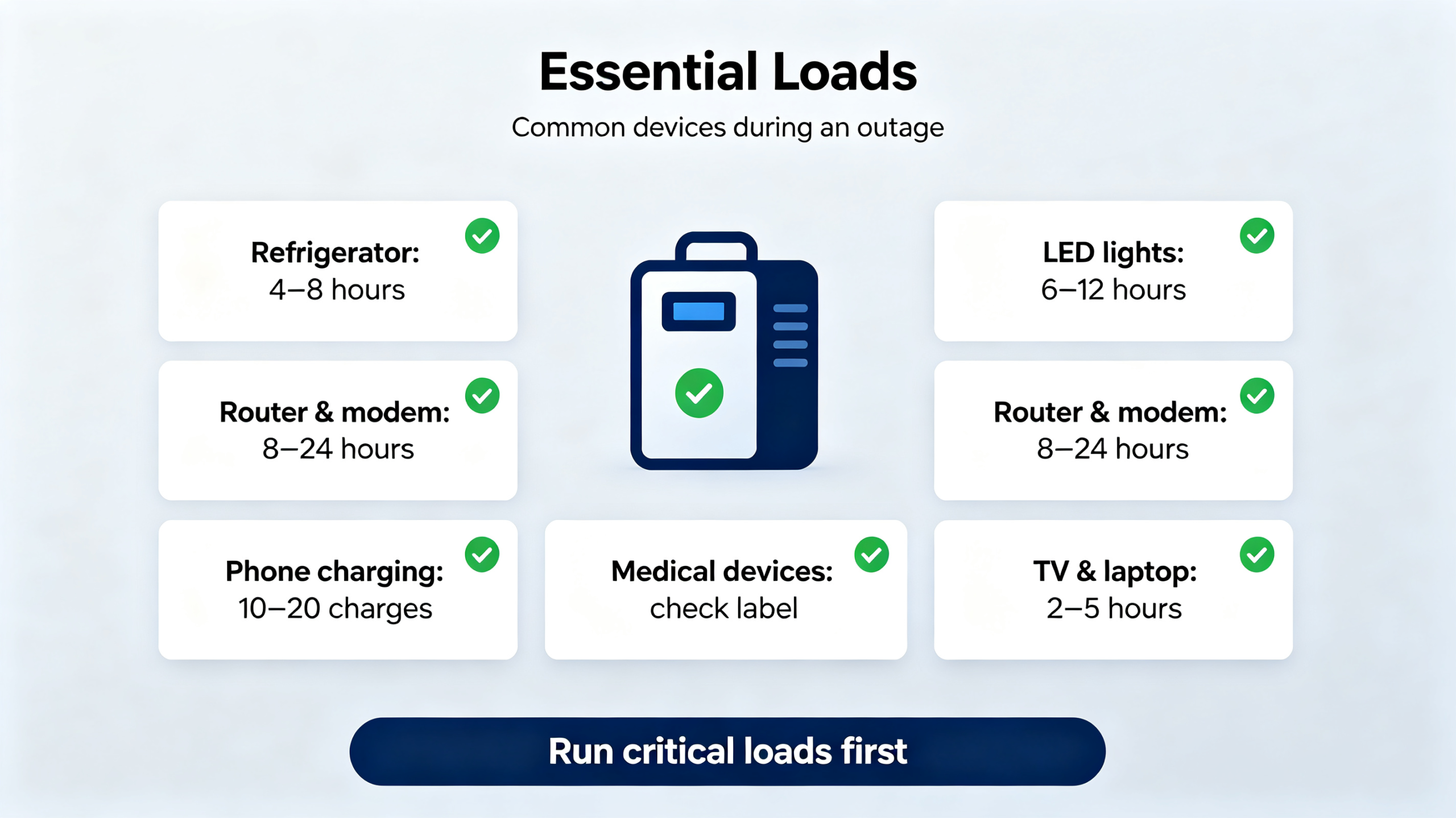
TL;DR: What can a home battery run depends on three things: the size of the battery, which circuits are wired to it, and how much sun you get to recharge it. A 10kWh battery easily covers a fridge, lights, internet and a few outlets for a day – roughly the essentials for 8 to 12 hours, or several days if you ration it. What it cannot do is carry central air conditioning, an EV charger or electric heating for more than a few hours. Those are the loads that decide whether you need 10kWh or 30kWh.
Battery capacity is quoted in kilowatt-hours, which tells you almost nothing about what will still work in your house when the grid goes down. Two homes with the same 10kWh battery can have completely different experiences, depending on what the installer connected to it.
Here is the practical version: what each appliance actually costs you, and how far a battery really goes.
The Short Version
A battery runs what you connect to it, for as long as its stored energy lasts. Three variables decide the answer:
- Battery size in kilowatt-hours, which sets the total energy available
- Which circuits are backed up – most installations power a critical-loads panel rather than the whole house
- Recharge – solar refilling the battery during the day, or no solar and no grid, which means one charge has to last
Modern lithium batteries let you use close to their full rated capacity. Older lead-acid systems allowed only about half, which is why you sometimes see capacity figures that look far too generous for what the system delivers.
What Each Appliance Actually Costs
The table below uses typical daily energy use, not peak power. It assumes a 10kWh battery with most of its capacity available.
| Load | Typical daily energy | Rough runtime on 10kWh |
|---|---|---|
| Fridge and freezer | 1-2 kWh | 5-9 days |
| LED lighting, whole house, evening | 0.3-0.6 kWh | 15-25 days |
| Wi-Fi router and modem | 0.15 kWh | Weeks |
| Laptop and phone charging | 0.2-0.5 kWh | 18-40 days |
| Television, four hours | 0.4 kWh | About 20 days |
| Gas furnace blower, winter | 1-2 kWh | 5-9 days |
| Well pump | 1-3 kWh | 3-8 days |
| Sump pump | 0.5-1 kWh | 9-18 days |
| Electric range, cooking only | 1-2 kWh | 5-9 days |
| Electric water heater | 5-10 kWh | 1-2 days |
| Central air conditioning, 3-ton, six hours | 12-20 kWh | Under a day |
| Heat pump, winter | 15-30 kWh | Under a day |
| EV charging, 40 miles of range | 10-12 kWh | Under a day |
Read the first six rows together and you get the normal picture: a 10kWh battery running a fridge, lights, internet, laptops and a television uses roughly 2 to 4 kWh a day. That is two to four days of essentials on a single charge, and indefinitely if the sun comes back and refills it.
Now read the bottom three rows. One hot afternoon of central air, one cold day of heat pump output, or one EV charge can consume the entire battery on its own.
The Loads That Break the Maths
Almost every disappointing battery story comes down to one of three appliances.
Central air conditioning. It is not just the energy – it is the surge. A compressor starting up can pull several times its running current for a second or two, which is why some batteries need a soft-start kit to run an AC unit at all.
Electric resistance heating. Electric furnaces, baseboard heaters and electric water heaters convert electricity to heat at a ratio of one to one, which makes them the most expensive way to stay warm on stored power. A heat pump is two to three times more efficient, and still heavy.
EV charging. A single overnight charge can be 10 to 15 kWh. Charging a car from a home battery during an outage is usually the fastest way to empty it.
The workaround is load management. Many systems let you exclude specific high-draw appliances from the backup circuit, or install a soft start on the air conditioner and a smart panel that sheds loads when the battery is low. That approach usually delivers a better experience than simply buying a bigger battery.
Essentials Versus Whole Home
Most residential batteries are installed one of two ways.
Critical loads panel. The installer moves selected circuits – fridge, a few lighting circuits, internet, some outlets – onto a separate panel that the battery feeds. You ride out outages comfortably, and the battery lasts far longer because the heavy loads are not connected.
Whole home backup. The battery sits behind the main panel and can carry the entire house, subject to its capacity and its output rating. It is more convenient and considerably more expensive, and it still cannot run central air and an EV charger at the same time for long.
For most households, the critical-loads approach delivers more value per dollar. If your goal is running the whole house indefinitely, a battery alone rarely gets there – our comparison of a home battery versus a standby generator explains why.
How Much Battery Do You Actually Need?
Work backwards from the loads, not forwards from the price.
- List the appliances you refuse to live without during an outage.
- Add up their daily energy use using the table above.
- Decide how many days you want to cover without sun.
- Multiply, then add margin for cold weather, battery age and cloudy days.
A household that wants a fridge, lights, internet and a well pump covered for two days typically needs around 10kWh. Add central air conditioning to that list and the requirement jumps past 20kWh, because a single hot day can consume 12 to 20kWh on cooling alone.
Sizing is where most quotes go wrong, and the reason to ask what your battery backup system will actually power in writing, appliance by appliance, before you sign.
What Changes the Answer Over Time
- Season. The same battery covers less in winter, because heat pumps and furnace blowers run longer and solar production is lower.
- Battery age. Capacity fades gradually, so a ten-year-old battery holds less than the day it was installed.
- Habits during an outage. Turning off the water heater, skipping the dryer and charging devices in the afternoon can double how long a battery lasts.
- Weather. A battery paired with solar in a sunny climate behaves very differently from one in a cloudy one, which is why two identical systems can have very different reputations.
If you are still working out how the whole system behaves when the grid fails, our explainer on what happens during a power outage is the place to start.
FAQ
How long will a 10kWh battery run a house?
Running essentials – fridge, lights, internet, laptops and a television – roughly two to four days on a single charge. Running central air conditioning or an EV charger, less than a day.
Can a home battery run central air conditioning?
It can, if the battery and inverter are sized for the surge current, and often with a soft-start kit fitted to the air conditioner. The limiting factor is usually energy rather than power: a hot day of cooling can drain a 10kWh battery in a few hours.
How many days will a battery last in an outage?
With solar attached and decent weather, it can cycle indefinitely. Without solar, one charge has to cover the whole event, which for essentials is usually two to four days on a 10kWh unit.
Is 20kWh enough to run a whole house?
It is enough for a whole house on light loads and in mild weather. Add central air, electric heating or an EV charger and you will need substantially more, or a system that sheds those loads when the battery runs low.
Can I add more battery capacity later?
Usually yes, if the inverter and the wiring were sized for it. Modular home batteries are designed to be expanded, so ask the installer how many more units the system can accept before you buy the first one.
Related: Solar Panels with Battery Backup – What to Know Before You Buy
1 thought on “What Can a Home Battery Actually Run? – A Practical Breakdown”