TL;DR: How many solar panels to run an air conditioner depends on the unit, not the house. A modern 1.5-ton unit needs about 4-6 panels, a 3-ton unit 9-11, and a 4-ton unit 12-15 – and that only covers the hours the compressor is actually running while the sun is up.
How Many Solar Panels To Run An Air Conditioner?
For most American homes the answer is between 4 and 15 panels of 400W each, and the number is decided by three things: the size of the unit in tons, its efficiency, and how many hours a day it actually runs.
The number people usually want is smaller than they expect. The number that matters – covering the air conditioning reliably, day and evening – is bigger.
Start With Running Watts, Not Tonnage
Tonnage tells you how much heat the unit moves, not how much electricity it uses. A 3-ton unit from 2005 and a 3-ton unit built this year can differ by more than a kilowatt while running.
| AC size | Typical running watts (modern 14-16 SEER) | Panels at 400W |
|---|---|---|
| 1.5 ton | 1,300-1,800 W | 4-6 |
| 2 ton | 1,800-2,400 W | 6-8 |
| 3 ton | 2,700-3,500 W | 9-11 |
| 4 ton | 3,600-4,600 W | 12-15 |
| 5 ton | 4,500-5,800 W | 15-18 |
You can find the real figure on the unit’s rating plate or in the spec sheet, listed as running amps or watts. That single number beats every rule of thumb, including these.
The Formula Behind Those Numbers
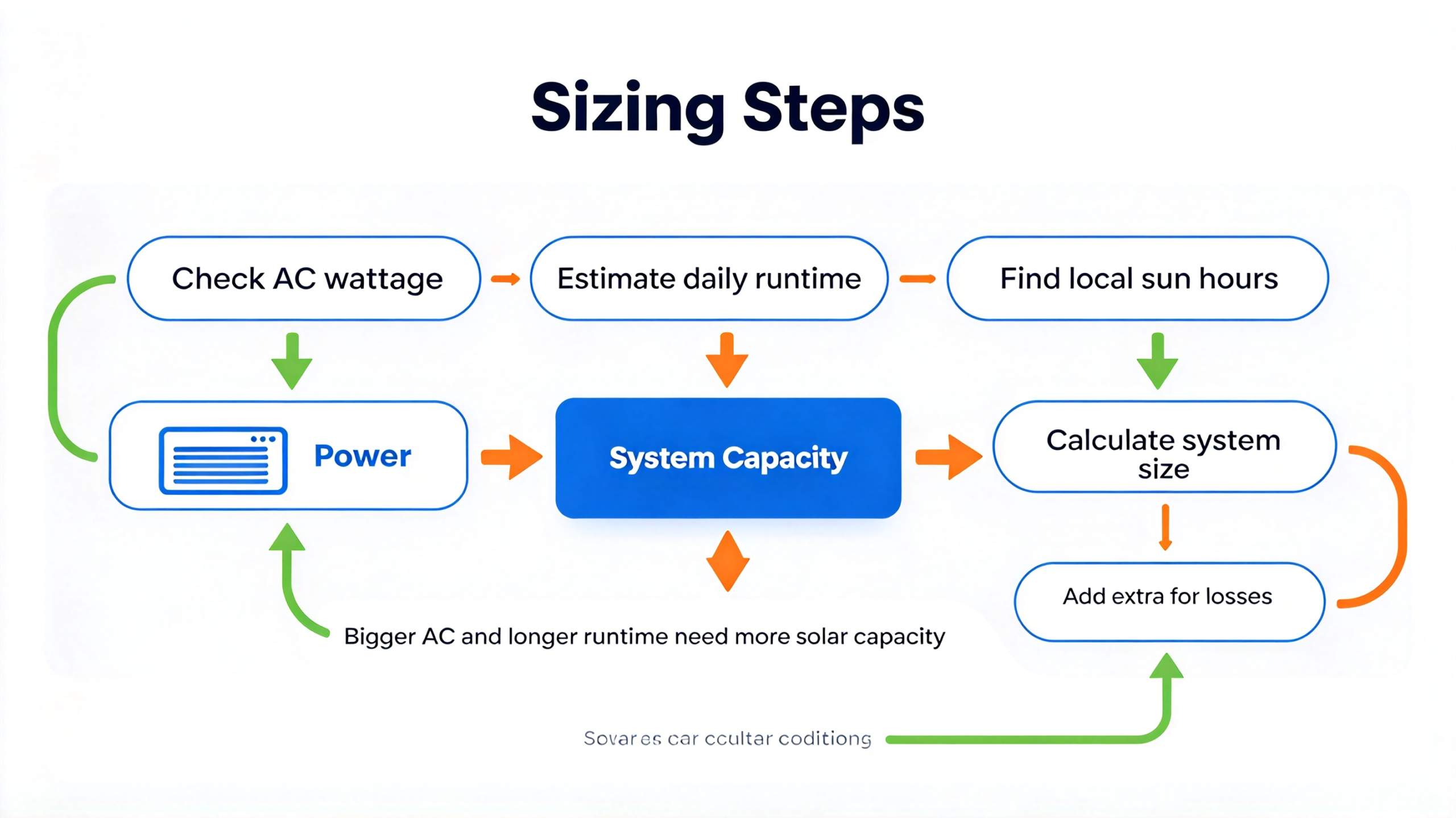
- Step 1: Find the running watts of the condenser unit
- Step 2: Divide by your panel wattage – 3,000W of load needs eight 400W panels on paper
- Step 3: Divide again by a derate factor of about 0.8, because heat, wiring and inverter losses take a share. That same load now needs ten panels
- Step 4: Multiply by run hours to get daily energy. A 3-ton unit running six hours a day uses roughly 16-20 kWh
Step 4 is the one people skip, and it is the one that decides whether your array is big enough. For how that compares with what an array actually produces, see our breakdown of what a 5kW solar system produces per day – a 5kW array on a good summer day makes about as much as one 3-ton air conditioner consumes.
The Catch Nobody Mentions
Air conditioning is a daytime load with an evening habit.
At 2pm the array can carry the compressor directly, and any surplus goes to the grid or a battery. At 9pm the array is producing nothing, and the unit is still running on a hot night. That power comes from the grid, or from storage.
- Daytime cooling: solar covers it, no battery required
- Evening cooling: grid power, unless you have a battery
- Whole-home cooling during an outage: the hardest case, and usually the most expensive to design
A 3-ton unit running overnight needs roughly 12-20 kWh just for itself, which is one or two home batteries with nothing left over for the rest of the house. Our guide to what a home battery can actually run works through it room by room.
Startup Surge And Why Inverter Units Are Easier
A traditional single-speed compressor draws two to three times its running watts for a fraction of a second every time it starts. That surge is what trips generators and forces battery systems to be larger than the running load suggests.
An inverter-driven air conditioner or heat pump ramps up gradually instead, with a surge closer to 1.2-1.5 times running watts. A soft-start kit does something similar for an older unit. If you are designing a system that has to run the air conditioning on stored power, this detail matters more than the panel count.
What Actually Decides The Number In Your House
- Climate and run hours. The same 3-ton unit runs two hours a day in Seattle and eight in Phoenix
- SEER rating. Moving from 14 SEER to 18 SEER can cut running watts by roughly 20%
- Thermostat setting. Each degree of cooling adds to run time, and small changes compound across a summer
- Insulation and duct condition. Leaky ducts can waste a meaningful share of everything the unit produces
- Shade and orientation. A west-facing condenser in full afternoon sun works harder than the same unit in shade
- Roof space. Each 400W panel needs roughly 20-25 square feet, so a 3-ton load implies 220-275 square feet of usable roof
Which Plan Makes Sense For Your Situation
- Cut the daytime cost: a grid-tied array sized for the whole house, which absorbs the air conditioning automatically
- Keep cooling on during outages: a hybrid system with enough battery for the compressor’s surge, or a smaller mini-split on the backed-up circuits
- Small budget, real comfort: a high-efficiency mini-split plus a modest array often costs less than enlarging a whole-home battery bank
- New air conditioner coming anyway: choose an inverter-driven unit before you size the solar, because it changes the answer
If storage is part of the plan, it is worth reading about solar panels with battery backup before committing, because the difference between powering a few circuits and powering a compressor is significant.
FAQ
How many solar panels do I need to run a 3-ton air conditioner?
About 9-11 panels of 400W each to cover the running load while the sun is up. Add more if you also want to cover the rest of the house, and add a battery if you want it running after dark.
Can solar panels run an air conditioner at night?
Not without storage. Production stops at dusk while the load often continues, so evening cooling comes from the grid or from a battery sized for the compressor’s running and startup demand.
Do I need a special inverter for air conditioning?
No, but it helps. A soft-start kit or an inverter-driven air conditioner lowers the startup surge, which reduces the size of battery or generator system you need to keep it running.
Is a mini-split easier to run on solar?
Yes. A typical 12,000 BTU mini-split draws around 800-1,200W, so three or four panels cover it, and cooling only the rooms in use cuts the run hours as well.
Will solar cover my whole summer bill with the AC running?
It offsets the daytime share and typically the largest part of the cooling load, but evening runtime still comes from the utility unless storage is added. Check the bill in kWh rather than dollars to see how much of the load actually moved.
Related: How Much Solar Power Do You Need – A Simple Calculator Guide