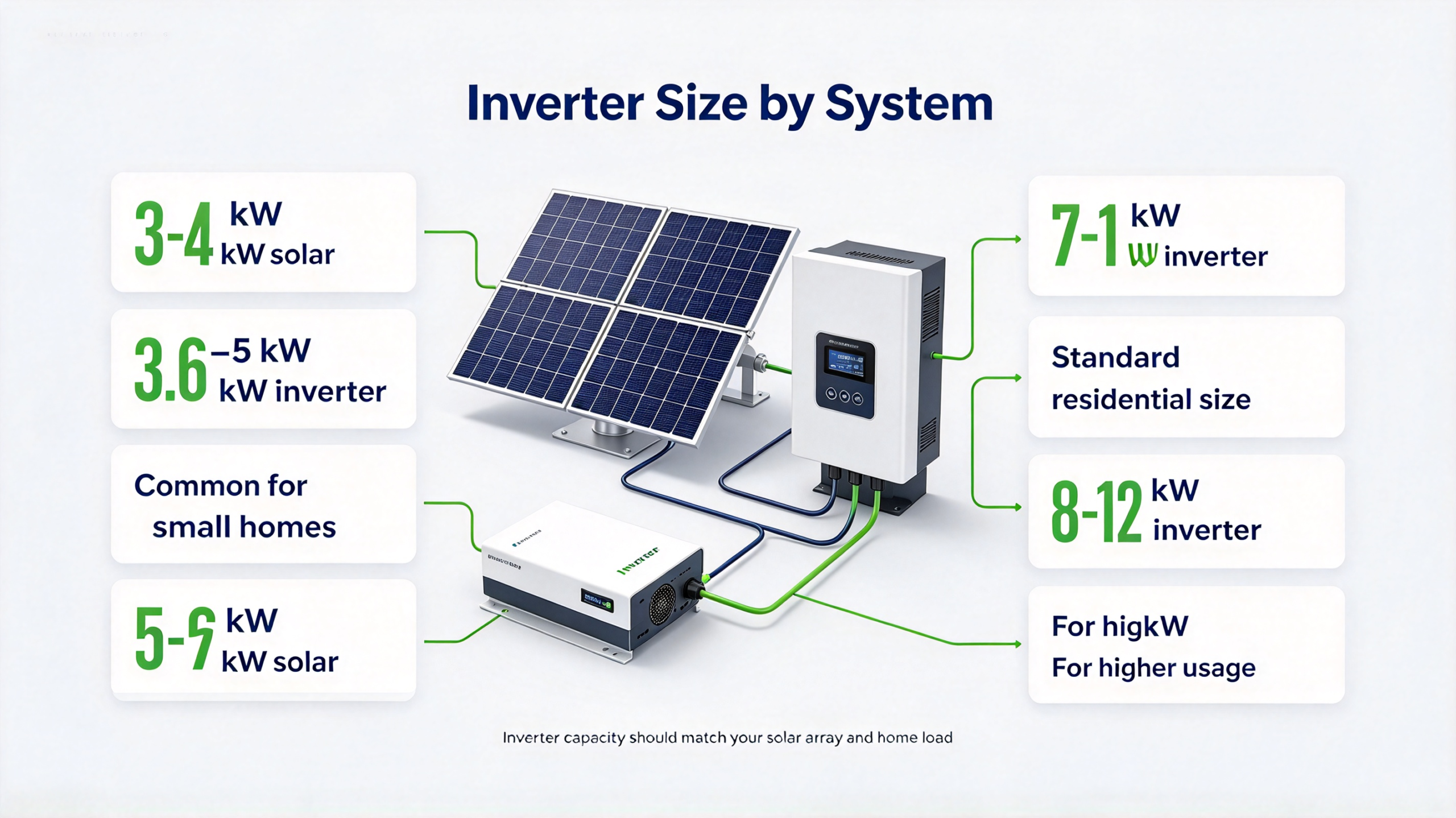
TL;DR: What size inverter do I need? A good starting point is 80-100% of your array size in kW, which means a 5kW array usually pairs with a 4-5kW inverter. The correct answer also depends on roof layout, whether you plan to add a battery, and how much clipping you are willing to trade for a better price.
What Size Inverter Do I Need?
The inverter is sized against the array, not against the house. Most residential systems use an inverter rated 10-25% lower than the array’s nameplate output, because a panel almost never produces its full rating in real conditions.
| Array size | Typical inverter size | DC to AC ratio |
|---|---|---|
| 3 kW | 3.0 kW | 1.00 |
| 5 kW | 4.0-5.0 kW | 1.00-1.25 |
| 8 kW | 6.0-7.6 kW | 1.05-1.30 |
| 10 kW | 7.6-10 kW | 1.00-1.30 |
| 12 kW | 10-12 kW | 1.00-1.20 |
Those ratios are normal, not a compromise. An array rated at 8kW rarely reaches 8kW on the roof, so an inverter rated slightly lower loses almost nothing across a year.
The DC To AC Ratio, Explained Simply
Panels are rated in DC watts under laboratory conditions. Inverters are rated in AC watts, which is what actually feeds the house. The ratio between the two is the number that decides clipping.
- Ratio 1.0: array and inverter matched exactly. Almost no clipping, slightly more money spent on inverter capacity
- Ratio 1.1-1.25: the common residential sweet spot. Expect clipping losses of roughly 0.5-2% across a year
- Ratio above 1.4: more heat, more clipping losses, and the inverter runs closer to its limit for longer each day
A useful rule: the cooler and cloudier the climate, the higher the ratio you can justify. In hot, consistently sunny locations the array hits its peak more often, so a lower ratio makes more sense.
Strings, Voltage And Roof Layout
Sizing is not only about kilowatts. A string inverter has three electrical limits that decide whether your roof layout is even possible:
- Maximum DC input voltage – the string’s voltage in cold weather cannot exceed this. Cold raises voltage, which is why the calculation uses the coldest expected temperature, not a summer one
- MPPT voltage window – the range where the inverter tracks power efficiently. Too few panels in a string drops you below it; too many pushes you above it
- Number of MPPTs – two or more trackers let you run different roof faces independently. One tracker across two directions means the weaker face drags the stronger one down
This is why a slightly larger inverter is sometimes the cheaper answer to a difficult roof: more MPPTs can do more for production than an extra kilowatt of rating.
Microinverters Change The Question
With microinverters there is no single inverter to size. Each panel gets its own small inverter, usually rated 15-25% below the panel’s wattage, so a 400W panel pairs with a 320-350W unit.
That design removes the string voltage puzzle and the shading problem in one move, at a higher upfront cost. The trade-offs between the two approaches are laid out in our comparison of microinverters versus string inverters.
If You Plan To Add A Battery Or More Panels
Two future plans change the sizing decision today:
- A battery later. A hybrid or storage-ready inverter costs more now and saves a second inverter purchase later. Ask specifically whether the unit is battery-compatible and which batteries it accepts
- More panels later. Leave headroom in the inverter’s DC input, and confirm the utility and code limits before assuming an expansion is allowed
If storage is likely, it is worth understanding how the pieces fit first – our guide to solar panels with battery backup covers the difference between AC-coupled and DC-coupled designs.
Too Small Versus Too Big: What Actually Happens
| Sizing error | What you notice | Real cost |
|---|---|---|
| Inverter too small | Production flatlines at midday, inverter runs hot | Clipping losses, more derating, shorter service life |
| Inverter too large | Nothing obvious – bills just never improve as expected | Money spent on capacity the roof cannot feed, plus higher standby draw |
| Right size, wrong MPPT count | Two roof faces, one performing poorly | Several percent of annual production |
A modern inverter is most efficient when it is working reasonably hard. A unit rated far above the array spends its life at low load, which is the least efficient place for it. And if an inverter does fail, replacement is a real cost – our breakdown of solar inverter replacement cost shows what to budget.
The Numbers To Check On A Quote
- Continuous AC output in kW – this is the number that matters, not a peak or surge figure
- Maximum DC input and the allowed DC to AC ratio in the datasheet
- MPPT count and the voltage window for each
- Efficiency – 96-98% is normal for a good residential unit
- Warranty length – 10-12 years is standard for string inverters, longer if extended
- Monitoring – confirm it reports per-string or per-panel data, not just a daily total
Common Sizing Mistakes
- Sizing the inverter to the house’s annual kWh instead of the array’s kW
- Ignoring cold-weather voltage when the string is calculated
- Using one MPPT for two roof directions to save money
- Assuming a bigger inverter always means more production
- Forgetting that the future battery decision is made at this moment, not later
FAQ
What size inverter for a 5kW solar system?
Usually a 4-5kW unit. A 4kW inverter against a 5kW array gives a DC to AC ratio of 1.25, which is common and costs very little in annual production, while a 5kW unit gives a closer match.
Can the inverter be smaller than the solar array?
Yes, and in most residential systems it is. Arrays rarely hit their nameplate rating, so a slightly smaller inverter clips only briefly at midday and loses only a small fraction of annual output.
Does a bigger inverter produce more power?
No. The array sets the ceiling. An oversized inverter cannot make more electricity than the panels supply, and it operates at lower efficiency at part load, so the extra capacity is mostly unused.
How long do solar inverters last?
A quality string inverter typically lasts 10-15 years, with the warranty commonly covering 10-12. Microinverters are usually warranted for 25 years, though replacing one requires access to the roof.
Do I need a bigger inverter if I add a battery later?
Not necessarily bigger, but it needs to be battery-compatible. Storage-ready hybrid inverters cost more upfront and can avoid a full replacement later, which is why the decision is worth making at the design stage.
Related: Solar System Components Explained – What Every Part Actually Does
3 thoughts on “What Size Inverter Do I Need? A Simple Sizing Guide”