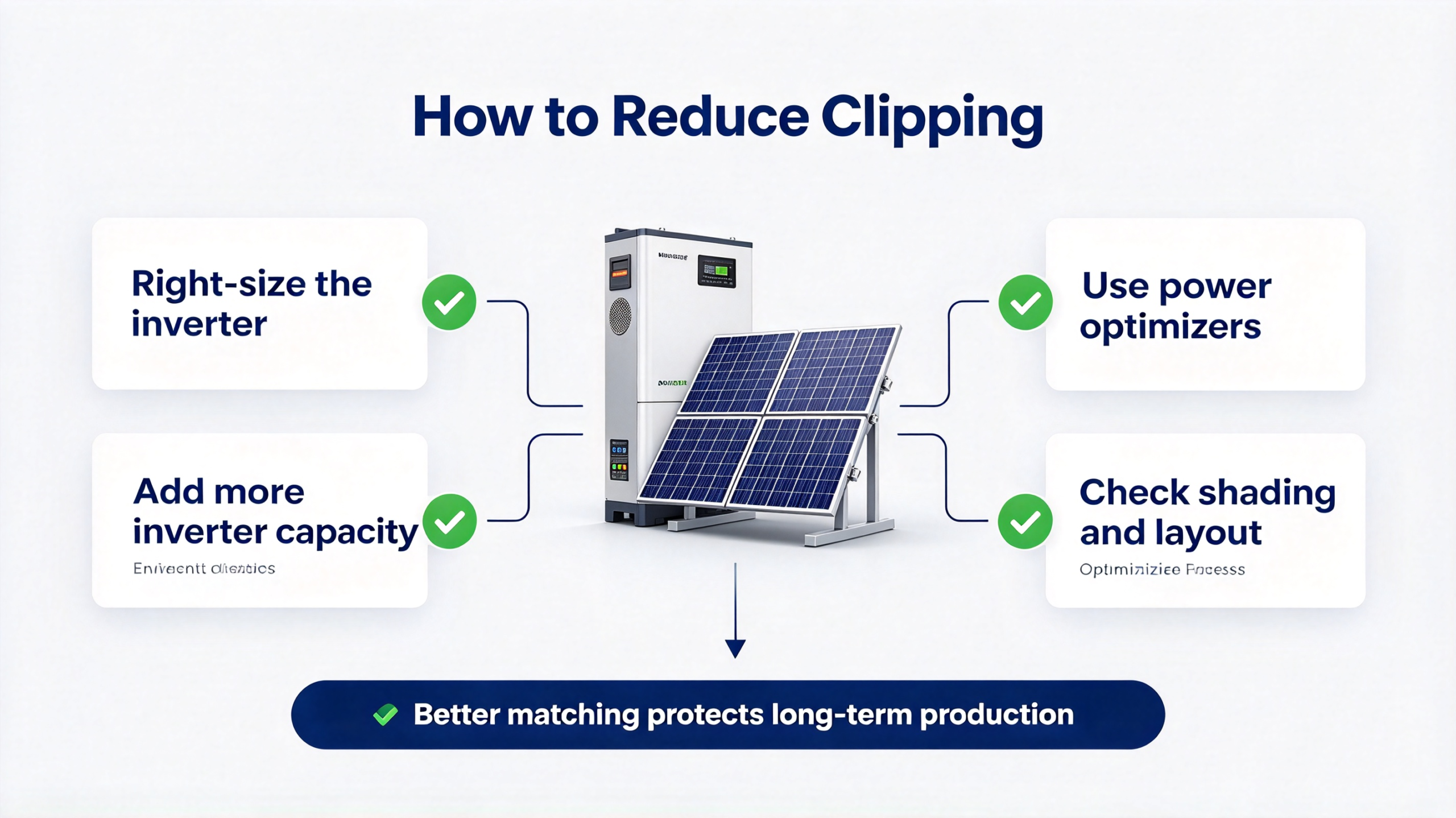
TL;DR: Inverter clipping is usually a deliberate trade-off, not a fault. The array is sized a little larger than the inverter’s AC output so it produces more in low light, morning and evening; at midday the inverter caps the output and the graph goes flat. A DC/AC ratio around 1.2-1.3 often loses only about 0.5-2% of annual production. Clipping becomes a problem when the ratio is too high, the inverter overheats, or an export limit is mistaken for inverter clipping.
The flat top on a production curve looks like lost energy, and it is. The question is whether that loss is larger than the savings from a smaller inverter and the extra output at the edges of the day. In most well-designed residential systems, it is not.
Inverter Clipping: Short Answer
Clipping happens when the DC array can produce more power than the inverter is allowed to send to the AC side. The inverter limits its output to its rated maximum. The extra DC energy is not sent to the grid or the house; it is left in the array. That is normal at solar noon on a clear, cool day.
A modest amount of clipping is designed in. A large amount means the inverter is undersized for the array, or the system is being limited by something else, such as an export cap or a battery interface.
What Clipping Actually Is
A solar array produces DC, and the inverter converts it to AC. The inverter has a maximum AC output. When the array’s available DC power exceeds what the inverter can convert, the inverter moves its operating point away from the array’s maximum power point and caps the AC output. The production curve flattens at the inverter’s limit.
This is not the same as a fault. The inverter is doing exactly what it was designed to do. The design question is whether the array was oversized on purpose and whether the lost kWh are worth the lower equipment cost.
Clipping vs Curtailment vs Derating
| Term | What causes it | Data signature | What to do |
|---|---|---|---|
| Inverter clipping | Array DC output exceeds the inverter’s AC limit | Flat top at the inverter’s maximum output | Calculate the annual loss; usually no action |
| Export curtailment | Utility or grid limit on exported power | Output capped below the inverter’s rating | Check the interconnection agreement |
| Thermal derating | Inverter or panels get too hot | Output falls on hot afternoons; fan runs hard | Improve airflow and shade |
| String or module fault | One string or panel underperforms | Step change or one string below the rest | Inspect and test the array |
| Grid voltage limit | Inverter trips or reduces output at high grid voltage | Fault code or repeated shutdown | Ask the utility and installer to check voltage |
The distinction matters because the fix is different. A clipped system may need nothing. A curtailed system may need a tariff or export review. A derated inverter may need airflow, cleaning or service.
The DC/AC Ratio
The DC/AC ratio is the array’s DC rating divided by the inverter’s AC rating. An 8 kW array with a 6 kW inverter has a ratio of 1.33. A 10 kW array with a 10 kW inverter has a ratio of 1.0.
| DC/AC ratio | Typical annual clipping loss | How to think about it |
|---|---|---|
| 1.0-1.1 | Very little | Rarely clips; inverter may cost more |
| 1.2-1.3 | Roughly 0.5-2% | Common residential sweet spot |
| 1.3-1.5 | Roughly 2-4% | Can still make sense in cloudy or east-west systems |
| 1.5-1.7 | Roughly 4-7% | Check the model; may be undersized |
| Above 1.7 | Often over 7% | Review the design and inverter choice |
These are planning ranges, not a universal rule. A south-facing array in a cool, clear climate clips more than an east-west array in a hot, hazy one. A system with a battery or export limit may have a different constraint. The inverter sizing method is in what size inverter do I need.
How Much Energy Is Really Lost
Clipping loss is the area between the array’s potential curve and the inverter’s flat top, summed over the year. It is not the height of the flat top, and it is not the number of minutes the curve is flat. A system can clip for two hours a day in June and still lose less than 1% of annual production if the rest of the year is unchanged.
| Observation | What it tells you | What it does not tell you |
|---|---|---|
| Flat top at inverter max | Clipping is happening | How much annual energy is lost |
| Flat top only in spring | Seasonal oversizing | Whether the annual trade-off is good |
| Flat top plus hot inverter | Possible thermal derating | Whether the array is undersized |
| Output capped below inverter max | Export limit or curtailment | Inverter clipping |
| One string lower | String or module problem | Clipping |
Use a production model with hourly data to estimate the lost kWh, then multiply by your electricity value. A visual flat top is not a dollar figure. The monitoring basics are in solar panel monitoring.
Why Oversizing Often Saves Money
A larger inverter costs more, and it may run at a lower part-load efficiency. A slightly oversized array costs less per kW than a larger inverter in many quotes, and it produces more in the morning, evening, clouds and winter. The clipping loss at noon is the price of that extra production.
This is why a DC/AC ratio above 1.0 is common. The design is not trying to capture every possible kWh at noon; it is trying to maximize annual value per dollar. If the goal is peak output or backup capacity, a larger inverter or battery may be the better choice.
What Makes Clipping Worse
| Factor | Effect | What to check |
|---|---|---|
| High irradiance and cool temperatures | Array can exceed the inverter limit for longer | Local hourly model |
| South-facing, shallow tilt | Concentrates production around noon | Orientation and tilt |
| Oversized array | Raises the DC/AC ratio | Array kW vs inverter AC kW |
| Inverter heat | Derates and lowers the AC ceiling | Airflow, shade, fan |
| Export limit | Caps output below the inverter rating | Utility agreement and inverter settings |
| Battery interface | May charge or limit depending on design | AC- or DC-coupled architecture |
A hot inverter can make the graph look like clipping when the real issue is thermal derating. A utility export cap can look like clipping when the inverter is fine. Check the inverter’s maximum output, the AC output, the DC input and the error log before blaming the array. Heat effects are covered in solar panels in hot climates.
How to Read the Data
- Find the inverter’s rated AC output. If the curve flattens exactly there, clipping is likely.
- Compare a cool, clear day with a hot day. A lower flat top on the hot day suggests derating.
- Look at the season. Spring clipping with low winter output is a sizing trade-off, not a year-round loss.
- Check the export limit. If the cap is below the inverter rating, the issue is curtailment.
- Model the annual loss. Use hourly production, not one screenshot.
- Compare the cost of a larger inverter with the lost kWh. That is the economic question.
When to Act
| Situation | Action | Why |
|---|---|---|
| DC/AC ratio around 1.2-1.3, annual loss under 2% | Leave it | Normal design trade-off |
| Ratio above 1.5 and loss over 4% | Review inverter size and model | The array may be unnecessarily constrained |
| Inverter hot, fan loud, output falling | Improve airflow and service | Derating is not the same as clipping |
| Export cap below inverter max | Check the utility agreement | Curtailment has a different fix |
| Battery added and clipping changed | Check AC/DC coupling | An AC-coupled battery may not recover clipped DC |
| Repeated fault codes | Call the installer | Could be grid voltage, heat or hardware |
Do not replace a healthy inverter just because the graph has a flat top. First calculate the annual lost kWh and compare it with the installed cost of a larger unit. If the loss is small, the money is better spent on efficiency, shade control or a battery if backup matters. The payback logic is in solar panel payback period.
Battery and Export Limits
An AC-coupled battery sits on the AC side of the inverter. If the inverter is already clipping, the battery cannot recover the DC energy that was never converted. A DC-coupled hybrid system may use some of that DC for charging, depending on its design and settings. Ask which architecture you have before assuming a battery will “soak up” clipping.
An export limit is a different constraint. The inverter may be capable of more, but the utility agreement or the inverter setting caps what goes to the grid. That is curtailment, not clipping. The battery and backup design is covered in solar panels with battery backup.
Conclusion
Inverter clipping is usually a designed trade-off: a slightly larger array, a smaller inverter, and a small loss at midday in exchange for more output at the edges of the day. A DC/AC ratio around 1.2-1.3 commonly loses only a fraction of annual production. It becomes a problem when the ratio is extreme, the inverter is derating, or an export limit is being mistaken for clipping. Read the data, model the annual loss, and compare it with the cost of a larger inverter before changing hardware.
FAQ
Is inverter clipping bad?
Usually not. A modest amount is a deliberate trade-off that can lower equipment cost and increase output in low light. It becomes a problem when the array is heavily oversized or the inverter is derating.
What is a normal DC/AC ratio?
Many residential systems sit around 1.2-1.3. The right number depends on climate, orientation, tariff and how the system is modeled. A ratio above 1.5 deserves a closer look.
How much production does clipping lose?
A well-designed 1.2-1.3 system may lose about 0.5-2% of annual production. Higher ratios lose more, but the exact number depends on the hourly production profile.
How do I know if my inverter is clipping?
The production curve flattens at the inverter’s rated AC output, often around midday in clear, cool weather. Confirm the cap is the inverter limit, not an export limit.
Is clipping the same as curtailment?
No. Clipping is the inverter’s AC limit. Curtailment is an external limit, such as a utility export cap. They can look similar on a graph but have different fixes.
Does clipping damage the inverter?
No. The inverter is operating at its design limit. Heat, poor airflow and repeated faults are separate issues that can shorten life.
Should I buy a larger inverter to stop clipping?
Only if the annual lost kWh are worth more than the larger inverter. A bigger unit costs more and may run at lower part-load efficiency. Model the trade-off first.
Does a battery fix clipping?
It depends on the architecture. An AC-coupled battery cannot recover DC energy the inverter never converted. A DC-coupled hybrid may use some of it, depending on settings.
Why does clipping happen more in spring?
Cool, clear spring weather can produce high power without the summer heat derating. The array may exceed the inverter limit for longer, even though summer has more sunlight.
Does clipping mean my system is oversized?
Not necessarily. It means the DC array is larger than the inverter’s AC rating. That can be intentional. The question is whether the annual energy loss is acceptable.
Can clipping hide a fault?
It can make a production problem harder to see at midday, because the inverter is capped. Compare morning and afternoon output, string data and the inverter error log.
What should I ask my installer?
Ask for the DC/AC ratio, the modeled annual clipping loss, the inverter’s rated AC output, the export limit and whether the battery is AC- or DC-coupled.
Related: What Size Inverter Do I Need?
1 thought on “Is Inverter Clipping Wasting Your Money?”