TL;DR: Is solar panel efficiency worth it? It depends on one thing above all: how much roof space you have. Efficiency buys you more watts in the same area, so it pays off when space is tight and costs you money when it is not. On a large open roof, a standard panel plus one more panel usually beats a premium panel for less money.
Is Solar Panel Efficiency Worth It?
The honest answer: for most homes with a decent south-facing roof, no – and for a specific group of homes, yes, clearly.
Efficiency decides how much power you can fit into a given area. It does not decide how much power you can produce in total. Those sound similar and are not, and the difference is the whole decision.
What Efficiency Actually Measures
A panel’s efficiency rating is the share of sunlight hitting it that becomes electricity, measured per square metre of panel.
- 17-19% – standard residential panel
- 20-21% – mainstream premium
- 22-23% – high-efficiency, usually the top of the residential range
A 400W panel at 22% efficiency is physically smaller than a 400W panel at 19%. That is the entire benefit: the same wattage in less space. A 400W panel is a 400W panel whatever its efficiency, and it will produce the same energy in the same conditions.
When Paying For Efficiency Is The Right Call
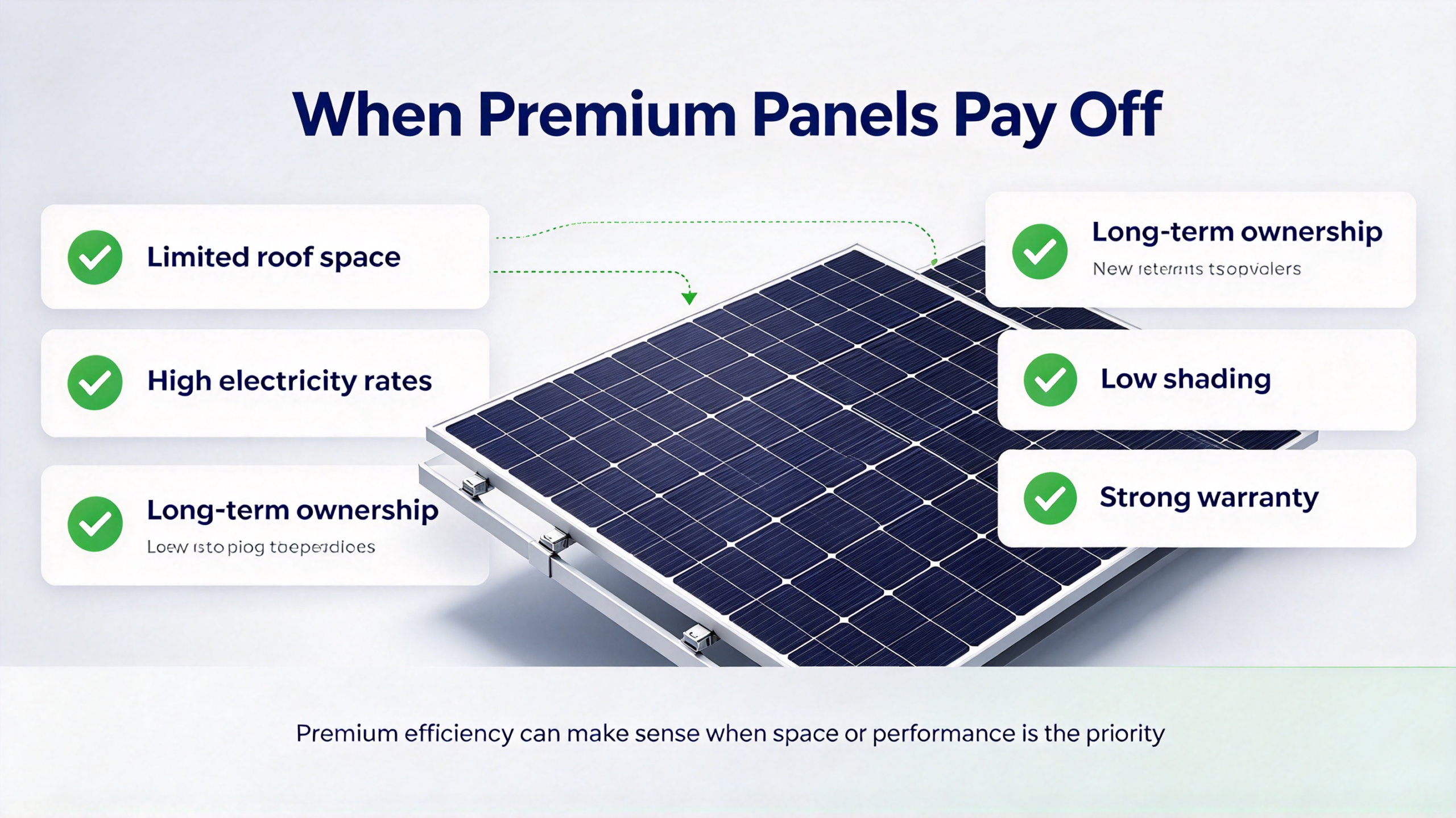
Three situations where the premium genuinely earns its money:
- Your roof area is limited. A small or heavily broken-up roof cannot accept more panels, so the only way to add capacity is to add it per square metre. This is the classic case, and it is common on townhouses, older homes and any roof with dormers, vents or skylights
- Shading or awkward orientation. If only part of the roof is usable, every usable square metre has to work harder
- You are staying for decades and rates are high. Premium panels often carry a slightly lower degradation rate and a longer production warranty, which compounds over 25 years
When Standard Panels Are The Better Buy
- You have open roof space. If two more standard panels fit, adding them beats upgrading what you already have, usually for less money
- You are moving within a few years. Efficiency pays back over decades, not over three years
- Budget is the binding constraint. Spending the premium on more capacity or on a battery usually returns more than spending it on a better cell
- Simple rectangular roof, no shade. The conditions that make efficiency valuable are exactly the conditions you do not have
The Numbers: What The Premium Actually Costs
| Panel tier | Efficiency | Typical wattage | Power per m2 | Premium you pay |
|---|---|---|---|---|
| Standard | 17-19% | 350-400 W | approx. 190 W/m2 | baseline |
| Mainstream premium | 20-21% | 400-430 W | approx. 210 W/m2 | roughly 10-20% more per panel |
| High efficiency | 22-23% | 420-450 W | approx. 230 W/m2 | roughly 20-35% more per panel |
The gap looks bigger than it is, because the percentage applies to the panel price rather than the whole installation. On an installed cost of $2.50-$3.50 per watt, a 25% panel premium usually moves the total by a few percent – and the question becomes what else that same money could buy, such as an extra panel or part of a battery.
For a full breakdown of where the money goes in a quote, see our guide to solar installation cost in 2026, and for the wider product picture, our comparison of the best solar panel brands.
Why Heat And Shade Matter More Than Efficiency
This is the part buyers miss, and it is worth more money than the efficiency rating.
- Temperature coefficient. Output falls as a panel heats up. A good coefficient is around -0.30% per degree C, a weaker one -0.40%. Over a hot summer that gap can cost more energy than the difference between an efficient panel and a standard one
- Shade tolerance. How a system handles shade depends far more on the inverter design and the number of power trackers than on panel efficiency
- Soiling and tilt. Dust, pollen and a poor tilt angle each cost production every single day
A standard panel with a good temperature coefficient, clean glass and an unshaded roof will beat an expensive panel fighting heat and shade. This is why the efficiency number belongs at the end of the comparison, not the beginning.
The Simple Test
Answer these three questions and the decision usually makes itself:
- Can two more standard panels fit on the roof? If yes, add panels instead of efficiency
- Is the roof unshaded and reasonably south-facing? If yes, efficiency is a small factor, not a deciding one
- Will you still own this house in 15 years? If no, the premium has less time to work
Two or more “yes” answers point toward standard panels and more of them. Two or more “no” answers point toward efficiency, because you are buying capacity per square metre rather than capacity in general.
Common Mistakes
- Comparing panels by wattage only. Two 400W panels can differ by 15% in physical size, which is the number that matters on a tight roof
- Assuming premium means more annual energy. In the same conditions, a 400W panel produces what a 400W panel produces
- Ignoring the inverter. A high-efficiency array clipped by an undersized inverter loses more than the upgrade gained
- Paying for efficiency on a large roof. The most expensive way to buy watts you could have bought cheaply
- Forgetting degradation. The annual losses add up over 25 years, and the difference between tiers is real – just smaller than most sales conversations suggest
If total system size is still unclear, work that out first with our simple method for how many solar panels you need – the efficiency question only makes sense once you know the target.
FAQ
Are more efficient solar panels worth the extra cost?
Only when roof space is the limiting factor. If you can fit more standard panels, adding one usually delivers more energy for less money than upgrading to a higher-efficiency panel.
Do higher-efficiency panels produce more electricity?
Not at the same wattage. A 400W panel at 22% efficiency and a 400W panel at 19% produce the same energy in the same conditions – the difference is the physical size of the panel, not its output.
How much more do high-efficiency panels cost?
Typically 10-35% more per panel depending on the tier. Because that premium applies to the panel price rather than the whole installation, the effect on the total system cost is usually a few percent.
Do efficient panels perform better in hot weather?
Sometimes, because premium panels often have a better temperature coefficient. That is a genuine advantage in hot climates, but check the actual coefficient on the datasheet rather than assuming it comes with the price tag.
What efficiency should I look for in a solar panel?
20-21% is a comfortable middle for most homes. Above 22% is worth considering when space is tight. Below 19% is usually fine on a large open roof where more panels can simply be added.