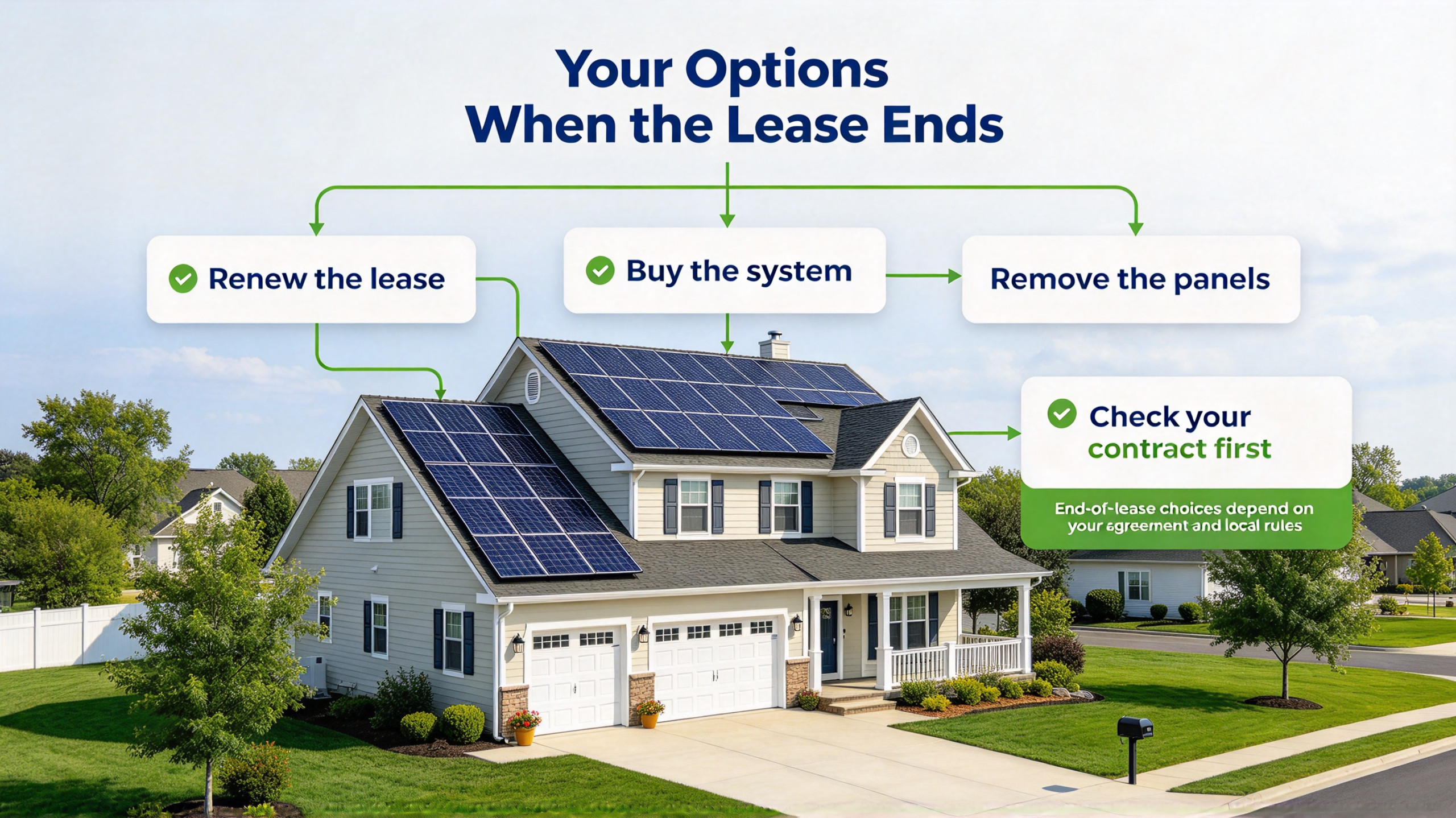
TL;DR: When a solar lease ends, you normally have four options: buy the system at a buyout price, renew the lease for another term, have the company remove the panels, or transfer the agreement to a buyer if you are selling the house. The buyout price comes from a schedule written into your original contract and drops every year – it is not based on what the used equipment is worth. The single most important thing you can do is read that schedule and your notice deadline two years before the term ends, not after.
A wave of residential solar leases signed between roughly 2008 and 2015 are running out right now, and most of those homeowners have not looked at the paperwork since the day they signed it. That is how people end up auto-renewed into another five years without noticing.
Your Four Options At The End Of The Term
Buy Out The System
You pay a lump sum and take ownership of the equipment. The upside is clear: the monthly payment disappears, and the panels keep producing for you. The catch is that the buyout price is set by a formula in your contract, and the number is not the same as what a comparable used system would sell for on the open market.
Renew The Lease
Some companies offer a renewal term, usually at a lower monthly rate than you were paying. It makes sense if the system still performs well and the renewal price is genuinely below what the electricity it produces would cost you. It makes no sense if you have already paid for the equipment several times over.
Have It Removed
This is the option most people assume is free and often is not. Read what your contract says about de-installation, roof patching, and who pays for disposal. If the system is 25 years old, your roof may also be at end of life, which turns a removal into a roofing project – the same test used in whether to replace your roof before installing solar applies here.
Transfer It To A Buyer
If you are selling the house, the buyer can usually take over the lease – but only if they qualify on credit, and only if they agree to it. That is a real negotiation point in a home sale, and it is one more reason solar leases complicate closings. Buying a house with solar panels explains what a buyer’s agent will look for.
Fixed Schedule Or Fair Market Value?
There are two common structures, and it matters a great deal which one you have.
- Fixed schedule. Your contract prints a table: buyout price in year 1, year 2, year 3, and so on, declining each year. This is easy to plan around – you can look up the exact number for today’s date
- Fair market value (FMV). The buyout is based on what the system is worth at the time you ask, usually assessed by an independent appraiser the leasing company hires. These often come in lower than people expect for an older system
Either way, buyout prices fall over time and, by the final years of a term, often land in the low thousands of dollars rather than anywhere near the original retail price. Do not guess – find the schedule page in your own agreement. If there is an early-buyout table, you may find that buying out a few years early costs barely more than waiting.
The Deadline That Catches People Out
Almost every solar lease has a notice requirement near the end of the term, and it is usually 60 to 120 days before the end date. Miss it, and one of two things happens:
- Evergreen auto-renewal. The contract rolls into another term – often five years – with the same annual escalator still attached
- Forced buyout. A smaller number of contracts require you to purchase the system if you do not notify in time
Put a calendar reminder two years before your term ends. That is early enough to get the buyout quote, compare it against your remaining payments, and still have room to negotiate. It is also early enough to decide whether you want the panels gone before you list the house.
The Escalator, In Numbers
The annual escalator is the clause that decides what a lease actually costs, and it is easy to skip past because each year’s increase looks small.
Take a $120 monthly payment with a 3% annual escalator:
- The payment in year 25 is about $244 a month
- Total paid over 25 years: roughly $52,500
- With no escalator at all, the same 25 years would cost $36,000
So the escalator adds about $16,500 – and it is the reason “the monthly payment” is not the number to compare. At 1% the same lease costs around $40,800; at 3% it costs $52,500. That gap is usually bigger than the buyout.
Find your escalation rate before you decide anything. If the term is close to the end and the escalator is 3%, that is an argument for buying out sooner rather than later.
Can You Take The System With You?
This is the option almost nobody mentions, and it matters if you are moving within the same utility area.
Some leases allow the system to be relocated to your new home. It is not free and it is not automatic:
- The new roof has to be suitable – orientation, pitch and enough structural capacity
- Re-installation, new permits and a new interconnection application are on you
- The remaining term and the escalator come with it, unchanged
- Some contracts prohibit relocation outright, and others require the leasing company’s approval first
If you might move in the next few years, read the relocation clause now rather than after you have found the new house. It is often the difference between keeping a system you have already paid for and paying to have it taken away.
What Removal Actually Involves
- Crew and time: one to two days for a typical residential array
- Roof work: every mounting foot leaves a penetration that has to be sealed or patched
- Electrical work: disconnecting the inverter, the DC conductors, and the AC disconnect
- Disposal: panels are electronic waste and are banned from regular landfills in several states
Some contracts state that removal at the end of the term is the company’s cost. Others push it to the homeowner. Either way, get the answer in writing before the term ends rather than on the day the truck arrives.
Checklist: Two Years Before The Term Ends
- Find your contract and photograph the buyout schedule and the notice clause
- Get the current buyout quote in writing
- Compare it against the total of your remaining monthly payments
- Check the system’s actual production against its first-year numbers, so you know what you are buying
- If you might sell, ask the leasing company now about the transfer process and the buyer’s credit requirements
- If you might move, ask about relocation
Is A Buyout Worth It, Or Should You Start Over?
One more angle: if your lease is nearly over and the buyout looks attractive, compare it against today’s prices for a new system.
Twenty-five-year-old panels produce meaningfully less than when they were new, and modern modules put out considerably more power per square foot. New financing may beat a buyout on an aging array. Solar loans and financing covers what owning outright looks like today.
What To Look For In The Contract
- Annual escalator. A 1-3% yearly increase adds up to a large sum over 25 years. Know your rate
- Auto-renewal wording. Search the contract for “renew”, “extend” and “evergreen”
- UCC filing or lien. Many leases place a fixture filing on the system. That shows up during a home sale and needs clearing
- Relocation clause. Whether the system can move with you, and who pays
- End-of-term obligations. Some contracts spell out removal fees that are easy to miss in the fine print
FAQ
Do I have to buy the system when the solar lease ends?
No. Renewing, removal and transfer are all realistic options in most contracts. A small number of agreements require purchase if you miss the notice window, which is why the notice clause matters so much.
What is a solar lease buyout?
It is the amount the leasing company charges to transfer ownership, calculated either from a fixed schedule in your contract or from a fair market value assessment. It drops over time and is often in the low thousands by the final years.
Does the lease company remove the panels for free at the end?
Usually not. Some contracts cover removal at end of term and others charge for it, and roof patching and disposal may be extra. Plan on roughly $1,500-$3,000 plus patching if it falls to you.
What happens if I miss the notice deadline?
In many contracts it auto-renews for another term on the same escalating rate. In others you are obligated to buy. Never let the deadline pass without acting.
Is it better to buy out or keep leasing?
Leases usually win on upfront cost and lose badly on lifetime cost. If you are staying in the house, buying or financing generally costs less over 25 years – see the pros and cons of leasing solar panels for the side-by-side.
How do I get out of a solar lease early?
Usually by buying it out. Check whether your contract has an early-buyout schedule – many do, and the price a few years early is often close to waiting. If you are moving, ask about relocation instead: moving the system to your new home can be cheaper than buying out or removing it, provided the new roof qualifies.
What does it cost to remove solar panels at the end of a lease?
Roughly $1,500-$3,000 for a typical residential array, before roof patching and disposal. Disposal is not trivial either – panels are electronic waste and several states ban them from regular landfills.
Next up: Selling a House With Solar Panels: What Happens to the System
1 thought on “What Happens When a Solar Lease Ends?”