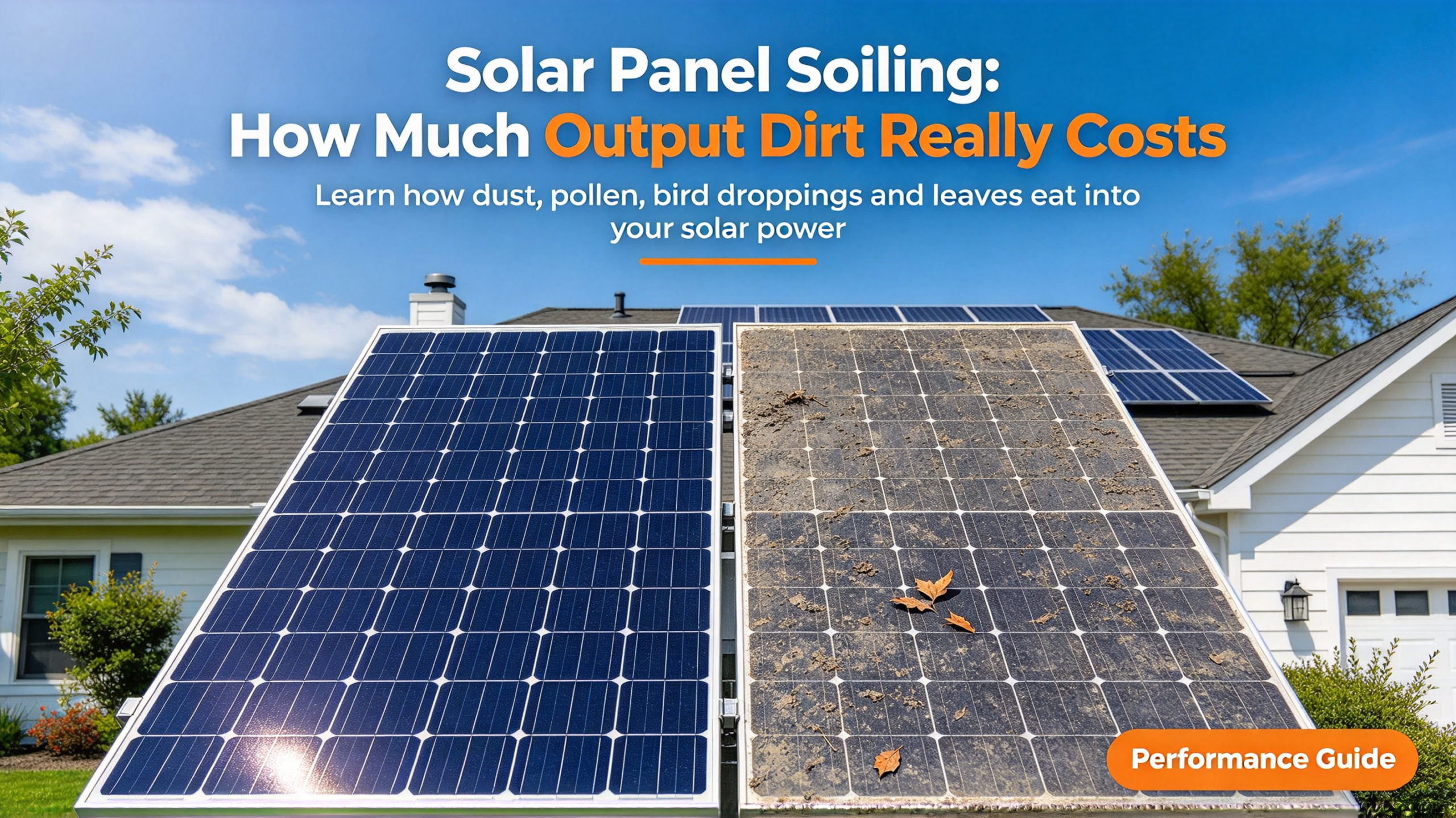
TL;DR: Solar panel soiling is dirt on the glass, and the output loss ranges from about 1-3% for a light dust film to 5-15% for heavy pollen, construction dust, wildfire ash or widespread bird droppings. Rain helps with light dust but can leave muddy spots and does not remove stuck droppings. Measure the loss before cleaning: if a professional wash costs more than the lost kWh are worth, wait.
Soiling is reversible. Degradation is not. That distinction matters because a dirty panel can look like a failing system, and an expensive cleaning can be sold as a fix for a problem that is really shade, a bad string or a failing inverter.
Solar Panel Soiling: Short Answer
Soiling is anything on the glass that blocks light: dust, pollen, bird droppings, ash, salt, agricultural spray or construction residue. A light film usually costs a few percent. A heavy, uneven layer can cost much more, especially when one panel is dirtier than its neighbours. Cleaning pays when the recovered energy is worth more than the wash.
What Counts as Soiling
| Type | Typical source | Typical output effect |
|---|---|---|
| Light dust film | Roads, dry air, general dust | About 1-3% |
| Pollen | Trees, grasses, seasonal bloom | About 2-6% |
| Bird droppings | Birds, roosting nearby | Local hot spots; 5-15% if widespread |
| Construction dust | Concrete, gravel, nearby work | About 5-15% until rinsed |
| Wildfire ash | Smoke and airborne ash | About 5-15%, plus a stubborn film |
| Salt film | Coastal spray | About 3-8% and possible frame corrosion |
| Snow | Winter accumulation | Near 100% while covered |
The ranges are illustrative. A light film is not a crisis; a thick, uneven layer is. Bird droppings deserve prompt attention because they can create a hot spot, not just a uniform loss. Snow is not soiling in the usual sense, but it belongs in the same conversation because it blocks the light completely.
How Much Output It Costs
The cost is not just the percentage on the panel. It is the lost kWh multiplied by the value of that energy. A 5% loss on a system producing 10,000 kWh a year is 500 kWh. At $0.20 per kWh, that is about $100 a year.
| Annual production | Soiling loss | Lost kWh | Value at $0.20/kWh |
|---|---|---|---|
| 8,000 kWh | 3% | 240 kWh | $48 |
| 8,000 kWh | 8% | 640 kWh | $128 |
| 10,000 kWh | 5% | 500 kWh | $100 |
| 10,000 kWh | 10% | 1,000 kWh | $200 |
| 12,000 kWh | 12% | 1,440 kWh | $288 |
This is why “clean your panels” is not automatically good advice. A $300 professional wash on a system losing $48 a year is a bad purchase. The same wash on a heavily soiled array losing $300 a year may be reasonable. The numbers decide.
Why Rain Is Not Enough
Rain helps, but it is inconsistent. A light shower can turn dust into muddy spots that bake on. A heavy, steady rain can rinse a tilted array fairly well. Bird droppings, tree sap and construction dust often survive both.
Rain also does not reach the lower edge of a panel evenly, and it does not clean the frame or the gaps where debris collects. After a long dry spell, the first rain can make the glass look worse before it looks better. Do not assume a rainy month means the array is clean.
How to Measure Soiling
| Method | What it tells you | Limits |
|---|---|---|
| Same-month comparison | Whether output is below last year | Weather varies; one month is not enough |
| Normalized yield | Production per installed kW | Needs consistent monitoring |
| String or module data | Whether one panel or string is dirtier | Requires per-string or per-module monitoring |
| Before/after cleaning | The actual recovery | Compare similar sun and temperature |
| Visual check from the ground | Visible film, droppings or debris | Cannot measure a thin film accurately |
| Soiling station or test coupon | A controlled sample of the local dust | More common in commercial systems |
For a homeowner, the practical method is to compare the same month year over year, then clean and compare a similar sunny period. Do not use one cloudy day as proof. The monitoring basics are in solar panel monitoring.
When Cleaning Pays
The break-even soiling loss is cleaning cost divided by the value of annual production. If a wash costs $200 and the annual energy is worth $2,000, the wash only pays if the soiling loss is above 10%.
| Annual energy value | Cleaning cost | Break-even soiling loss |
|---|---|---|
| $1,000 | $150 | 15% |
| $1,600 | $200 | 12.5% |
| $2,000 | $200 | 10% |
| $2,400 | $300 | 12.5% |
| $3,000 | $300 | 10% |
A DIY wash with a hose and soft brush costs almost nothing, so the break-even is much lower. A professional wash on a steep roof has a real labour and safety cost. That is why the same soiling level can justify cleaning on one house and not another. Cleaning prices are in solar panel cleaning cost.
Safe Cleaning Method
| Safe | Why | Avoid |
|---|---|---|
| Garden hose with gentle spray | Lifts loose dust without pressure | Pressure washer |
| Soft brush or microfiber cloth | Removes film without scratching | Abrasive pad or steel wool |
| Plain or filtered water | Leaves fewer mineral spots | Hard water final rinse |
| Early morning or late afternoon | Glass is cool; less evaporation | Hot midday glass |
| Mild soap for bird droppings | Soaks the spot | Bleach, acid or solvent |
| Ground-level tools | Keeps you off the roof | Walking on panels |
Rinse first, then wash, then rinse again. Work in sections and do not let soap dry on the glass. If the array is steep, high or fragile, hire a professional. The full method is in solar panel cleaning tips, and the wider routine is in solar panel maintenance tips for beginners.
Cleaning Frequency by Environment
| Environment | Typical schedule | Watch for |
|---|---|---|
| Normal suburban roof | 1-2 times a year | Visible film or dull glass |
| Heavy pollen | After pollen season, then autumn | Yellow film, sap, bird droppings |
| Dust, gravel or farmland | Every 3 months in the dry season | Brown dust after wind |
| Coastal salt | Every 2-3 months | Salt film and frame corrosion |
| Wildfire ash | After ash settles and roof is safe | Dark ash, grit, cloudy film |
| Snow country | Do not chase every snowfall | Use a soft roof rake from the ground |
Do not clean on a fixed calendar if the glass is visibly clean. Do clean before a heavy soiling layer bakes on. The climate-specific schedule is in solar panel cleaning frequency.
Common Mistakes
- Assuming rain cleaned the panels. Light rain can leave muddy spots.
- Using a pressure washer. It can force water past the frame seal.
- Scrubbing dry grit. Rinse first or the brush becomes sandpaper.
- Cleaning hot glass. Water evaporates and leaves streaks.
- Paying for a wash without measuring the loss. The energy recovered may be worth less than the service.
- Confusing soiling with degradation. Dirt is reversible; cell ageing is not.
- Walking on the roof. A fall costs more than a dirty panel.
Conclusion
Solar panel soiling is a reversible output loss, and the cost depends on the type of dirt, the array size and the value of the energy. Light dust may cost 1-3%; heavy pollen, ash or droppings can cost much more. Measure before cleaning, compare the same month year over year, and use the break-even calculation. A safe wash with water and a soft tool is cheap; a professional wash needs a real energy loss to justify it.
FAQ
How much does solar panel soiling reduce output?
A light dust film may cost about 1-3%. Heavy pollen, construction dust, wildfire ash or widespread bird droppings can cost 5-15% or more, especially on one dirty panel or string.
Does rain clean solar panels?
Rain removes some loose dust, but light rain can leave muddy spots and does not remove bird droppings or sap. A heavy, steady rain on a tilted array does more.
How do I measure soiling loss?
Compare the same month year over year, use normalized yield, and compare a similar sunny period before and after cleaning. One cloudy day is not a measurement.
When is professional cleaning worth it?
When the recovered energy is worth more than the wash. Divide the cleaning cost by the annual energy value to get the break-even soiling percentage. A $200 wash on $2,000 of annual energy needs a 10% loss to break even.
Can dirty panels damage the system?
Usually they just reduce output. Heavy, persistent bird droppings can create a hot spot, and long-term neglect can make the dirt harder to remove. Clean before it bakes on.
Do I need to clean the panels every year?
Not always. Many homes need one or two washes a year; dusty, coastal or agricultural sites may need quarterly cleaning. Clean when the glass is visibly dirty or the data shows a loss.
What is the safest way to clean solar panels?
Use a garden hose, a soft brush or microfiber cloth and plain water, early in the morning when the glass is cool. Never use a pressure washer, abrasive pad or metal scraper.
Can I use dish soap?
A small amount of mild dish soap is fine for bird droppings or sap, but rinse thoroughly. Avoid bleach, solvents, acids and abrasive cleaners.
Why are my panels dirty again so quickly?
Nearby roads, fields, construction, trees, coastal salt or flat tilt can increase soiling. Check the source before increasing the cleaning frequency.
Does soiling look like degradation?
It can. Both reduce output. Soiling is reversible after cleaning; degradation is a permanent loss. Compare before and after a wash to separate them.
Can snow be treated like soiling?
Snow blocks output completely while it covers the glass. Do not climb on the roof; use a soft roof rake from the ground only if it is safe.
Is it worth cleaning a small array?
Often yes if you can do it safely yourself. A small array has less energy to recover, so a professional visit may not pay. DIY with a hose and soft tool is usually the right answer.
Related: Solar Panel Cleaning Tips