TL;DR: Can you mix different solar panels in one array? Usually yes, and most DIY setups do. The catch is that panels in the same string behave like a team with one slow runner – the whole string runs at the pace of the weakest panel. Match the ratings within about 5%, keep different panels on separate MPPT inputs if you can, and mismatching costs you a little. Ignore it and it can cost you a lot.
Why Panels In One String Have To Agree
A solar panel is not a battery. It is a current source, and it has opinions about voltage.
- In series – voltages add up, but the current is set by the lowest-current panel. One weak panel throttles the whole string
- In parallel – currents add up, but the voltage is set by the lowest-voltage panel. A big voltage difference makes the stronger panel push current backwards into the weaker one
That backward current is not just wasted energy. It is heat, and heat in a shaded or mismatched panel is how hot spots start.
The Three Numbers On The Nameplate That Matter
Ignore wattage for a moment. Wattage is the marketing number. These are the working numbers:
- Vmp – voltage at maximum power. This is the one to match first
- Imp – current at maximum power. Match this if the panels go in one series string
- Voc – open circuit voltage. Matters for the controller’s maximum input voltage, not for matching
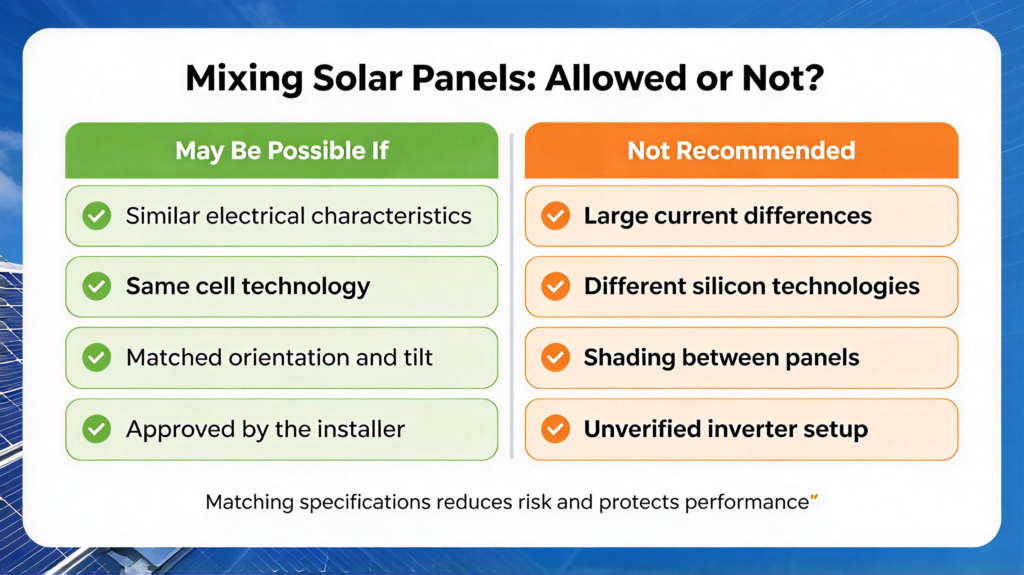
The practical rule: if Vmp differs by less than about 5%, panels play nicely. Between 5% and 10% you lose a few percent of output. Beyond 10%, do not put them in the same string.
What Actually Happens When You Mix
Three common real-world cases:
Same voltage, different wattage. A 100W and a 200W panel with the same Vmp in parallel – this usually works fine. Voltages agree, currents just add.
Different voltage, same string. This is the one that hurts. The string current drops to the lowest Imp, and the higher-rated panel does the work of the lower one.
Old panel plus new panel. The most common mistake. A ten-year-old panel has lost a few percent of its current, so in a series string it sets the ceiling for everything. On its own the loss is small. Added to three new panels, it can cost more than the old panel was ever worth.
Where MPPT Helps – And Where It Does Not
An MPPT charge controller tracks the best operating point for the array. That is genuinely useful, and it protects you from small mismatches.
But it tracks the array as one thing per input. If your mismatched panels share one input, the controller optimises a compromise. It cannot fix a bad pairing, only find the least-bad operating point for it.
The real fix is per-panel electronics: microinverters or DC optimisers. Each panel gets its own tracking, so a weak or shaded panel only loses its own output. If you know your array will be mismatched or partly shaded, this is where the money should go.
The Practical Checklist Before You Wire Anything
- Read the nameplates. Write down Vmp and Imp for every panel, including the old ones
- Group panels with Vmp within 5%. Those can share an MPPT input
- Do not put different voltages in one series string. Ever
- Give each group its own MPPT input if your controller has more than one
- Check the controller’s maximum Voc. Series strings add voltage, and cold weather raises it
- If the groups are very different, use separate controllers rather than forcing them together
One more: mix panels freely if you follow the rules above, but do not mix battery chemistries or voltages on the same charger. That mistake costs more than a few percent – it damages hardware. Battery behaviour is a different subject, covered in how long solar batteries last.
Worth Knowing: Mismatch Is Not Always Visible
A mismatched string does not fail. It just quietly underperforms, and the loss looks like weather.
That is why system monitoring matters if you have built a mixed array: compare the mixed string against a clean one on the same day. If it is consistently several percent lower, the mismatch is costing you more than you assumed. The same logic applies to panels that have degraded naturally, which is what panel degradation looks like in the numbers.
FAQ
Can I mix 100W and 200W solar panels?
Usually yes, provided their Vmp is close. Put them in parallel if voltages match; do not put them in one series string unless the current ratings are similar, because the string will run at the lower current.
Can I mix old and new solar panels?
You can, but the old panel usually becomes the bottleneck in a series string, because its current has dropped with age. For one extra panel on a small setup the loss is minor. Adding an old panel to three new ones is usually a waste of the new panels’ capacity.
Can I mix different brands of solar panels?
Yes. Brand is irrelevant. What matters is the electrical ratings on the nameplate – Vmp and Imp specifically. Two different brands with matching ratings behave like matching panels.
Do mixed panels damage the inverter?
Not directly, as long as voltage limits are respected. The real risks are lost output and, in bad mismatches, reverse current that creates heat in the weaker panel.
Will mismatched panels cause a fire?
Not on their own, but sustained reverse current in a mismatched or shaded panel is one of the ways hot spots form, and hot spots are the failure mode that can damage the backsheet. If a panel in a mixed array is running visibly hotter, separate it from the string.
Do I need an MPPT controller for mismatched panels?
An MPPT controller helps, but it optimises the whole input, not each panel. If your array is genuinely mixed, per-panel microinverters or optimisers solve the problem properly.
1 thought on “Can You Mix Different Solar Panels? What Actually Happens”