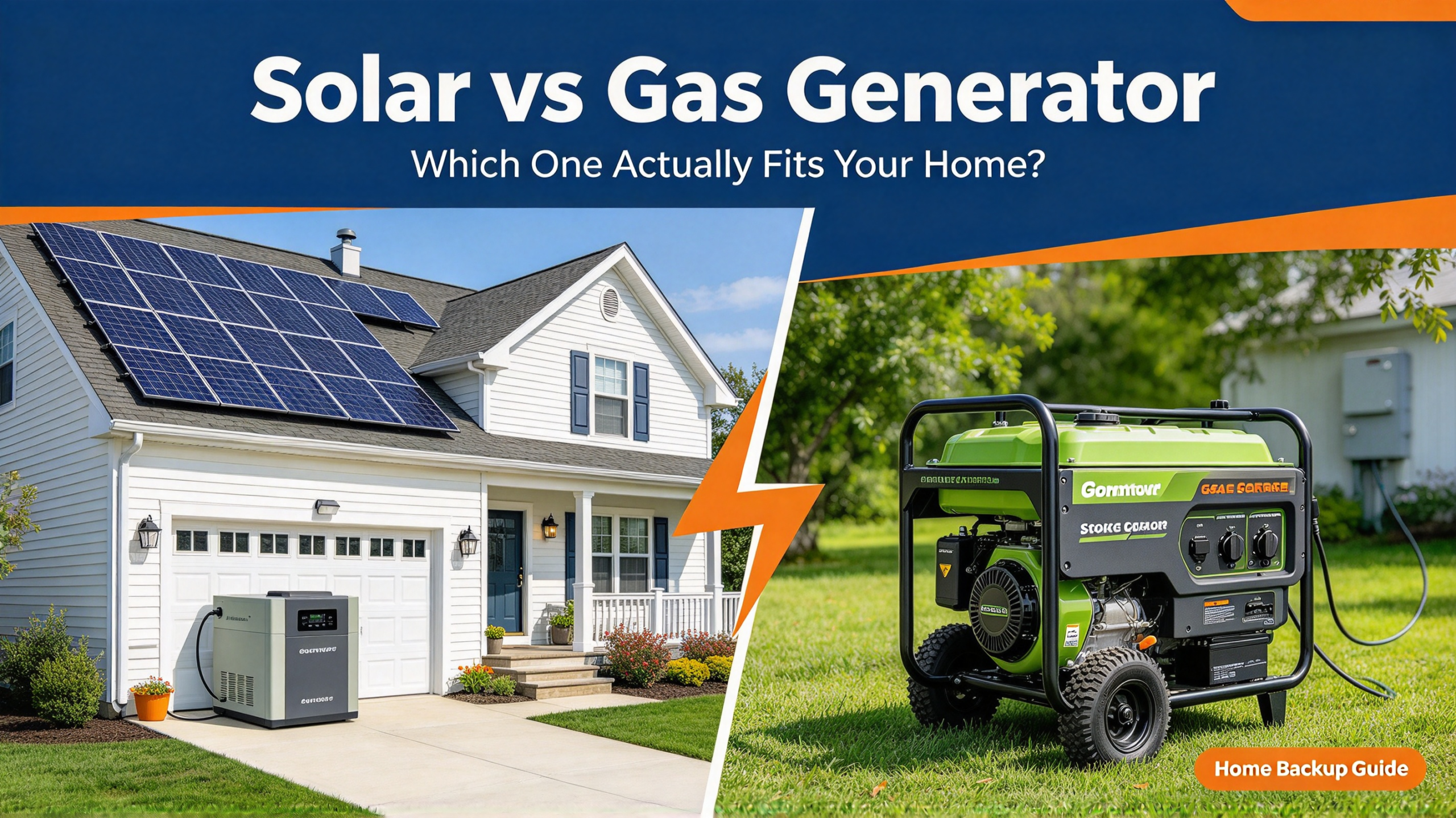
TL;DR: They are not the same product doing the same job. A gas generator is cheap up front, runs for as long as you feed it fuel, and must never run indoors. A solar generator (a battery with an inverter) is silent, has no exhaust and is safe inside, but it runs out when the battery does. Choose by how long your outages actually last: hours, or days.
First, The Two Different Jobs
Most of the confusion is people comparing the wrong pair of things.
- Short outages, small loads. Router, fridge, laptop, lights, phone. A battery is the better tool
- Long outages, or heavy loads. Well pump, furnace fan, air conditioning, several days off grid. Fuel or a proper standby system is the better tool
“Solar generator” is a battery with an inverter built in. It does not generate anything – the panels that charge it are separate. Worth saying out loud, because the marketing does not.
Side By Side
| Solar generator (power station) | Gas generator | |
|---|---|---|
| Up-front cost | Higher per kWh of capacity | Lower – a few hundred dollars for a small unit |
| Running cost | Near zero if recharged from a wall or existing solar | Fuel, and fuel does not store forever |
| Runtime | Fixed by battery size – then it is empty | As long as you keep refuelling |
| Noise | Silent | Loud enough that neighbours notice |
| Indoor use | Safe | Never – carbon monoxide |
| Maintenance | None | Oil, filters, fuel stabiliser, starting it up before you need it |
| Power quality | Clean, inverter-based | Conventional units are dirtier; inverter generators are cleaner |
The One Rule That Matters Most
Never run a gas generator indoors, in a garage, in a shed, or near an open window or door. Not “with the door open”. Not “just for ten minutes”.
Carbon monoxide is colourless and odourless, and generator exhaust kills people every year during outages – usually because the unit was moved somewhere sheltered so it would not get wet or be stolen. If it burns fuel, it goes outside, well away from any opening.
That single safety constraint is why a battery is the easier answer for an apartment, a basement flat, or anyone who cannot put a generator in a yard.
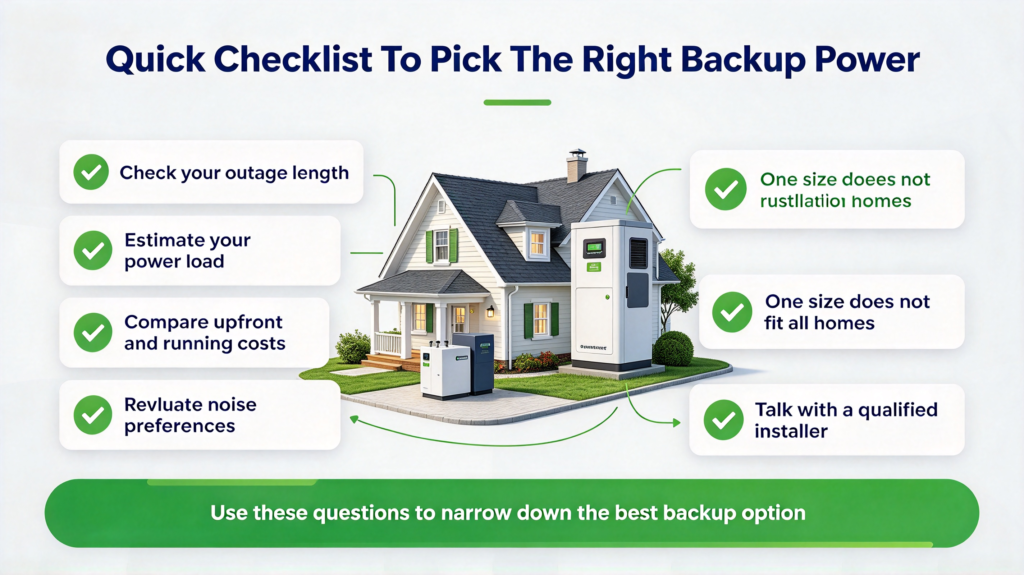
Choose By Outage Length
This is the decision, and it is mostly arithmetic.
- Outages of a few hours, a few times a year – a battery sized to your critical loads is enough, and you never touch fuel
- One to two days – a larger battery, or a battery plus a small generator for topping up. Running a generator for two hours to recharge a battery is far cheaper than running it for forty
- Three days or more, regularly – a standby generator, or a home battery plus a generator. This is where fuel wins on pure capacity and loses on noise, maintenance and safety
If you already have solar, the maths changes again, because you can recharge a battery from the roof. That is what turns a battery from a one-shot reserve into something that survives a multi-day outage. Battery life matters less than people think here – capacity and recharge rate are the two numbers that decide whether you get through the night.
What Most Households Actually End Up With
A small battery for the frequent short outages, and something with fuel for the rare long one. The combination sounds like overkill until you price one spoiled fridge load, and then it usually looks reasonable.
Sizing the battery is where people overspend. A power station rated at 1 kWh does not run a fridge for a day – the usable capacity is less, the fridge compressor cycles, and the inverter loses some in conversion. Work backwards from the actual wattage of the things you refuse to lose, not from the biggest number on the box. Solar batteries and portable power stations are the same chemistry doing different jobs.
FAQ
Is a solar generator better than a gas generator?
For short outages and indoor use, yes – it is silent, has no exhaust and needs no maintenance. For long outages or heavy loads such as a well pump or air conditioning, no – a battery runs out and a gas generator does not.
Can a solar generator run a whole house?
A portable one cannot for more than a short period. Running a whole house for days needs an installed home battery, typically 10 kWh and up, and even then it depends on which circuits you put on the backup panel.
Can I run a gas generator indoors?
No, under any circumstances. Carbon monoxide from generator exhaust kills people during outages every year, often when a unit is moved into a garage or shed to keep it out of the rain. Outside only, away from windows and doors.
How long can a solar generator run a fridge?
Depends on the fridge, the battery’s usable capacity and the ambient temperature. A fridge that averages around 100W draws roughly 2.4 kWh over a day, so a small power station measurably does not cover a full day, while a midsize one with a few hundred watts of solar input can.
Do I need both a battery and a generator?
Plenty of households in storm-prone areas end up with both. The battery carries the short outages with no fuel and no noise, and the generator handles the rare multi-day event by recharging the battery rather than running the house directly.
What about a standby generator?
It is a permanent install, runs on propane or natural gas, exercises itself weekly and needs annual servicing. It handles heavy loads a battery cannot, and it costs several thousand dollars installed. It is the answer for regular multi-day outages, not for two-hour blips.
2 thoughts on “Solar vs Gas Generator: Which One Actually Fits Your Home”