TL;DR: Series vs parallel solar panel wiring comes down to two rules. In series, voltages add up and current stays the same. In parallel, currents add up and voltage stays the same. Series is the standard for home systems because higher voltage means thinner wire and lower losses over distance, while parallel wins when part of the array is shaded or when your charge controller has a low maximum input voltage. Most real systems use both at once.
Two panels and two ways to connect them, producing the same watts but behaving completely differently. Getting this right decides how much wire you need, how much power you lose, and whether one shaded panel shuts down the whole array.
Series vs Parallel Solar Panel Wiring: The Two Rules That Explain Everything
- Series: voltage adds, current stays the same.
- Parallel: current adds, voltage stays the same.
Take two 100W panels, each rated 22V open-circuit (Voc) and 5A short-circuit (Isc):
- Series: 44V at 5A. Same watts, double the voltage.
- Parallel: 22V at 10A. Same watts, double the current.
That is the entire concept. Everything else is consequences.
Series Wiring: How It Works
Connect the positive of one panel to the negative of the next, like batteries in a flashlight. The string’s voltage is the sum of every panel’s voltage, and the current stays at whatever one panel can produce.
- Higher voltage means less wire loss. Voltage drop over a long run depends on current, so the same wire carries the same power much further at higher voltage. This is why home arrays are wired in series — the run from the roof to the garage can be 100 feet or more.
- Thinner, cheaper wire. Lower current means smaller gauge for the same loss.
- One shaded panel can drag the whole string down. In a series string, current is limited by the weakest link. Unless you add power optimizers, partial shade on one panel cuts output from every panel behind it.
Parallel Wiring: How It Works
Connect all the positives together and all the negatives together. Voltage stays at one panel’s level, and the current adds up.
- Shade tolerance. If one panel is shaded, the others keep producing at close to full output. This is the main reason small off-grid systems use parallel wiring.
- Lower voltage limits your distance. Moving 10A at 22V over 50 feet needs much heavier wire than moving 5A at 44V. Parallel systems usually sit close to the controller for this reason.
- Needs fusing and a combiner. Each parallel string normally needs its own overcurrent protection and a combiner box, which adds cost and complexity.
If shade is your main concern, this is also why microinverters exist — they get parallel-like behavior while keeping the array at household voltage. How much shading is too much covers when the problem is big enough to change your design.
The Cold Weather Trap Nobody Warns You About
Panel voltage rises as temperature falls. A string that reads 300V on a warm day can climb toward 340V or higher on a freezing morning. That is a real safety issue, not a technicality.
Every charge controller and inverter publishes a maximum input voltage, and exceeding it destroys the unit — sometimes with a bang. When you size a series string, always use the record low temperature for your area, not the average, and apply the panel’s voltage temperature coefficient from its datasheet. Series wiring is the right choice in most cases, but only if the cold-weather math clears the limit with real margin.
Which One Should You Use?
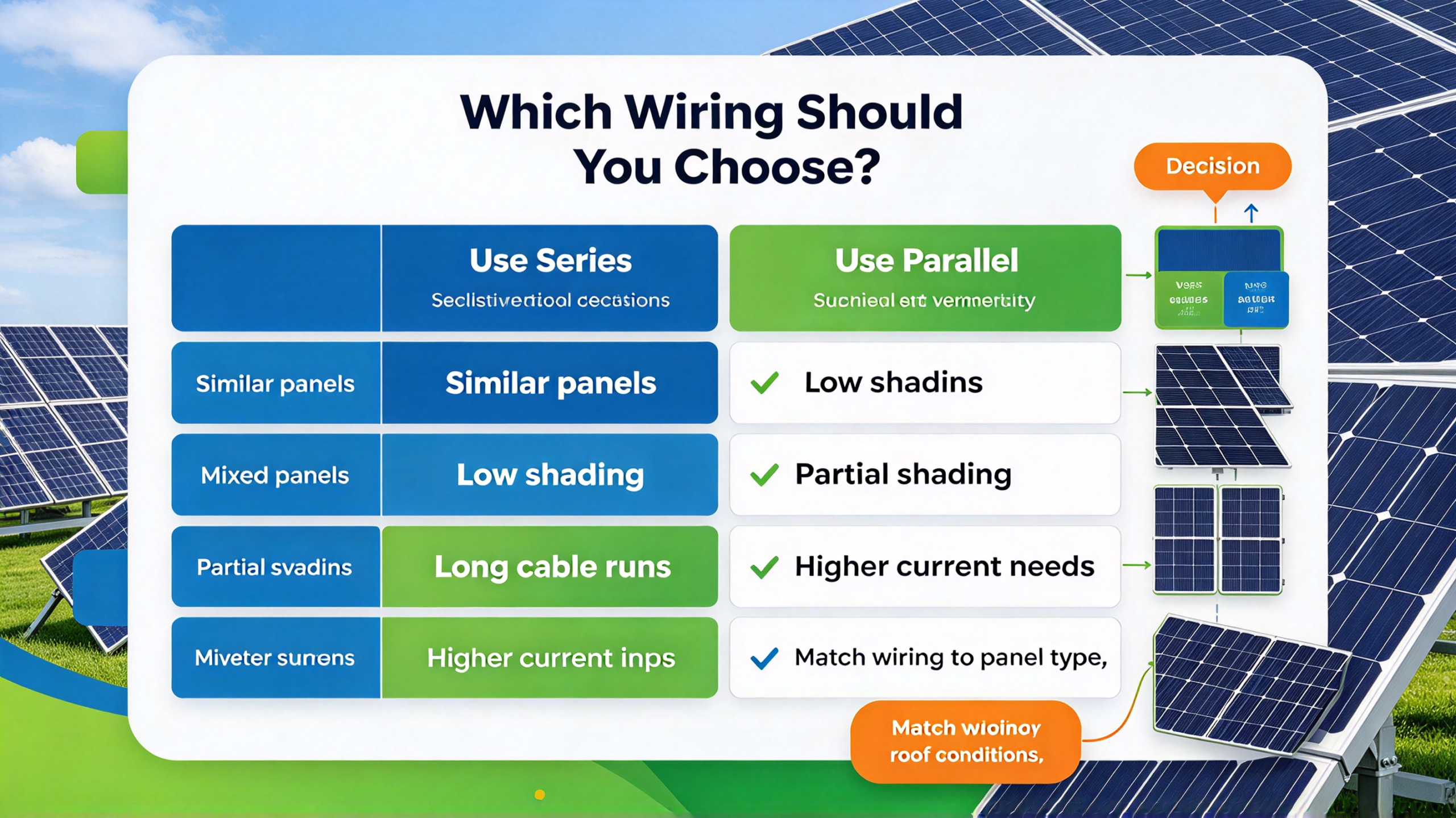
The right answer depends on your controller, your wire run, and how much shade you have. Work through this list for your own series vs parallel solar panel wiring decision:
- Grid-tied home: series. High voltage is what the string inverter wants, and it keeps wire losses low over a long roof-to-garage run.
- Off-grid cabin with an MPPT controller: series, sized to stay under the controller’s voltage limit. MPPT controllers convert the extra voltage into usable charging current.
- Small kit with a PWM controller: parallel, or a short series string, because PWM controllers cannot step voltage down efficiently.
- Partially shaded array: parallel, microinverters, or series with power optimizers.
- Very long wire run: series, without question. Higher voltage is how you keep the loss reasonable.
MPPT versus PWM is the part most beginners miss, and it changes the right answer. Choosing the right solar charge controller explains the difference in plain terms.
Series-Parallel: What Most Real Systems Do
Large arrays usually combine both. Panels are wired in series to build voltage, then several of those strings are wired in parallel at a combiner box to build current. A typical off-grid or commercial array might have three strings of eight panels each, all combined into one feed.
This gets you the wire efficiency of high voltage and the fault tolerance of parallel strings — but combined strings of unequal length or unequal panel models will underperform, so matching matters.
Wiring Rules You Should Not Skip
- Never exceed the equipment’s maximum system voltage, and always calculate it at your record low temperature.
- Fuse each parallel string. If one string faults, the other strings will feed current backward into it. That is what the fuse is for.
- Match MC4 connector brands. Mixing brands is a known cause of poor contact, heat, and fire. MC4 is a standard, but the tolerances are not identical between manufacturers.
- Check polarity before connecting. Reversed DC connections can destroy a controller instantly.
- Use DC-rated breakers and disconnects. AC breakers do not extinguish a DC arc, and DC arcs do not self-extinguish.
- Size wire for ampacity and voltage drop, not just for what fits the terminal.
If you are building a small system from scratch, setting up solar for an RV or van walks through the wiring in a real, step-by-step build where parallel strings are the norm.
FAQ
What is the difference between series and parallel solar panel wiring?
Series adds voltage and keeps current the same. Parallel adds current and keeps voltage the same. Total power is roughly the same either way, but the wire size, loss, and shade behavior are very different.
Does parallel wiring increase amps?
Yes. Two 5A panels in parallel produce 10A at the same voltage. That is exactly why parallel strings need heavier wire and per-string fusing.
Is series or parallel better for shade?
Parallel. In a series string, one shaded panel limits current for every panel behind it. In parallel, the unshaded panels keep working at full output.
Can I mix series and parallel wiring?
Yes, and most larger systems do. You build voltage with series strings, then build current by combining equal strings in parallel at a combiner box.
Does series wiring give me more power?
No. Series and parallel produce roughly the same total watts from the same panels. Series changes the shape of the power — higher voltage, lower current — which is often more useful, but it does not create free energy.