TL;DR: Solar carport cost in the United States runs roughly $9,000-$18,000 for a single-car structure and $18,000-$35,000 for a two-car carport, installed. That works out to about 30-60% more per watt than a rooftop system, because you are paying for a steel structure, engineered foundations and trenching on top of the panels. A two-car carport typically generates 8,600-10,000 kWh a year, which is worth roughly $1,400-$2,700 depending on your electricity rate. Expect a payback of about 10-16 years. It makes sense if you need covered parking anyway and want to charge an EV from the sun.
A solar carport sounds like an obvious upgrade: shade for your car, free electricity, and no holes in your roof. All of that is true, but it comes with a price tag that surprises many homeowners. Here is what a solar carport actually costs in 2026, what drives the number up or down, and how to decide whether it is worth it for your property.
What Is a Solar Carport?
A solar carport is a standalone structure with a steel or aluminum frame and a roof made of solar panels instead of metal sheet. It can be freestanding or attached to the side of a house or garage. Because there are no roof penetrations and no roof-angle limits, the panels can be tilted at whatever angle produces the most energy at your location.
It differs from a ground-mounted array in one important way: a ground mount exists only to hold panels, while a carport does two jobs at once. That dual purpose is the main reason people pay extra for it.
Solar Carport Cost in 2026
Pricing varies a lot by state, wind and snow load requirements, and site conditions, but these ranges cover most residential projects:
| System | Typical Installed Cost | Annual Output (Sunny State) |
|---|---|---|
| Single-car carport, 3 kW | $9,000-$18,000 | 4,300-5,000 kWh |
| Two-car carport, 6 kW | $18,000-$35,000 | 8,600-10,000 kWh |
| Two-car carport, 9 kW | $28,000-$50,000 | 13,000-15,000 kWh |
| Retrofit solar onto an existing carport | $8,000-$20,000 | Depends on roof area |
Per watt, that is roughly $3.50-$5.50 installed, compared with about $2.50-$3.50 for a typical rooftop system. For reference, a plain metal carport with no solar at all usually costs $2,500-$12,000, depending on size and finish.
| Cost per Watt Installed | |
|---|---|
| Solar carport (3-9 kW) | $3.50-$5.50 |
| Rooftop solar | $2.50-$3.50 |
| Ground mount | $2.75-$4.00 |
What Drives the Price
- Structure size and steel gauge. The bigger the span and the heavier the local wind or snow load, the more steel you need. Coastal hurricane zones and heavy-snow regions pay noticeably more.
- Foundation and engineering. Concrete footings, soil testing and stamped structural drawings can add $1,000-$3,000 on their own.
- Electrical run. Trenching from the carport to your main panel, conduit, and the inverter location all add cost, especially with long or paved runs.
- Inverter choice. Microinverters cost more upfront but simplify wiring and make panel-level faults easier to find. A string inverter is cheaper but needs a suitable mounting spot.
- Battery storage. Adding a battery can easily add $8,000-$15,000 or more.
- Permits and inspections. Usually $200-$800, but higher in some cities because the structure is treated as a building plus an electrical installation.
- EV charger integration. Running an EV charger under the carport adds roughly $500-$1,500 if the wiring is already there.
- Site preparation. Grading, removing a tree, or working on a slope all push the number up.
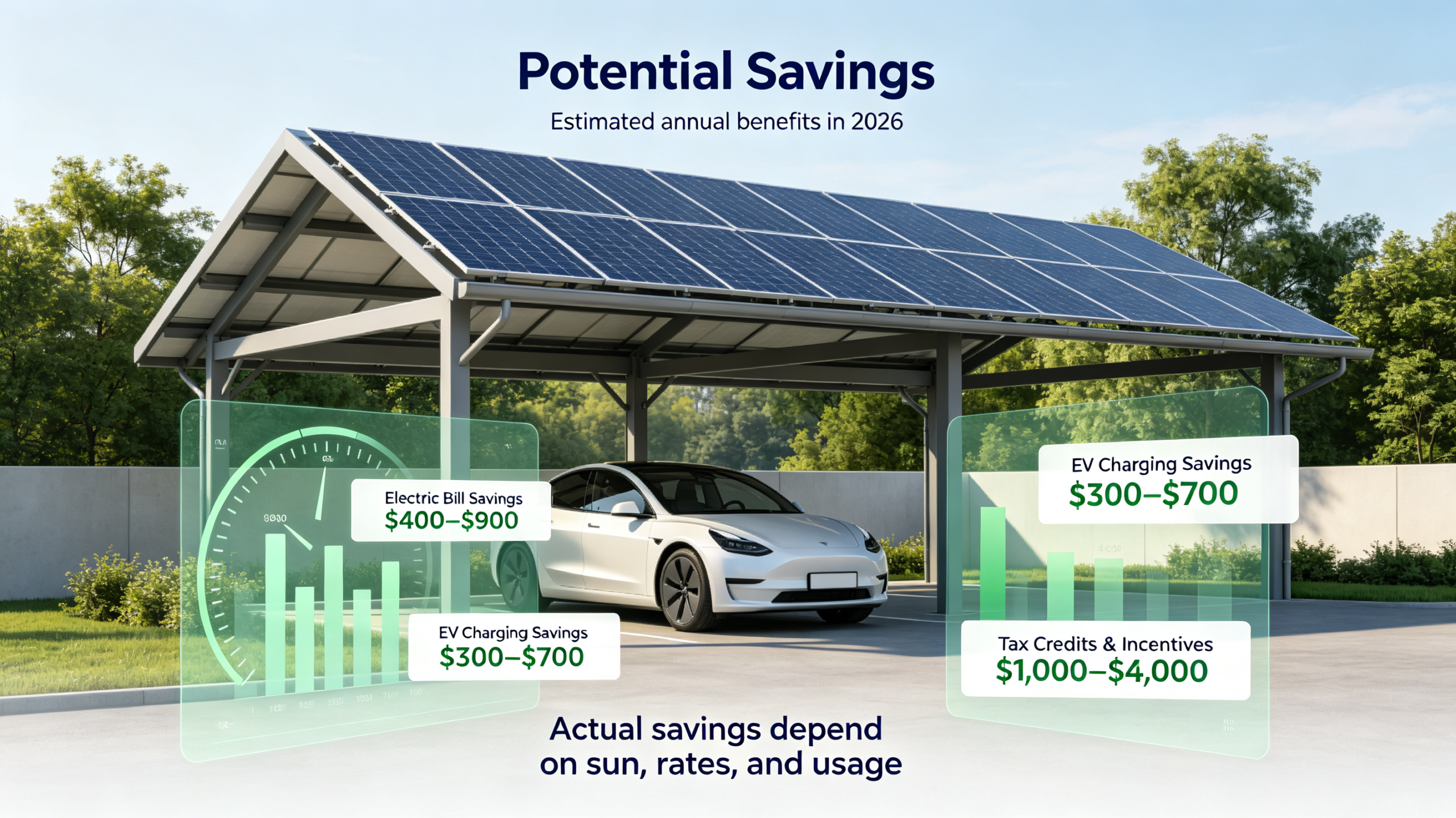
How Much You Save
Production depends on your location, tilt and shading. As a rule of thumb, every 1 kW of panels in a sunny US state generates about 1,400-1,600 kWh a year.
What that power is worth depends entirely on your electricity rate:
- At $0.16 per kWh, a 6 kW carport saves roughly $1,400 a year
- At $0.22 per kWh, the same system saves roughly $1,900 a year
- At $0.30 per kWh, it saves roughly $2,600 a year
Against a $25,000 installation, that is a payback of roughly 10 to 16 years. Rooftop solar usually pays back faster because the structure is already paid for. The honest way to look at a carport is this: you are buying covered parking and solar in one project, so compare it against the cost of building a carport plus buying the same solar separately.
Incentive rules for residential solar and for structures have changed in recent years and vary by state. Ask your installer for a written breakdown of exactly what applies to your address today rather than budgeting from last year’s articles.
When a Solar Carport Makes Sense
- You already want covered parking for one or two cars
- Your roof is shaded, old, or too small for the array you want
- You have open ground with full sun and no shading
- You are adding an EV and want to charge it from your own roof
- You plan to stay in the home long enough to reach payback
- You want to expand later — ground-level structures are far easier to extend than a roof
When It Does Not
- You only want the cheapest possible solar — a rooftop system wins on cost per watt
- Your site is shaded, or your HOA or local covenants restrict structures
- You expect to move within a few years
- Your ground is soft or uneven enough to require expensive foundations
- You need the power close to your main panel, and the trenching cost becomes extreme
Maintenance and Insurance
The good news is that carport solar is easy to live with. Panels sit at ground level, so cleaning and inspection take minutes instead of a ladder. Check the structural bolts and the powder coating once a year, and look for rust at joints after winter.
Because it is a permanent structure, tell your homeowner’s insurance company about it. Most policies can add the carport as an attached structure, and the premium increase is usually small. Do this before construction rather than after, so you know whether your policy covers wind and hail damage to the array.
FAQ
Is a solar carport cheaper than a rooftop system?
No. Per watt, a carport usually costs 30-60% more because the structure, foundations, engineering and trenching are all extra. It can still be the cheaper option if you would have built a carport anyway.
Can I add solar panels to a carport I already own?
Sometimes. The existing roof must be structurally rated for the panels plus wind uplift, and most installers will want an engineer to confirm it. When it works, a retrofit is usually much cheaper than a new build.
How much power does a two-car solar carport produce?
A 6 kW carport typically produces 8,600-10,000 kWh a year in a sunny state, which covers a large share of a typical household’s usage.
Do solar carports qualify for solar incentives?
Rules differ between programs, and the treatment of the structure versus the panels is often different. Ask your installer to confirm what your address qualifies for right now, in writing.
Will a solar carport survive hail and high winds?
A properly engineered one is designed to your local wind and snow load code and to the same hail standards as rooftop equipment. The failure stories you read online usually involve cheap kits installed without engineering or permits.
Can I charge an EV under a solar carport?
Yes, and it is one of the best reasons to build one. Your car charges in the shade, directly from the array above it, which maximizes the value of every kWh you generate.
Do I need a permit for a solar carport?
Almost always, and usually two: one for the structure and one for the electrical work. Skipping permits can create problems when you sell the house or file an insurance claim.
Bottom Line
A solar carport is a premium way to go solar, and the numbers only work when you genuinely want covered parking and a place to charge an EV. If that describes your property, get at least three quotes, insist on stamped engineering drawings, and compare each one against the cost of a plain carport plus a separate rooftop array. If you simply want cheap electricity, your roof is still the better deal.
Related: Solar Panel Installation Process – What to Expect Step by Step
1 thought on “Solar Carport Cost in 2026 – Prices, Savings, and Is It Worth It”