TL;DR: The question of whether to replace your roof before solar comes down to simple arithmetic. Panels last 25 to 30 years, so if your roof has less time left than that, you will eventually pay to remove and refit the array – a job that usually runs $1,500 to $3,000, plus lost production. A five-question test tells you whether your roof will outlive the panels: age, material, number of layers, condition, and repair history. If it fails the test, re-roof first.
Two lifespans have to line up for a solar installation to make financial sense. The panels will be on the roof for a quarter of a century. The roof underneath may not be.
Installers are paid to install solar, not to advise you on roofing, so the sequencing question often goes unasked. It is one of the few decisions in a solar project where getting the order wrong costs real money.
Why the Two Lifespans Do Not Line Up
Solar panels carry 25-year performance warranties and typically keep working for 30 years or more. Roof coverings vary enormously:
| Roof covering | Typical service life |
|---|---|
| Asphalt shingle (3-tab) | 15-20 years |
| Architectural asphalt shingle | 25-30 years |
| Metal standing seam | 40-70 years |
| Clay or concrete tile | 50 years or more |
| Wood shake | 20-30 years |
| Flat membrane (EPDM, TPO) | 15-25 years |
If your roof is a 40-year metal standing seam, the question is settled: install solar and forget it. If it is 18-year-old three-tab shingle, the arithmetic points the other way.
The Five-Question Test
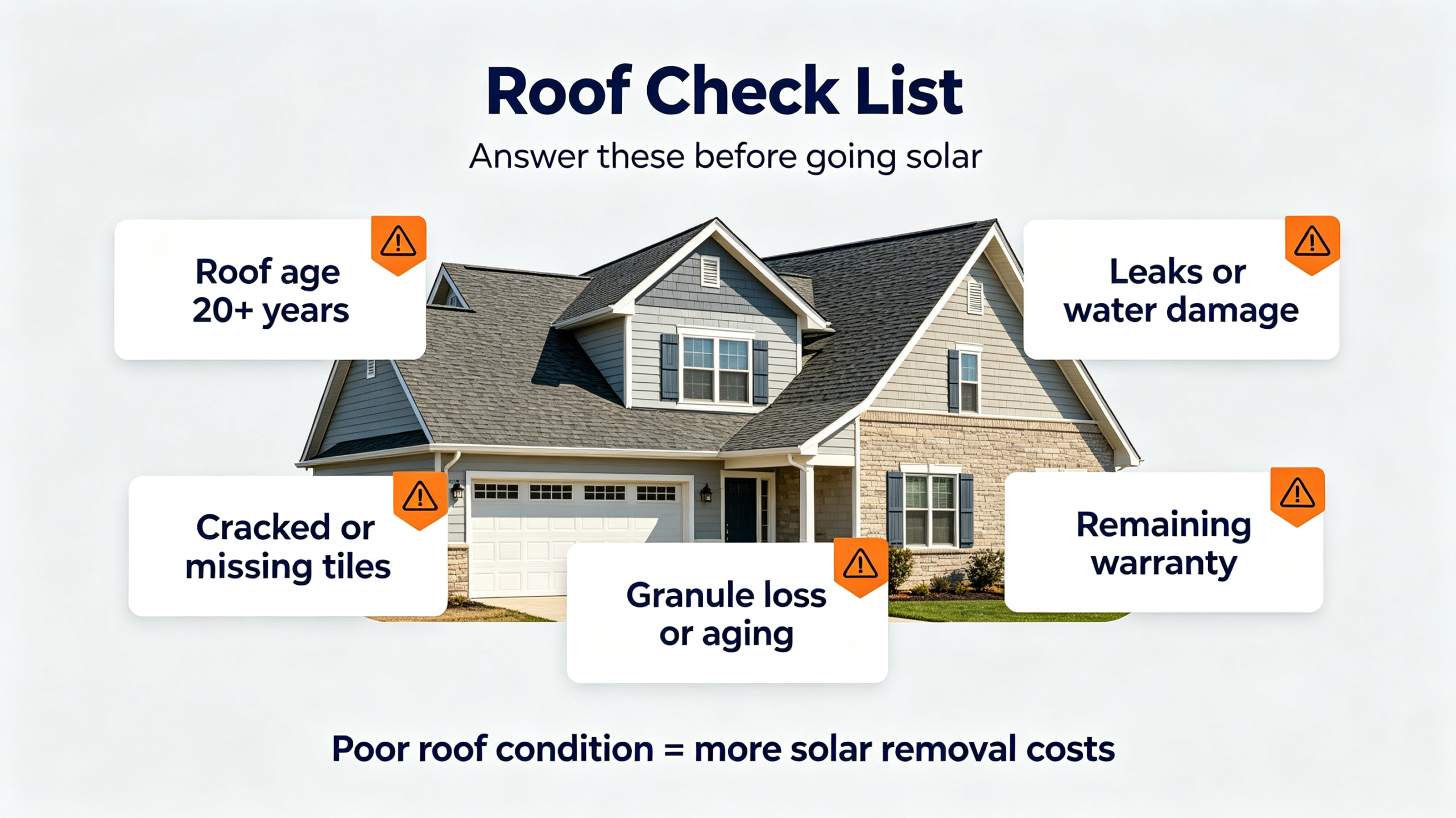
Answer these honestly. Two or more warning answers means the roof should be replaced before the panels go on.
1. How old is the roof?
Compare the actual age against the service life in the table above. A 20-year-old architectural shingle roof has maybe 5 to 10 years left – well short of the panels.
2. What is it made of?
Metal and tile usually outlast the array. Asphalt, wood and most flat membrane roofs usually do not.
3. How many layers are already on it?
Many roofs carry two or even three layers of shingles. That matters twice over: it shortens the remaining life, and it makes the eventual tear-off more expensive because all layers must come off.
4. What condition is it in?
Look for curling or missing shingles, granules collecting in gutters, cracked or lifted flashing around vents and chimneys, and any soft spots. A roofer’s inspection is worth the cost here.
5. How many repairs has it needed?
A roof that has been patched three times in five years is telling you something. Frequent repairs point to a covering at the end of its life rather than one unlucky leak.
The Cost Comparison
This is the calculation that decides the order of work.
| Approach | What you pay |
|---|---|
| Re-roof first, then install solar | Roof replacement only |
| Install solar now, re-roof in 10 years | Roof replacement plus array removal and refitting |
Removing and reinstalling a typical 20 to 30 panel system typically costs $1,500 to $3,000 on its own, and there are usually extras: a permit and re-inspection, new flashing, and the occasional cracked panel. Expect the system to be offline for two to six weeks while the roof work happens, which is lost generation on top of the labour bill.
Our guide to solar detach and reset cost breaks down those numbers in detail. The short version: doing the roof first avoids almost all of it.
There is a second benefit that is easy to overlook. If you re-roof and install solar in the same project, one set of scaffolding, one set of permits and one mobilisation covers both jobs. Splitting them across a decade means paying for that setup twice.
What If the Roof Is Mid-Life?
The awkward case is a roof with 10 to 15 years left – too good to tear off now, too short to outlast the panels. Three reasonable options:
- Wait and re-roof when it is genuinely near the end, then install solar on the new roof. You lose a few years of production but avoid paying twice.
- Re-roof now and install solar immediately, which costs more upfront but gives you a single, clean project and 25 years of uninterrupted output.
- Install a small array now on the section of roof in best condition, and expand after the eventual replacement. This only works on roofs with distinct planes at different ages.
What you should not do is install a full array on a roof that will need replacing in five years. That is the most expensive version of this decision.
What Many Installers Will Not Say
Solar sales representatives are not roofers, and their commission depends on the solar contract being signed this quarter. Many will tell you the roof “looks fine” from the ground, because recommending a $10,000 roof replacement first is the fastest way to lose the sale.
Get an independent roofing inspection before you sign a solar contract, especially if the roof is over 15 years old. If a solar company resists that, treat it as information about how they will behave after the installation is finished.
Roof condition also affects more than the covering itself. The structure has to carry the added load, and the flashing around every mounting point has to be done properly. Both are covered in our articles on whether your roof can support solar panels and on whether solar panels cause roof leaks.
If You Do Both, Sequence Them Properly
- Choose the roofer and the solar installer before either starts, so both know what the other is doing
- Have the solar company approve the roofing plan, particularly the flashing details at mounting points
- Confirm who pulls which permit, and who arranges the final inspection
- Insist that the roof warranty remain valid with panels installed on it – some manufacturers require specific flashing products
- Install solar immediately after the new roof, before it collects years of dirt and debris
FAQ
Should I replace my roof before installing solar panels?
If your roof has less than 25 years of service life left, yes. Panels last that long, so a premature roof failure means paying to remove and refit the array later, usually $1,500 to $3,000 plus lost production.
How long should a roof last before putting solar on it?
Aim for at least 25 years of remaining life. Metal and tile roofs almost always qualify. Asphalt shingle roofs usually need to be new or nearly new.
Can I install solar and replace the roof at the same time?
Yes, and it is usually the most economical approach because one mobilisation covers both jobs. Just make sure the roofing work is finished and inspected before the mounting hardware goes on.
Will installing solar void my roof warranty?
Not automatically, but some roof manufacturers require specific flashing and mounting products to keep the warranty valid. Ask your roofer which products preserve coverage, and tell the solar installer before work starts.
What happens if my roof fails after solar is installed?
The array has to come off, the roof gets repaired or replaced, and the array goes back on. That is the detach and reset process, and it is the reason this sequencing decision matters so much.
Related: Solar Detach and Reset Cost – What to Expect in 2026
4 thoughts on “Should You Replace Your Roof Before Solar Panels? – A Simple Test”