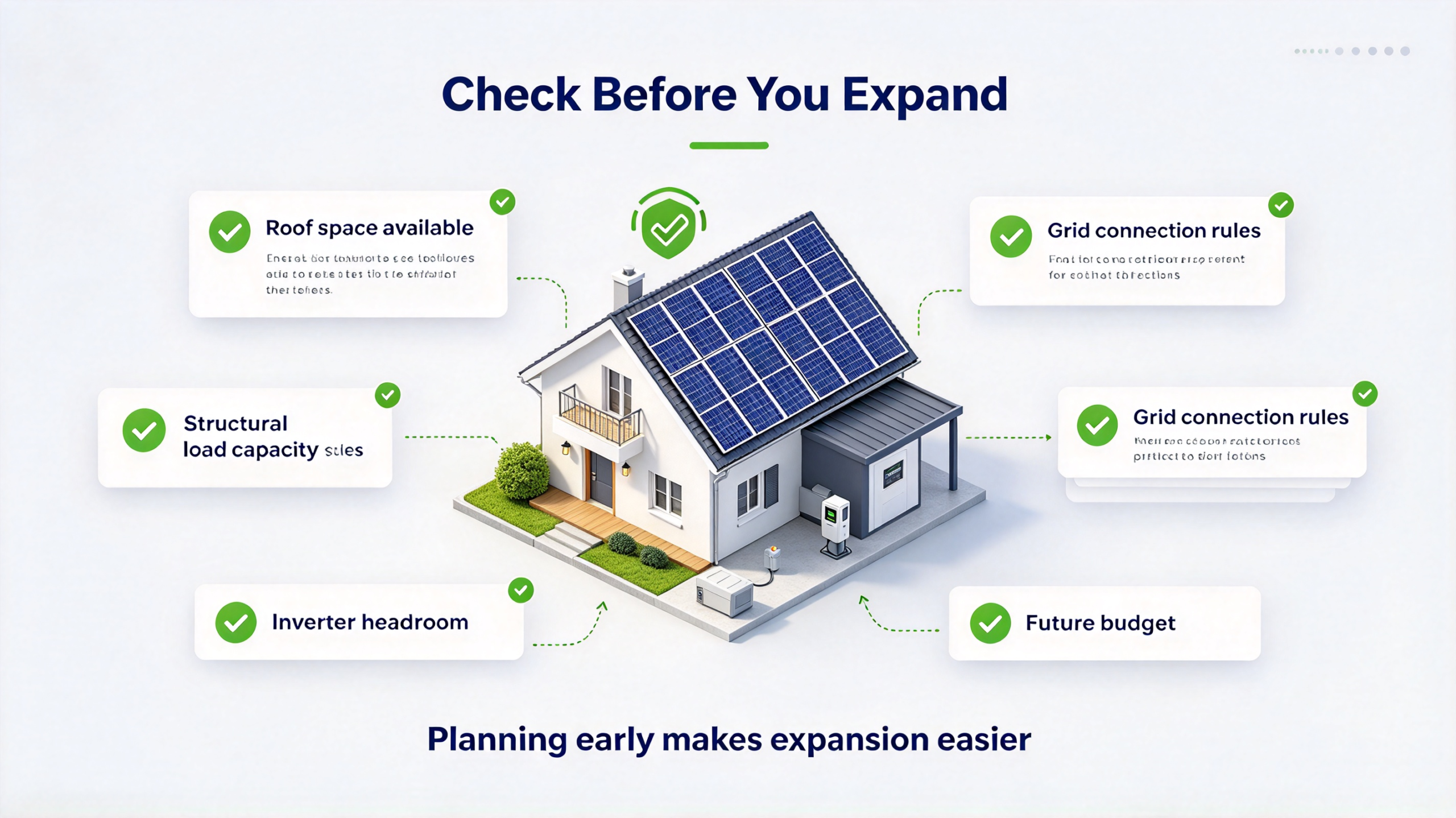
TL;DR: Can you add solar panels later? Usually yes, but only if four things allow it: inverter capacity, roof space, your electrical panel, and the utility’s rules. The inverter is the most common blocker, and the one people forget is that adding capacity can reset your net metering terms in some areas.
Can You Add Solar Panels Later?
Yes, in most cases – and the cost of doing it later is usually higher than doing it now, because the labour, the permit and the site visit are already paid for.
But “possible” is not the same as “easy”. Whether expansion is a straightforward add-on or a partial rebuild depends on decisions made on day one, often by someone who never mentioned them.
The Four Limits That Decide It
| Limit | What has to be true | How hard to fix later |
|---|---|---|
| Inverter capacity | Room in the DC-to-AC ratio, or a unit that accepts more input | Usually means a new inverter |
| Roof space | Unshaded area left, and mounting rails that can carry more | Depends entirely on the roof |
| Electrical panel | Busbar rating and spare breaker space | Panel upgrade can run into the thousands |
| Utility and permit rules | Adding capacity is approved and does not reset your rates | Sometimes impossible without losing your tariff |
The Inverter Is The Usual Blocker
Most grid-tied systems are deliberately sized with the array slightly larger than the inverter, typically a DC-to-AC ratio of 1.1 to 1.25. That is good design, and it also means there is very little headroom left: the inverter is already working with more panel capacity than its own rating.
So adding four or five panels to an eight-panel string inverter system is rarely a matter of bolting on hardware. The options are:
- Replace the inverter with a larger one, which is the cleanest answer and the most expensive
- Add a second inverter as a separate system, which works when the roof layout allows
- Accept more clipping, which is possible up to a point and wasteful beyond it
This is why the sizing decision matters more than the panel brand. If expansion is even remotely likely, our guide to what size inverter you need explains where the headroom comes from and how to ask for it.
Systems with microinverters or optimisers sidestep this entirely, because each panel has its own electronics. Adding a panel is then a matter of adding a panel, not redesigning a string.
Mixing Old And New Panels
On a single string, panels are only as strong as the weakest one. Mixing a five-year-old 350W panel with a new 430W panel on the same string drags the whole string toward the older specification, and mismatched voltage can reduce output further.
- Separate string and separate MPPT – the new panels run independently, which works well
- Module-level electronics – each panel behaves on its own, so mixing matters much less
- Same string, mixed panels – the option to avoid
One practical trap: panel models are discontinued quickly. Two years from now the exact model on your roof may not exist, which is a strong argument for installing a few extra panels at the start rather than trying to match later.
Roof And Mounting Considerations
Physically adding panels needs unused, unshaded roof area – which is the same constraint that decides system size in the first place. Our formula for how much roof space solar needs is worth working through before assuming there is room.
Two things people overlook: the mounting rails have a load limit, and the original installer may have used a rail profile they no longer stock. Matching an existing array visually is also harder than it sounds.
The Permit And Utility Problem Nobody Mentions
This is the one that costs real money, and it is rarely raised at the sales stage.
- You will usually need a new permit and inspection. Expansion is treated as a modification, not maintenance
- Your utility may treat the expanded system as a new system. Where net metering terms have changed since you installed, adding capacity can move you onto the current – usually less generous – rules. Homeowners who expanded to cover a new EV have lost their original tariff this way
- Some utilities cap total system size relative to your historical usage, which limits how much you can add regardless of roof space
So before expanding, one phone call to the utility beats a conversation with any installer. Ask two questions: is my current tariff preserved if I add capacity, and is there a size limit tied to my usage history?
What To Ask Before You Sign The First Contract
- What DC-to-AC ratio are you designing, and is there spare capacity in this inverter?
- Is this inverter expandable, and does it have a second MPPT free?
- Will you use microinverters or optimisers, which make expansion easy later?
- What is my electrical panel’s busbar rating, and how much spare capacity does it have?
- If I add capacity in three years, does my net metering rate change?
- Can you install the mounting rails for two more panels now, even if the panels come later?
If Your Reason Is An EV Or A Heat Pump
Most expansion plans exist because of a future load: an electric car, a heat pump, a pool, or a home office. An EV typically adds 3,000-4,000 kWh a year on its own, which is why it so often pushes a system past its original design.
If the future load is already fairly certain, sizing for it now is almost always cheaper than expanding later – the labour, permit and inspection are already in the price. Our guide to charging an EV from home solar covers how much extra capacity a car actually needs.
FAQ
Can I add panels to an existing solar system?
Usually yes, provided the inverter has capacity or can be replaced, there is unshaded roof area left, and the utility approves the change. The inverter is the most common reason an expansion turns into a bigger project than expected.
Will adding panels void my warranty?
Panel warranties normally stay intact if the work is done properly, but workmanship and inverter warranties can be affected by a third party working on the system. Ask the original installer first, and get the work documented.
Can I mix old and new solar panels?
On separate strings or with module-level electronics, yes. On the same string, mismatched panels generally reduce output, and the older panel sets the limits for the whole string.
Will adding panels change my net metering rate?
In some areas it can, because the expanded system is treated as new. Where export rates have been reduced since your original install, that can mean losing more than the extra panels gain. Confirm with your utility before committing.
Is it cheaper to size bigger now or expand later?
Almost always cheaper now. The design work, permit, inspection and installer mobilisation are already paid for, so the marginal cost of a few more panels today is well below the cost of a separate project in three years.
Related: How Many Solar Panels Do I Need in 2026 – Simple Formula