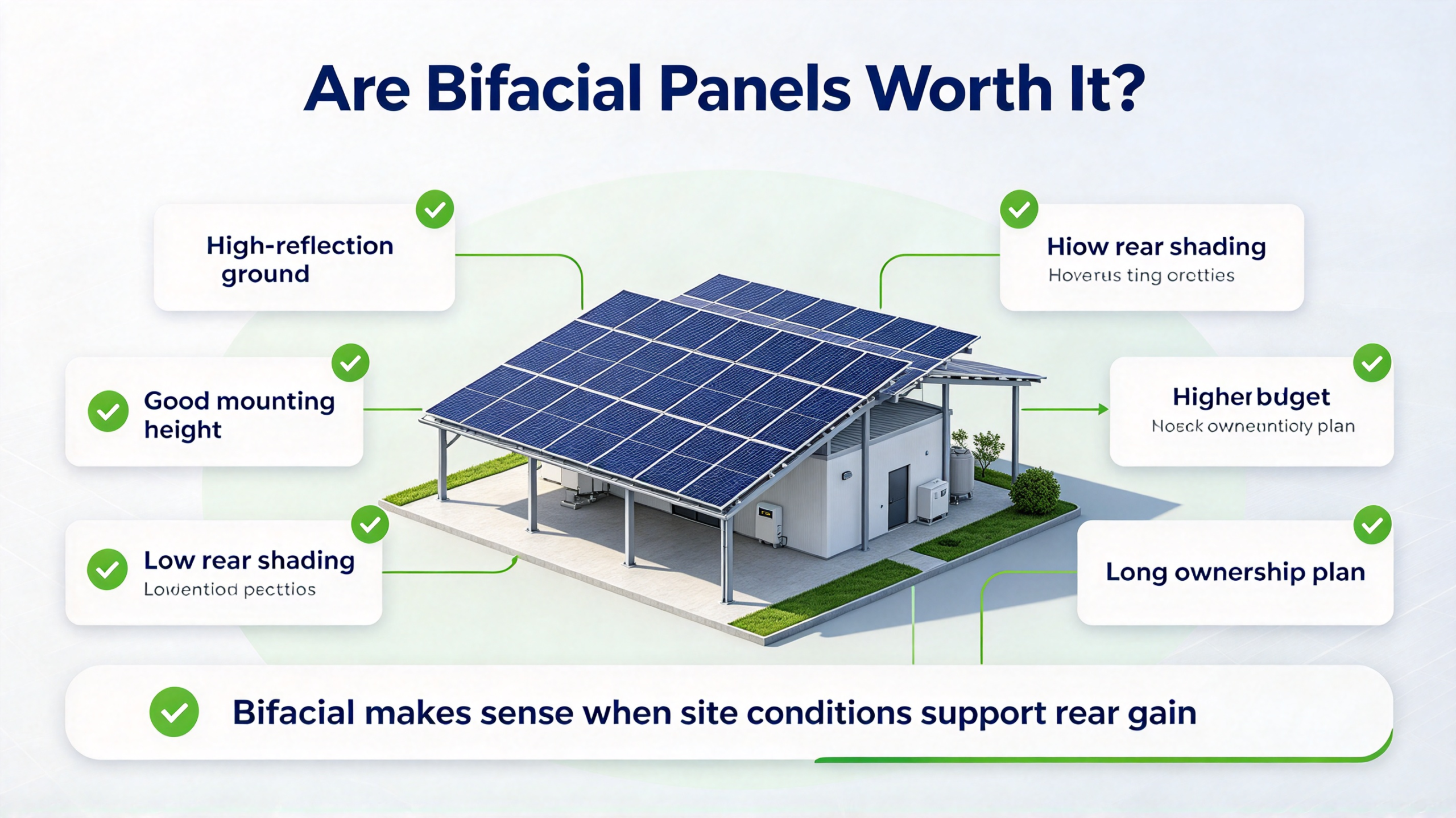
TL;DR: Are bifacial solar panels worth it? On a ground mount above a light surface, yes – you can gain roughly 5-15%. Bolted flat to a dark shingle roof with no clearance behind them, they produce about the same as a standard panel and you have paid extra for nothing. The mounting method decides the answer, not the panel.
Are Bifacial Solar Panels Worth It?
The honest answer: for most residential roof installations, no. For ground mounts, carports, and anything elevated above a reflective surface, they can be a straightforward win.
The reason is simple. A bifacial panel generates from both faces, but the back face only produces when light actually reaches it. If the panel is lying a few centimetres off a dark asphalt shingle, almost no light gets behind it.
What “Bifacial” Actually Means
A bifacial module collects light on the front, as always, and also on the rear through a transparent backsheet or glass backing instead of an opaque one. The extra energy is called the bifaciality gain, and it is expressed as a percentage of what the front side produces.
- Front side works exactly like a conventional panel
- Rear side collects reflected light from the surface below and behind
- The gain depends on how much light reaches that rear face – not on the panel’s marketing
Two identical bifacial panels can differ by 15% in output purely because of what is underneath them.
The Three Conditions For A Real Gain
To get useful rear-side production, all three of these have to be true:
- Rear clearance. The panel needs open space behind it – roughly a metre or more on a ground mount, or a carport or pergola where air and light pass underneath
- A reflective surface. Light-coloured gravel, white membrane roofing, sand or snow reflects a lot. Dark soil, asphalt and grass reflect very little
- The right tilt and height. Higher elevation means more of the reflected light reaches the back of the module instead of being blocked by the row behind
Ground mounts and elevated structures satisfy all three. A flush roof mount on shingle normally satisfies none of them.
When They Add Nothing At All
- Flush-mounted on a pitched roof. No clearance, dark surface, and often the roof itself blocks light from below
- Trackers or roofs with tight row spacing. The next row shades the rear face for much of the day
- Gravel over dark soil in a dusty climate. Reflectance drops as the surface collects dust
- Anywhere the panels are shaded anyway. A shaded array has bigger problems than bifaciality
In those situations you are paying a premium for the front-side efficiency of that particular panel – so compare it against standard panels on that basis alone, and ignore the bifacial claims.
How Much Gain Is Realistic
| Mounting situation | Typical rear gain | Why |
|---|---|---|
| Flush roof mount, dark shingles | 0-3% | Almost no light reaches the rear face |
| Elevated roof mount, light surface | 5-10% | Some reflected light, limited clearance |
| Ground mount on white gravel | 10-15% | High reflectance plus generous clearance |
| Carport or pergola, light underside | 10-20% | Light passes freely beneath the modules |
| Single-axis tracker | 15-25% | Panels stay angled toward the sun all day |
Marketing numbers of 30% or more exist, and they are measured under ideal lab conditions: white surface, perfect elevation, no shading, no dust. Treat anything above roughly 15% in a real installation with suspicion.
Because so much depends on the mounting, the choice between bifacial and standard is really a mounting decision. Our comparison of ground-mounted and roof-mounted systems is worth reading before you assume bifacial is relevant to your roof.
The Money Question
Bifacial modules usually cost more per panel than a comparable monofacial product, and the gap varies widely:
- Small gap (a few per cent) – often because glass-glass construction is now common across both types
- Large gap (10-20% per panel) – when you are buying a premium bifacial product with better cells as well
The maths only works in one direction: if you are getting 10% more energy at a 10% higher panel price, and the racking already exists, it is close to a wash and comes down to installation details. If you are getting 0-3% more energy at a 15% higher price, you have simply bought an expensive panel.
For a wider look at how panel choice interacts with price, our breakdown of whether higher efficiency is worth paying for covers the same logic from a different angle.
What To Ask An Installer
- What rear-side gain are you modelling for my specific mounting, and what assumptions are behind it?
- Is this a bifacial panel because of the mounting, or because it is what you stock?
- What is the price difference per panel against your standard option?
- If the gain is under 5%, what else could that money buy – grounding, monitoring, a bigger array?
- Does the racking allow enough rear clearance for the gain to happen at all?
Common Misconceptions
- “Bifacial means double the power.” No. The rear face adds single-digit to low double-digit percentages at best
- “Bifacial panels are always better made.” Glass-glass construction is genuinely durable, but that is a separate benefit from the bifacial claim itself
- “Bifacial works on any roof.” It does not – clearance is the whole story
- “The gain is guaranteed.” It is weather, surface and albedo dependent, and modelling software can be optimistic
- “Bifacial replaces the need for good orientation.” It does not. A badly oriented array is still a badly oriented array
When comparing specific products, it helps to know which brands have a track record rather than the most aggressive datasheet – our roundup of the best solar panel brands covers that side of the decision. For the underlying technology, our explainer on monocrystalline versus polycrystalline panels is the starting point.
FAQ
Are bifacial solar panels worth the extra cost?
Only where light can reach the back of the module – typically ground mounts, carports and elevated structures over a light surface. On a flush-mounted roof, the gain is usually 0-3% and rarely justifies a premium.
How much more energy do bifacial panels produce?
Real installation gains generally land between 5% and 15%, reaching 20% or more on trackers and carports. The exact figure depends on clearance, surface reflectance and how the rows are spaced.
Do bifacial panels work on a normal pitched roof?
They work, but the rear side contributes almost nothing because there is no clearance and the surface beneath is usually dark. You are effectively buying a monofacial panel with a glass back.
What surface reflects the most light for bifacial panels?
Light-coloured surfaces reflect the most: white gravel, sand, snow and white membrane roofing. Dark asphalt, soil and grass reflect very little, and dust reduces reflectance over time.
Do bifacial panels last longer?
Bifacial panels are typically glass-glass, which resists moisture and mechanical damage better than a polymer backsheet. That durability is a real advantage, but it comes from the construction rather than from the bifacial design.
Related: Best Solar Panel Brands 2026 – 7 Reliable Options Compared