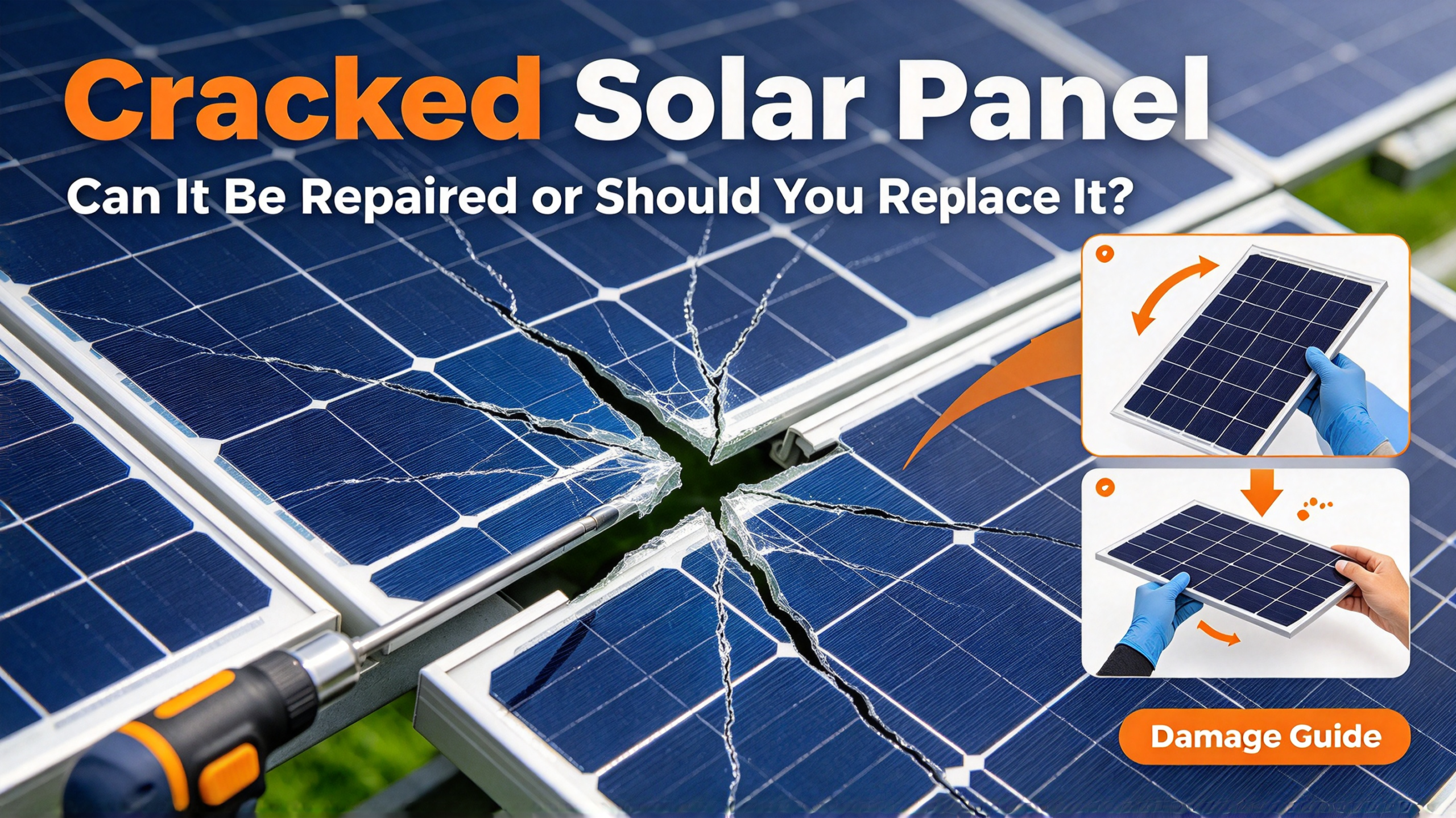
TL;DR: A cracked solar panel is almost never worth repairing. The glass, cells and backing are laminated together under vacuum, and once that seal is broken, moisture works its way in and the panel degrades from the inside. The real question is not whether it can be fixed, but whether it is still safe and still producing. A crack over the gap between cells can run for months with no output loss. A crack through a cell, or any browning and discoloration, means the panel should come off.
Every week, someone searches for how to fix a cracked solar panel and finds a video about silicone. That video is wrong, and following it can void your warranty and hide a problem that ends in a fire. Here is what actually happens, and what to do instead.
Why A Cracked Panel Cannot Be Repaired
A solar panel is not a piece of glass sitting on top of some cells. It is a single laminated sandwich: tempered glass, a clear encapsulant, the silicon cells, another layer of encapsulant, and a plastic backsheet, all bonded together in a vacuum oven. That lamination is what keeps water and oxygen away from the electrical parts for 25 years.
Repairing it would mean cutting the glass off, replacing the damaged cell, and re-laminating the whole panel in the same kind of equipment the factory uses. The labour alone costs more than a new panel, and no residential contractor has that equipment anyway.
The fixes people try instead all fail for the same reason:
- Silicone sealant: it sits on the surface and does nothing about the seal underneath. Moisture still gets in through the crack edges
- Clear tape or film: peels off within a season and traps water against the glass
- Epoxy: can damage the encapsulant and makes any warranty claim look like customer damage
Glass is not the waterproof layer. The lamination is. Once it is compromised, no surface treatment restores it.
When The Crack Misses The Cells
If the fracture runs across the narrow gaps between cells and never touches a cell itself, the panel is often still electrically perfect. It will not look pretty, and it is more vulnerable to moisture over time, but its output can sit right where it always was. Many of these panels run for years with nothing but a cosmetic scar.
When The Crack Crosses A Cell
When the fracture crosses a cell, the silicon itself is damaged. Sometimes the damage is invisible to the eye – hairline microcracks that only show under electroluminescence imaging. Sometimes it is obvious: a dark band, a burned spot, a discoloured patch.
A broken cell creates resistance in the middle of a string, which produces heat, which is what turns a small crack into a hot spot and, occasionally, into a fire.
How To Tell Which One You Have
Start with your eyes, on the ground, from a safe angle:
- Browning or discolouration around the crack – moisture has already entered. This panel is done
- A dark, sharply defined spot – that is a burned cell. Stop production on that string until it is replaced
- Clean glass crack with uniform blue cells – likely glass-only damage. Keep watching it
- Never press on the glass. Touching it with a bare hand is a cut waiting to happen, and pressure can widen the crack
Then confirm it electrically. Compare that panel’s output to a neighbouring panel of the same model, using a multimeter on the panel’s DC leads, or simply compare per-panel numbers in your monitoring app if you have module-level monitoring. A cracked panel with normal voltage and current is a monitoring case. A cracked panel with a big drop has a broken cell.
Safety Triage: Three Levels
Where the crack lands between these three levels should be decided in minutes, not weeks.
Level 1 – watch it. A clean glass crack that does not cross a cell, no discolouration, output matching the neighbours. Keep it in service, check it visually every few months, and photograph it each time so you can see whether it is changing.
Level 2 – schedule a replacement. A crack that crosses a cell, or any browning or darkening around the fracture. The panel is losing output and creating heat. Book the swap within weeks rather than months, and keep watching the monitoring data in the meantime.
Level 3 – take the string out of service. A dark, sharply defined burned spot; a melted or scorched junction box or connector; the smell of hot plastic; a ground fault or repeated inverter faults on that string. Switch off the AC side and call an installer. Do not climb up, and do not cover the panel with anything.
What The Real Risks Are
The shock risk is low. Tempered glass is an insulator, the frame is grounded, and the live parts sit under the laminate. The real risks are different:
- Hot spots. A damaged cell forces the rest of the string to push current through a high-resistance spot, which heats it up. On a roof, that heat has nowhere to go
- Arcing and fire. Severe damage can create an arc inside the panel. It is rare, but it is the reason a badly cracked panel should not just be left up there. See whether solar panels really catch fire for how often this actually happens and what causes it
- Ground faults. Moisture reaching the electrical parts can trip the inverter or create a shock hazard for whoever eventually works on the roof
- Cut risk. For the installer who has to handle it later, cracked tempered glass is genuinely dangerous
Which Warranty Applies
Three different coverages may apply, and people usually check only one:
- Product warranty (the panel maker). Covers manufacturing defects, not impact damage. A panel broken by a falling branch is not a defect
- Workmanship warranty (the installer). Covers how it was installed, usually for 5-10 years. Also does not cover hail or impact
- Homeowner’s insurance. This is the one that usually pays for storm or impact damage, minus your deductible. Hail and wind claims are common – filing a hail damage claim walks through the process and the timing
Warranty terms vary a lot between brands, especially on what counts as “damage in transit” and how long the claims window stays open. Solar panel warranties explained breaks down what each type actually covers.
Before you file anything: photograph the panel, the crack, and the surrounding roof, and note the date you first spotted it. Insurers ask for exactly that.
Who Should Do The Swap
The part homeowners underestimate is that the DC side stays live whenever there is daylight on the array. Switching off the inverter or the AC disconnect does not de-energise the roof.
That means the swap belongs to a licensed electrician or your original installer, not to a handy neighbour:
- They will isolate the string and confirm it is dead at the point of work
- Removing a cracked panel means handling broken tempered glass on a slope, which is how people get cut
- The replacement has to be electrically matched, and on some arrays the mounting hardware cannot be reused
The cost of doing this properly is $100-$500 in labour on an accessible roof. The cost of doing it badly starts with a fall.
What A Replacement Costs
- The panel itself: $150-$400 for a standard residential module, depending on wattage and brand
- Labour: $100-$500 to swap one panel, assuming the roof is accessible and the array does not need to be taken apart
- Matched-panel problem: if your model is discontinued, a replacement may be hard to find, and a mismatched panel drags down the output of the whole string
That last point is the one that surprises people. It is not the panel price that stings; it is discovering that the exact model is out of production.
The Matched-Panel Problem
Mixing panels of different wattage or age in one string costs you output, because the weakest panel sets the current for the whole row – the same mechanism covered in mixing different solar panels. Your options, roughly in order of cost:
- Find a used match of the same model – cheapest if you can find one locally
- Add a module-level optimiser to isolate the odd panel so it stops dragging the string down
- Replace the whole string with new matched panels – most expensive, but it resets the clock to zero
If the array is already past the halfway point of its life, replacing a full string with newer, higher-wattage modules often makes more sense than chasing a single orphan panel.
Disposing Of The Old Panel
Solar panels are classified as electronic waste in many states and are banned from regular landfills in some. Take it to an e-waste facility or a solar recycler, and ask whether the aluminium frame and junction box get recovered separately. Solar panel recycling and disposal covers where panels actually go.
FAQ
Can I repair a cracked solar panel with silicone?
No. The laminate under the glass is the waterproof layer, and silicone only touches the surface. It also gives a warranty inspector a clear reason to deny your claim.
Is a cracked solar panel still usable?
Often yes, if the crack misses the cells. That is exactly why an output test matters more than the crack itself – a glass-only crack may cost you nothing but appearance.
Is a cracked solar panel dangerous?
It can become one. A damaged cell creates a hot spot, and severe internal damage can arc. The risk is low, but it is real, which is why a panel with a cracked cell should not stay on the roof.
Does insurance cover a cracked solar panel?
Usually yes if the cause was a covered event like hail, wind or a falling branch, minus your deductible. Manufacturing defects fall under the panel’s product warranty instead.
How much does it cost to replace a cracked solar panel?
Plan on $250-$900 for the panel plus labour, assuming the model can be matched. Expect more if the array has to be partially disassembled to reach it.
How long can a cracked solar panel last?
A crack that misses the cells can run for years with little or no output loss – the risk is moisture slowly reaching the laminate. A crack that crosses a cell is a different category: output drops, heat builds, and the panel should be replaced rather than monitored. The crack itself does not decide it; what it crosses does.
Should I switch my solar system off if a panel is cracked?
Not for a clean glass-only crack with normal output. Do switch off the AC side and call an installer if you see a burned or dark spot, a scorched connector, a melted junction box, or if the inverter reports a ground fault or repeated arc faults on that string. The DC side stays live in daylight either way, so never open the roof-side wiring yourself.
3 thoughts on “Cracked Solar Panel: Can It Be Repaired or Should You Replace It?”