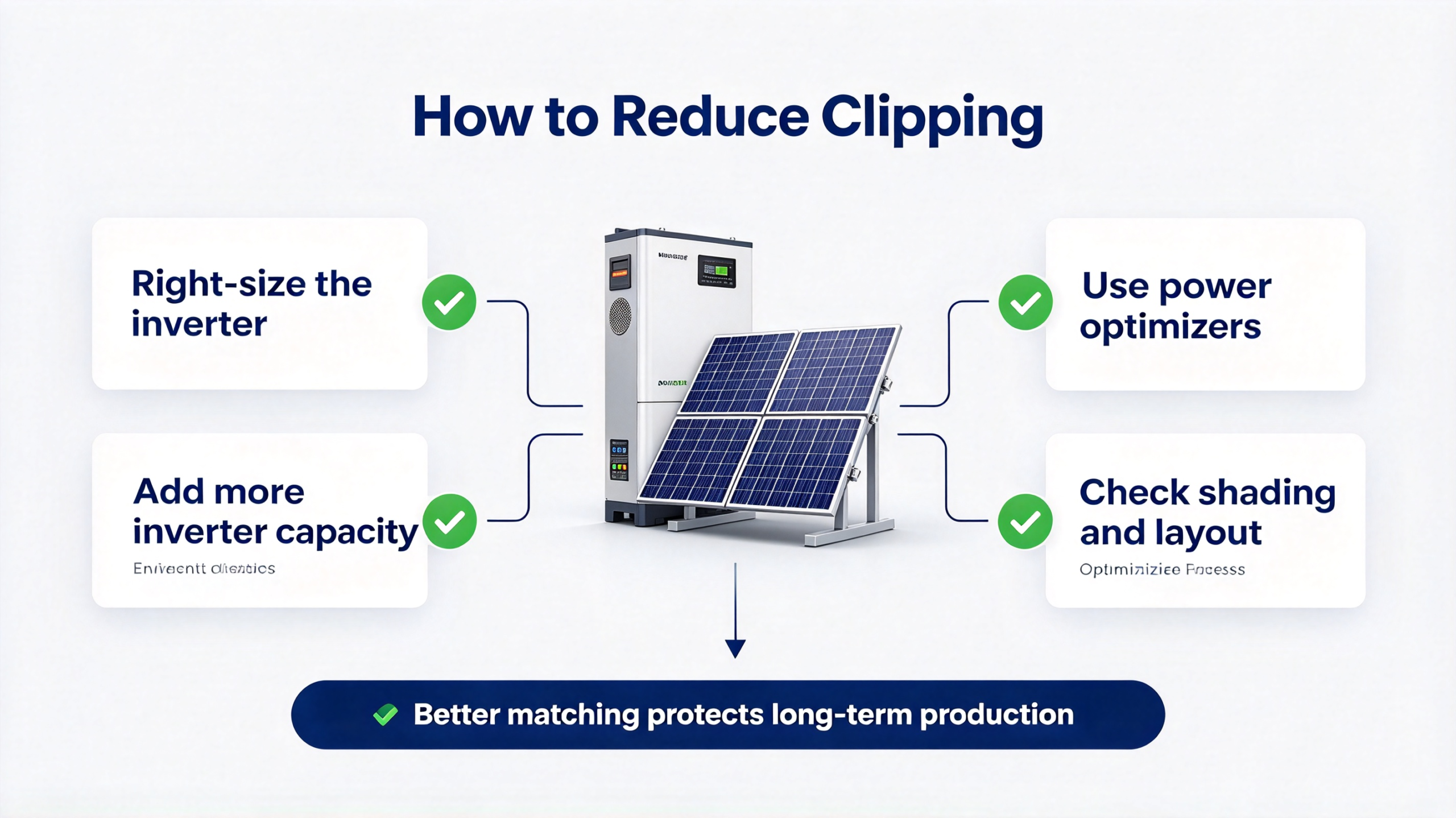
TL;DR: Inverter clipping is not a fault, and it is usually not wasting much money. A solar array is deliberately built larger than the inverter on purpose, so the inverter caps its output for an hour or two on the sunniest days of the year in exchange for producing more energy the other 8,000 hours. A well-designed system loses roughly 1-3% of annual production to clipping and gains more than that back from the bigger array. Clipping only becomes a real problem when the array is oversized so far past the inverter that losses climb well beyond that.
Then one hot afternoon in May, a homeowner opens the monitoring app, sees a perfectly flat line across the middle of the day, and assumes something is broken. Nothing is broken. Here is what is actually going on.
What Inverter Clipping Actually Is
Solar panels make DC power. The inverter converts it to AC power and has a hard ceiling on how much AC it can deliver — the maximum continuous output on its label. When the array’s DC output climbs above that ceiling, the inverter simply stops converting the excess. It runs at its maximum and the rest of the sunlight is converted to a little extra heat instead of electricity.
On a production graph this looks like a flat top: the curve rises normally in the morning, flattens at the ceiling around midday, then falls away normally in the afternoon. That flat line is clipping.
Example: 8 kW of panels on a 6 kW inverter. The ratio is 8 ÷ 6 = 1.33, and the system will clip whenever the array can push more than 6 kW. That is between roughly 10 a.m. and 2 p.m. on clear, cool, high-sun days.
Why This Is Deliberate, Not a Mistake
Panel nameplate ratings describe laboratory conditions that your roof almost never sees. A “400W” panel on a real roof delivers closer to 300-350W most of the time, because of heat, angle, dust, haze, and wire losses. Panels only approach their nameplate number on rare, perfect days.
Meanwhile, the inverter is the expensive, failure-prone part of the system, and panels are comparatively cheap. So designers do the math deliberately:
- Oversize the array so it produces more power in the mornings, evenings, winter, and cloudy weather — the majority of the year.
- Undersize the inverter slightly so it runs near its efficient sweet spot instead of idling, and costs less to buy.
- Accept a little clipping on the handful of days when the array peaks above the inverter’s limit.
The trade is nearly always favorable. You give up a sliver of production on the best days and gain meaningful production on all the mediocre ones.
How Much Output Clipping Actually Costs
At typical residential ratios, the annual loss is small:
- DC/AC ratio 1.0-1.15: little or no clipping. Slightly under-utilized inverter.
- 1.15-1.35: the sweet spot. Roughly 0.5-3% of annual production goes to clipping.
- 1.35-1.5: more visible clipping, but still often worth it in very sunny climates.
- Above 1.5: losses grow noticeably, and this is where the design deserves a second look.
Note what that means in practice. A 3% clipping loss on a system that produces 10,000 kWh a year is 300 kWh. If the oversized array added 800 kWh everywhere else, you are still well ahead. If the ratio crept to 1.7 and the system clips for four hours every sunny day, the math stops working in your favor.
The DC-to-AC Ratio: The Number That Decides Everything
The DC-to-AC ratio is simply total panel DC watts divided by inverter AC watts. It is the single number that tells you how much clipping a design will have.
- Low (near 1.0): almost no clipping, but you paid for inverter capacity you rarely use. Common in older or conservatively designed systems.
- Medium (1.2-1.3): the standard for most modern residential installs. Small clipping loss, good year-round output.
- High (above 1.4): used deliberately in very sunny, high-altitude locations where peak sun is strong and consistent — but it needs to be a conscious choice, not an accident.
If you do not know your ratio, ask your installer. It is a five-second calculation and it tells you immediately whether your flat-topped curve is normal. What size inverter you need walks through how the number gets chosen in the first place.
Clipping vs. Curtailment: Two Different Things
People mix these up constantly, and they are not the same:
- Clipping is an equipment limit. Your inverter runs flat out and cannot convert any more. Nothing is shutting anything down, and no energy is being “wasted” by anyone’s decision.
- Curtailment is an external instruction. Your utility tells the system to stop exporting power, usually because the local grid has too much solar at that moment. That energy is genuinely thrown away, and it is often out of your control.
If your flat top lasts an hour on sunny days, that is clipping. If your system shuts down entirely on a sunny day with no fault code, that may be curtailment — worth a call to your utility.
Does Clipping Hurt the Inverter?
No. Clipping is a design condition the inverter is built for. Running at its maximum rated output is exactly what it is rated to do, and it will do it for years. Manufacturers design for this; it is not an overload.
One nuance: on a hot day, an inverter running at full output runs hotter, and heat is what actually shortens an inverter’s life. That is one more reason to mount it in shade with proper clearance.
When Clipping Becomes a Real Problem
- The array is oversized far past the inverter. Above roughly 1.5, losses add up faster than the extra panels gain.
- The flat top lasts for hours every clear day, not just a few weeks a year.
- You have a battery. A hybrid inverter splitting its capacity between the house and the battery can clip more aggressively, because the battery also wants that midday power.
- Your utility caps exports. If export is limited, oversized production has nowhere to go regardless of the inverter.
How to Check Your Own System
- Look at the daily curve on a clear day in spring or fall. A narrow flat top around midday is normal. A wide flat top from 9 a.m. to 4 p.m. is worth investigating.
- Compare annual production against the original estimate. If the system is beating or matching its projection, clipping is not costing you anything real.
- Ask for the DC/AC ratio in writing if you do not have the design documents.
- Compare against a system of similar size in your area — system monitoring explains how to read those numbers.
And remember the architecture question: microinverters and string inverters clip differently, because a microinverter clips one panel at a time rather than the whole array at once. Microinverters versus string inverters explains why the same ratio can behave differently depending on which you have.
FAQ
Is inverter clipping bad?
No. It is a deliberate design tradeoff in almost every modern system. A small amount of clipping buys more total production across the year than a perfectly matched system would deliver.
What is a good DC-to-AC ratio?
For most residential systems, 1.15-1.35 is the sweet spot. Below 1.1 you are paying for inverter capacity you rarely use; above 1.5 clipping losses start to outweigh the benefit of the extra panels.
How much production does clipping cost?
Typically 0.5-3% of annual output at a normal ratio. It is worth checking against your annual production estimate, because that is the number that actually shows up in your bill.
Can I stop clipping?
Only by installing a larger inverter. That usually costs more than the clipped energy is worth, so it is rarely a good fix. Get the numbers before you spend anything.
Does clipping damage my inverter?
No. Operating at maximum rated output is what the inverter is designed to do. Long-term heat exposure shortens inverter life far more than clipping does.