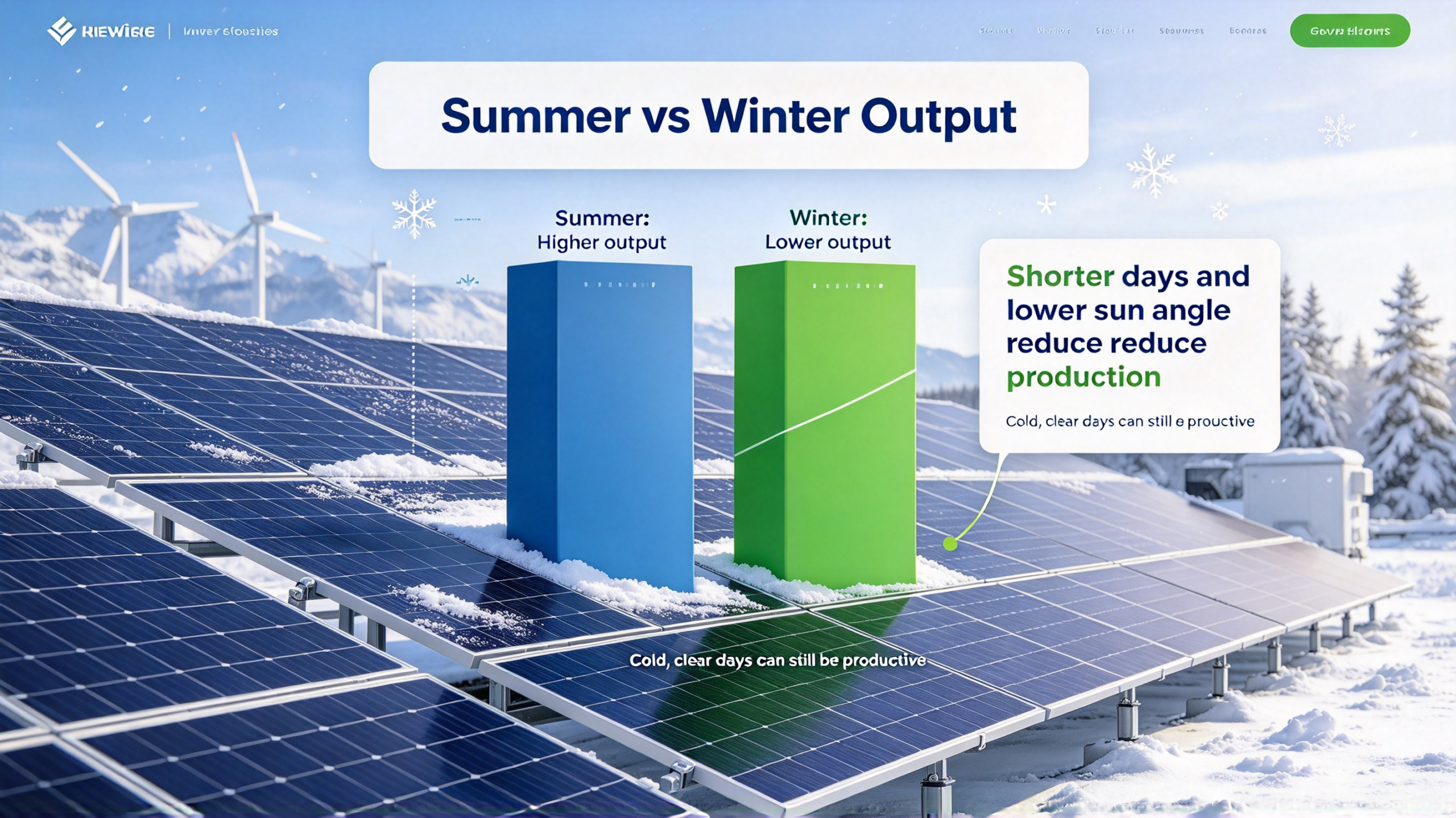
TL;DR: How much do solar panels produce in winter? In northern states, expect roughly 25-50% of your peak summer output during December and January. In the Sun Belt the drop is much smaller, often only 25-40% below summer. Cold air genuinely makes panels more efficient, but shorter days, a lower sun angle, and snow cost far more than the cold gives back. Your system is not broken in December — it is doing exactly what the physics allows.
This is the question new solar owners ask every January, usually while staring at an app that shows a number half the size of what they saw in July. Here is what is actually happening, and what you can do about it.
Two Forces Fighting Each Other
Why Cold Air Helps
A solar panel’s efficiency rating is measured at a cell temperature of 77°F (25°C). Above that, output falls; below it, output rises. On a hot July afternoon a roof panel can easily reach 140°F, which knocks 10% or more off its output. On a clear 30°F January day the same panel runs cool and efficient, and can briefly beat its nameplate rating.
Cold also brings a bonus most people do not expect: snow on the ground reflects sunlight back up onto the array, adding a few percent on a bright day after a storm.
Why Winter Still Loses
- Day length. A northern location may get over 15 hours of daylight in June and under 9 in December. That difference alone removes more than 40% of the possible sun.
- Sun angle. A low winter sun hits the panels at a glancing angle instead of straight on, and it has more atmosphere to pass through. Both cut output.
- Weather. Winter brings more overcast days in most regions, and clouds cut production sharply.
- Snow cover. A panel under snow produces essentially nothing. That is a bigger factor than temperature in snowy states.
The cold-weather efficiency gain is roughly 3-8%. The daylight and angle losses are 40% or more. There is no version of this where winter wins.
Real Winter Output by Region
These are typical December figures compared with the same system’s best summer month:
- Sun Belt (Arizona, Florida, Southern California, Texas): about 60-75% of summer output. Winter is mild and the sun stays relatively high.
- Mid-Atlantic and lower Midwest: about 45-60% of summer output.
- Northeast, upper Midwest, Pacific Northwest: about 25-45% of summer output.
Concrete example: a 7 kW system in Boston that produces about 1,000 kWh in June will typically produce roughly 400 kWh in December. The same 7 kW system in Phoenix might make around 1,200 kWh in June — heat pulls it down a bit — and about 700 kWh in December, because the sun never drops as low there.
Your own numbers will land somewhere in these ranges depending on roof pitch, shading, and how much snow you get.
Snow Is the Biggest Single Loss
A snow-covered panel produces close to zero, no matter how cold it is. The good news is that most rooftop arrays are tilted at 20 degrees or more, and snow slides off quickly once the sun hits it. Dark, warm panels also shed snow faster than a bare roof does.
What you should not do is climb up there with a shovel or a broom to hurry it along. Scraping, chipping ice, and hitting the glass with anything hard will crack cells and cost far more than the lost production is worth. Solar panel snow removal covers what is safe and what quietly destroys panels.
Clouds Matter More Than Cold
A dense overcast day can cut output by 80-90%, which is far more damaging than the temperature itself. Panels still work in clouds — they just work slowly. Solar panels on cloudy days explains the difference between overcast, haze, and bright cloud-edge conditions.
How to Protect Winter Output
- Steeper tilt helps in winter. A steeper array faces the low winter sun more directly. If your racking allows seasonal adjustment, tilting up for winter is one of the few changes that genuinely adds production.
- Watch tree shadows. A tree that shades nothing in June can throw a long shadow across your array in December. Winter is when trimming pays off most.
- Compare month over month, not to summer. Compare this December to last December. That is the comparison that tells you whether the system is healthy.
- Let snow slide. Clear the ground around the array instead, so you can see it and check for damage after storms.
- Expect the pattern, not a problem. A dip in winter is normal and is already built into the savings estimate you were given. Solar panel maintenance in winter covers the rest of the seasonal checklist.
Will Winter Production Cover a Winter Bill?
Usually not on its own, and that is by design. Most systems are sized so that strong spring and summer production outruns summer usage and builds up credits. Under many utilities’ net metering rules, those credits carry forward and offset winter bills. The exact rules vary a lot by state and utility, and some newer rate structures credit exports at a lower rate than you pay for power. It is worth reading your specific tariff once, early on, so you know what your winter number actually buys.
If your goal is full-year independence rather than a lower annual bill, sizing has to account for the worst month, not the average — which usually means a noticeably larger array.
FAQ
How much do solar panels produce in winter?
In northern states, expect around 25-50% of peak summer output during December and January. In the Sun Belt, expect 60-75%. Cold improves efficiency, but shorter days and a low sun angle outweigh that gain.
Do solar panels work in cold weather?
They work better in cold weather, per unit of sunlight. Efficiency actually improves below 77°F, and a clear cold day can produce more than a hazy hot one.
Do solar panels work in snow?
They work fine with snow on the ground, which reflects extra light upward. A panel buried under snow produces essentially nothing until the snow slides off or melts.
Why is my winter production so much lower than summer?
Almost entirely because of day length and sun angle. December days can be six hours shorter than June days, and the sun sits much lower in the sky. Temperature plays only a small role.
Should I clear snow off my solar panels?
Only with an extendable soft-bristle tool from the ground, and only if it is safe to do so. Never climb on a snowy roof, and never scrape or chip at the glass — a cracked panel costs far more than a few days of lost output.
1 thought on “How Much Do Solar Panels Produce in Winter?”