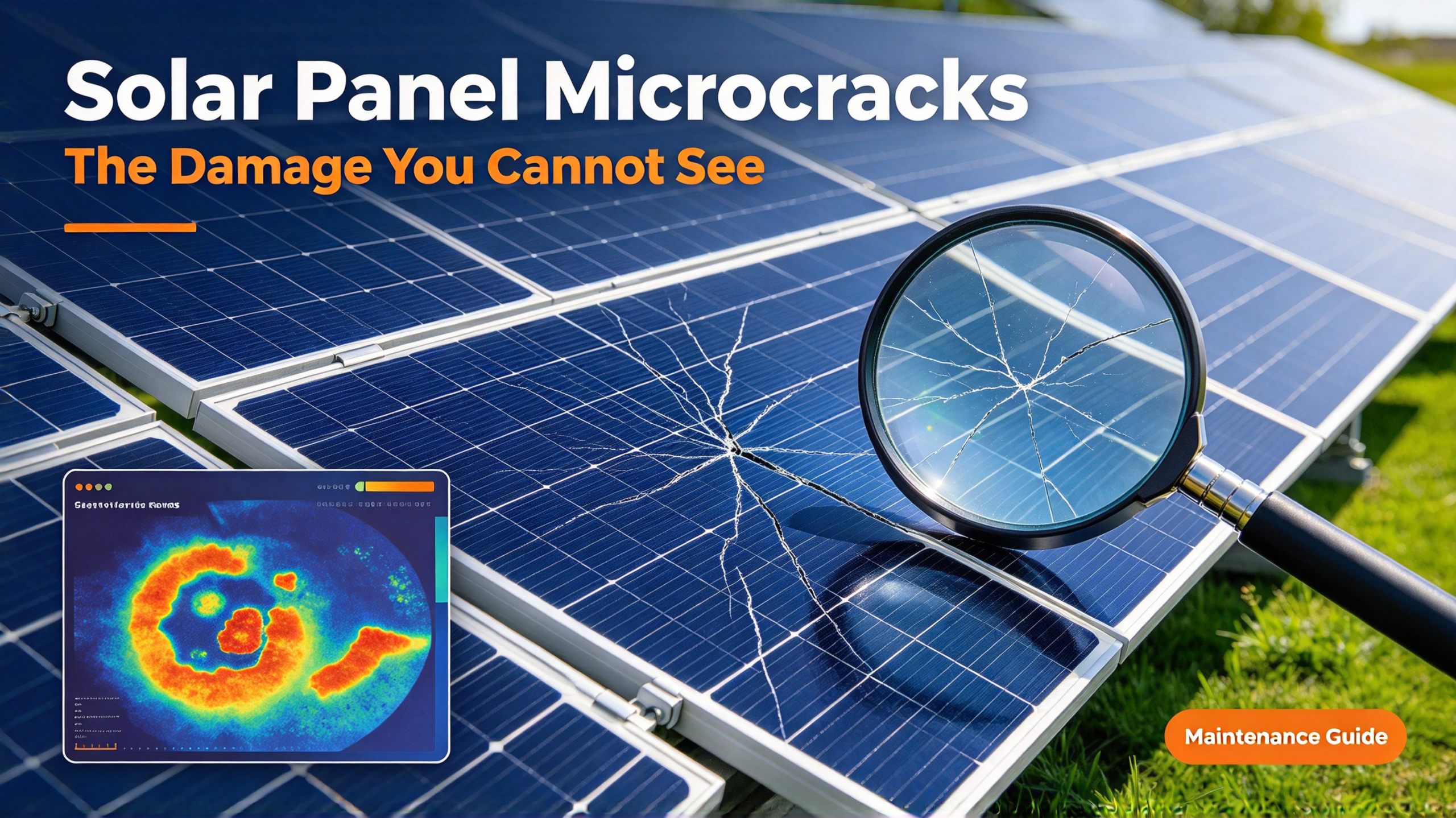
TL;DR: Solar panel microcracks are fractures inside the silicon cell, not in the glass on top of it. From the ground the panel looks perfect, because it is. The damage is invisible to the eye and shows up instead as a slow fall in output, and in bad cases as a hot spot. You cannot repair them, but you can catch them – and finding them early is what keeps them from costing you a panel.
Microcracks are the most common form of real damage on residential arrays, and almost nobody notices them until the output numbers start to slide.
What a Microcrack Actually Is
A solar panel is a sandwich: tempered glass, a clear encapsulant, the silicon cells, another layer of encapsulant, and a backsheet. The glass is thick and takes impacts well. The silicon underneath is thin, brittle, and about as forgiving as a potato chip.
A microcrack is a fracture in that silicon wafer, often hairline-thin and sometimes not even continuous. The cell still conducts, so the panel still works. It just works slightly worse, in a way that gets worse over time.
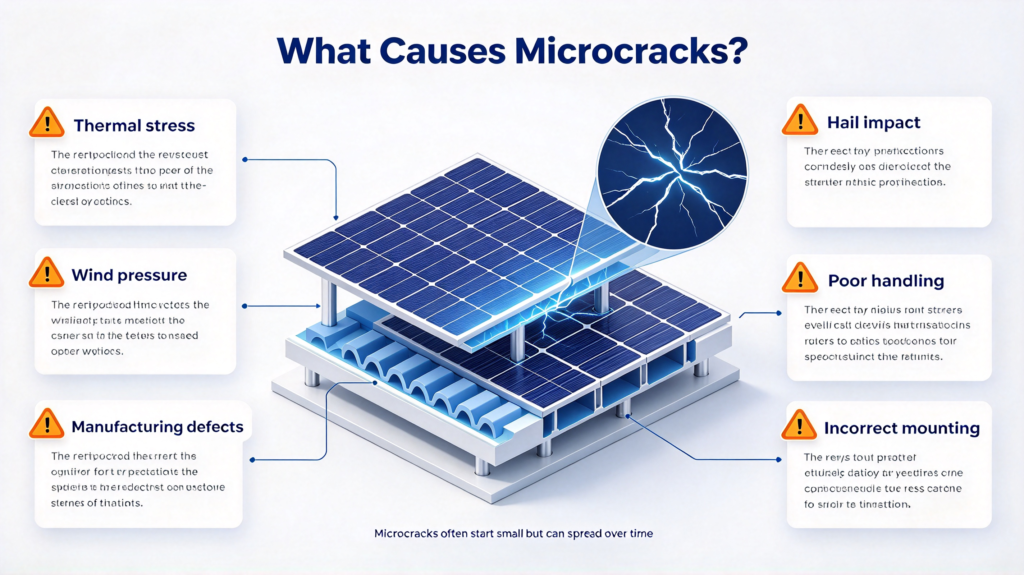
Five Things That Cause Them
- Handling and shipping. The single most common cause. Panels are flexible in the middle and a careless lift or a corner bump is enough.
- Hail. Even hail that leaves no visible mark on the glass can transfer enough shock to crack the cells below.
- Someone walking on the array. A person’s weight concentrated on one spot is far beyond what the panel is designed to take.
- Thermal cycling. Daily expansion and contraction in extreme climates stresses the silicon and the solder joints that hold it.
- Manufacturing defects. Less common than people assume, but real – a wafer that was already stressed can crack months later under normal conditions.
Why They Are So Hard to Find
Three reasons:
- The glass hides them. You are looking at the damage through a layer of textured, anti-reflective tempered glass.
- They are thin. A microcrack can be a fraction of a millimetre wide, at an angle, and invisible at any distance beyond a metre.
- They do not change the appearance of the cell. Unlike a burned cell or browning encapsulant, a microcrack leaves no colour change at all.
This is why a visual inspection from the ground tells you very little. It is also why a visible crack in the glass is actually the easier problem – at least you can see it.
How Microcracks Show Up in the Numbers
A single microcrack in one cell of one panel does not produce a dramatic drop. What you see instead is:
- A panel running slightly below its neighbours. On module-level monitoring, one panel consistently 3-8% under the rest of the row.
- A slow decline that does not match the weather. Compare the same month year over year.
- A string that underperforms its own history. Two identical strings, one always lower.
- Nothing at all, for years. Plenty of microcracked panels run for a decade without a noticeable loss.
That last point matters. Not every microcrack is a death sentence. The problem is the minority that turn into something worse. Normal panel degradation is roughly 0.5% a year; a panel falling 3% in one year is telling you something specific happened.
The Real Risk Is a Hot Spot
When part of a cell stops conducting, the current from the rest of the string has to go around it. The bypass diode handles this, but only at the level of a whole cell group – 20 or 24 cells. A single cracked cell inside that group does not get bypassed. It becomes a resistance in the middle of a circuit pushing full current through it.
Resistance plus current equals heat. That is a hot spot: a small area running tens of degrees hotter than the rest of the panel. In mild cases it costs output. In serious cases it damages the encapsulant and backsheet, and it is one of the few failure modes that can genuinely be a fire risk.
How Microcracks Are Actually Detected
- Electroluminescence (EL) imaging. The definitive method. Current is fed into the panel in a dark environment and it glows; cracks appear as dark lines. Done at the factory, at a test lab, or by some inspection services.
- Infrared / thermal camera. A hot spot shows up immediately as a bright patch. Practical from the ground or from a drone, and the most realistic field check.
- IV curve tracing. Measures the full electrical performance of the panel and compares it to the datasheet. Slower, more equipment, more precise.
- Module-level monitoring. Not a diagnosis, but the cheapest early warning there is.
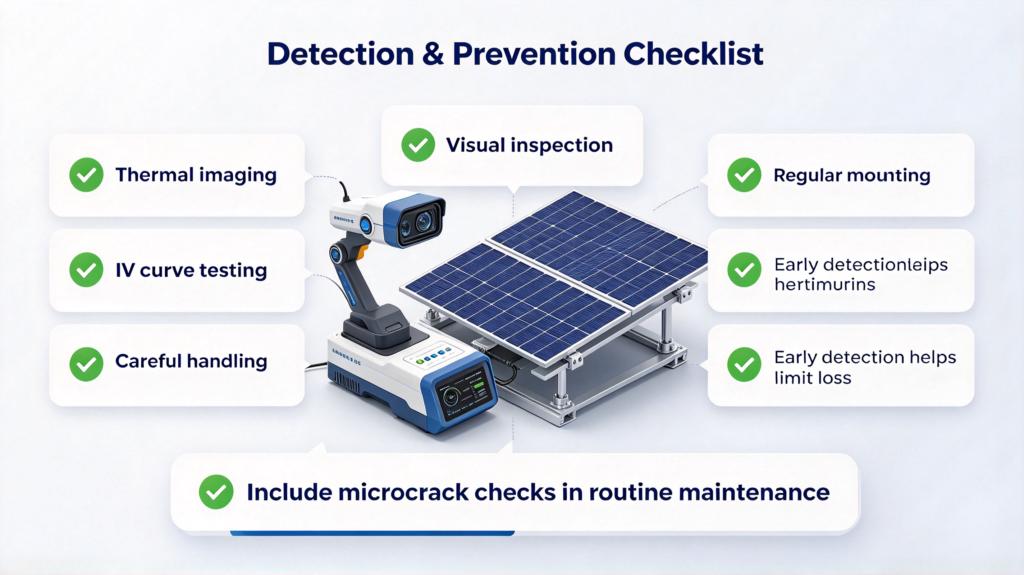
What You Can Do Yourself
- Watch for the outlier. If you have per-panel monitoring, look for the one panel that is consistently lower than its neighbours in the same conditions.
- Compare like months. Not July against December – this July against last July.
- Look at the panel from a low angle in strong, low sunlight early or late in the day. A slant reveals more than looking straight on.
- Get a thermal scan once, from ground level if possible, if you have any reason to suspect damage – after a hailstorm, after a roof repair, or after noticing a decline. System monitoring tells you when to bother.
Can a Microcrack Be Repaired?
No. The cell is inside a sealed laminate, and there is no way to reach it without destroying the panel. There is also nothing to glue back together – the crack is a fracture through a brittle wafer, not a tear in a fabric.
What you decide instead is whether to leave it, add module-level electronics to isolate it, or replace it. See whether a damaged panel is worth replacing for how that decision usually goes.
Is It Covered by Warranty?
Usually not, and this is the part that surprises people.
Manufacturing defects are covered for 10-12 years. But a microcrack is nearly always classified as handling or impact damage, and impact damage is not a defect. Unless you can show the crack was present before installation – which requires documentation from the day of install – the claim will be refused.
That is the practical argument for photographing your array on install day and keeping the file.
FAQ
What are solar panel microcracks?
Hairline fractures inside the silicon cells of a panel, caused by handling, hail, impact or thermal stress. The glass on top stays intact, so the damage cannot be seen from outside.
Can you see microcracks with the naked eye?
Almost never from any normal distance. Detecting them properly needs electroluminescence imaging or a thermal camera, because the crack is inside the laminate and produces no visible change to the cell’s appearance.
Do microcracks reduce solar panel output?
Usually slightly, and sometimes not at all. Output loss typically shows up as one panel running a few percent below its neighbours. The bigger concern is the small share that develop into hot spots.
Can microcracks cause a fire?
They can contribute to one. A cracked cell creates local resistance and heat, and sustained heating can damage the encapsulant and backsheet. It is uncommon, but it is the reason a hot spot should not be ignored.
Are microcracks covered by the warranty?
Rarely. Warranty covers manufacturing defects, and microcracks are normally classified as handling or impact damage. Without documentation from installation day, the claim is usually refused.
2 thoughts on “Solar Panel Microcracks: The Damage You Cannot See”