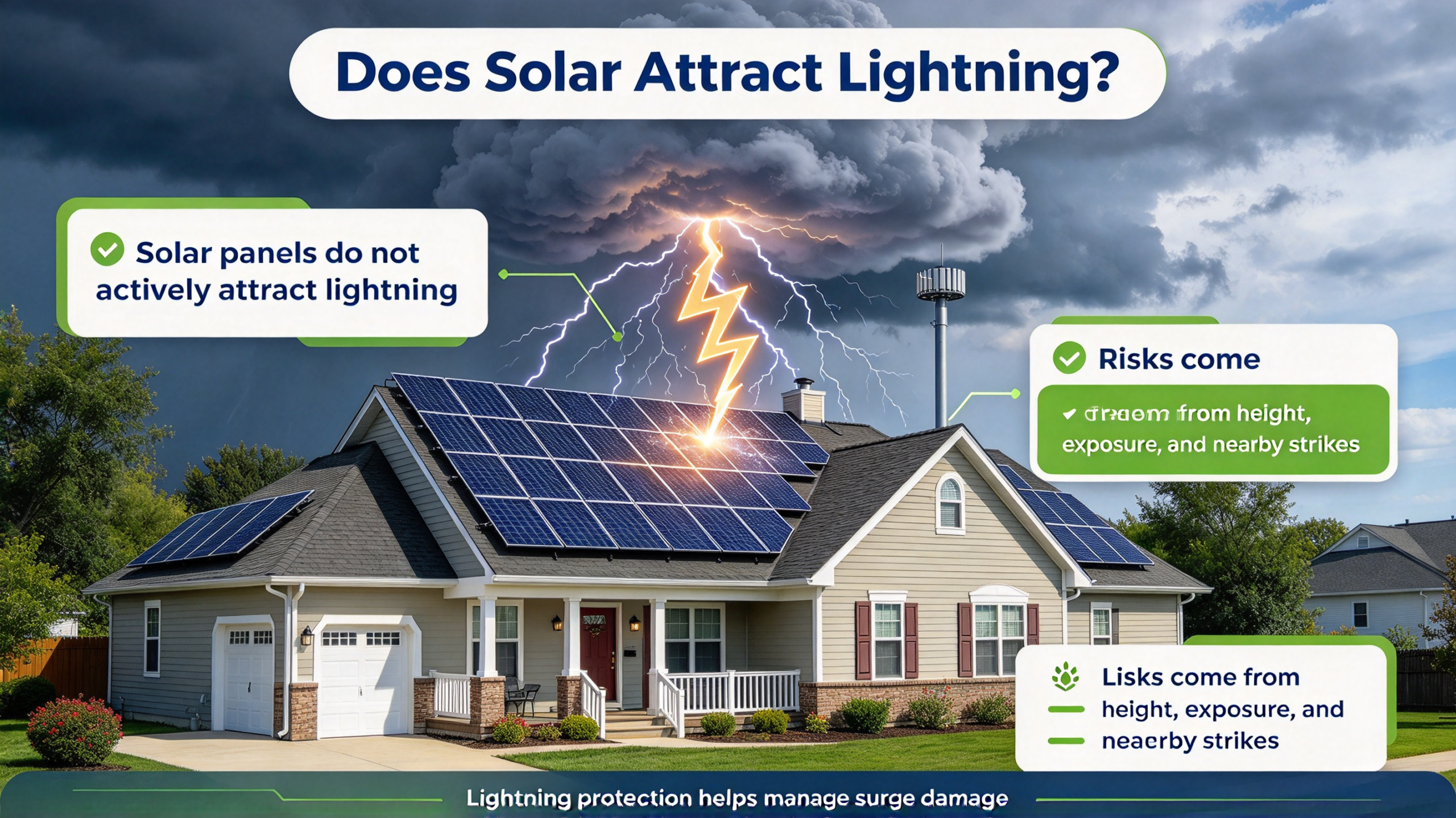
TL;DR: Do solar panels attract lightning? There is no credible evidence that they do – they are not tall enough to change where lightning goes on a typical house. What they can do is collect surge damage from a nearby strike, and the part that usually fails is the inverter. A surge protective device costs a fraction of an inverter replacement, which is why it is worth considering before storm season rather than after.
Do Solar Panels Attract Lightning?
Short answer: no. A rooftop array does not make your house more likely to be struck.
The confusion comes from two things that feel connected but are not. First, four hours before the storm you were fine; four hours later the system was damaged – so the panels seem to be the cause. Second, an array does add metal and surface area to the highest part of the roof, which sounds like an invitation.
What actually matters for where lightning strikes is the height and shape of the structure and the local ground conditions, not whether the roof has panels on it. A solar array on a typical pitched roof does not reach high enough to change that decision.
What Actually Damages A Solar System
Two different events get called “a lightning strike”, and they behave very differently:
- A direct strike on the array or the house. Rare, and usually catastrophic – you would know it had happened. Insurance claim territory rather than repair territory
- A nearby strike or a surge on the utility lines. Far more common. No visible damage, no scorch marks, but sensitive electronics take the hit
The second case is the one that catches owners out, because nothing looks wrong. The system simply stops producing, or produces less, and the monitoring app shows an inverter fault.
Why The Inverter Fails First
The inverter is the expensive electronic component in the system, and it sits between two long pieces of wiring – the DC side running down from the roof, and the AC side running to the main panel. A surge arriving from either direction has to pass through it.
Panels themselves are relatively robust to surges; the electronics are not. This is why a storm event usually ends with a failed inverter, a dead monitoring gateway, or both, while the panels test fine. If that has already happened to you, our guide to inverter error codes explains which faults point to surge damage, and the cost of replacing an inverter is worth knowing before you decide how to handle it.
The Protection That Actually Works
| Measure | What it does | Typical installed cost |
|---|---|---|
| DC surge protective device | Clamps surges arriving on the rooftop DC wiring | $150-$500 |
| AC surge protective device | Protects against surges arriving through the utility supply | $200-$600 |
| Grounding and bonding | Required by code; gives fault current a defined path | Part of the install |
| Rapid shutdown | Reduces voltage on the roof conductors for safe isolation | Standard on new systems |
| Homeowners insurance | Covers the loss itself, subject to your policy terms | Existing policy |
Notice the numbers: a DC surge protector costs a fraction of the inverter it protects. This is the same logic as a whole-house surge protector on your main panel – cheap protection against an expensive failure.
Product warranties are the part owners miss. Lightning damage is normally excluded from both panel and inverter warranties, which means the claim usually goes to your property insurer instead. Our guide to solar panel insurance covers how that side of it works.
Do You Actually Need Surge Protection?
It is not mandatory in most installations, so the decision comes down to exposure. Surge protection tends to make sense when:
- You live in a region with frequent thunderstorms
- The array is on a long rooftop run, or on a detached garage or outbuilding with a long cable route back to the house
- The site is exposed – open ground, hillside, the highest structure nearby
- You are installing an expensive inverter, or one with a long lead time to replace
If none of those apply, this is optional. If two or more apply, the cost is small compared with the risk. Ask for it as a line item at the design stage, because retrofitting surge protection is more expensive than including it in the original install.
What To Do After A Storm
- Check production first. A flat line, or production well below the same day last week, is the earliest signal
- Look for a fault code on the inverter rather than a green light. A green light does not mean the electronics survived
- Inspect the array and wiring from the ground for scorch marks, melted connectors or a damaged junction box
- Do not open the DC side yourself. Rooftop conductors stay live in daylight
- Document everything with photos and dates before contacting your insurer – including the monitoring graph, which is the best evidence that something changed on a specific day
- Call the installer to test the DC side and confirm whether the inverter or the modules took the damage
Myths And Reality
- “The panels attracted it.” There is no evidence an array changes strike probability on a typical house
- “If the panels look fine, nothing is damaged.” Surge damage is usually invisible from outside
- “The warranty will cover it.” Lightning is normally an exclusion; that is what insurance is for
- “Surge protection is a gimmick.” It is the same principle as a whole-house surge protector, and it is priced accordingly
- “It only happens to people in storm states.” Surges travel along utility lines, so distance from the strike does not guarantee anything
Storm damage is one failure mode among several. If you want the wider picture of what goes wrong on a solar system and how each fault presents itself, our roundup of common solar panel problems is the place to start.
FAQ
Do solar panels attract lightning strikes?
No. There is no credible evidence that a rooftop array makes a house more likely to be struck. Where lightning goes is decided by the height and shape of the structure and local ground conditions, not by the presence of panels.
Can a nearby lightning strike damage solar panels?
Yes, indirectly. A surge induced on the wiring can damage the inverter and monitoring hardware even when the strike lands some distance away. That kind of damage is usually invisible from outside.
What is the most common damage after a lightning event?
Inverter failure, followed by damage to monitoring equipment. The modules themselves are comparatively robust, which is why a system can test fine on the roof while the electronics need replacing.
Does insurance cover lightning damage to solar panels?
Homeowners insurance commonly covers storm and lightning damage to the system, subject to your policy terms. Manufacturing warranties usually exclude it, so the claim normally goes to your property insurer.
Is surge protection worth adding to a solar system?
Where storms are frequent, the site is exposed, or the cable runs are long, a DC surge protective device costing a few hundred dollars is reasonable protection for an inverter that may cost thousands to replace.
Related: Are Solar Panels Hurricane Proof? Wind Ratings, Prep And Insurance