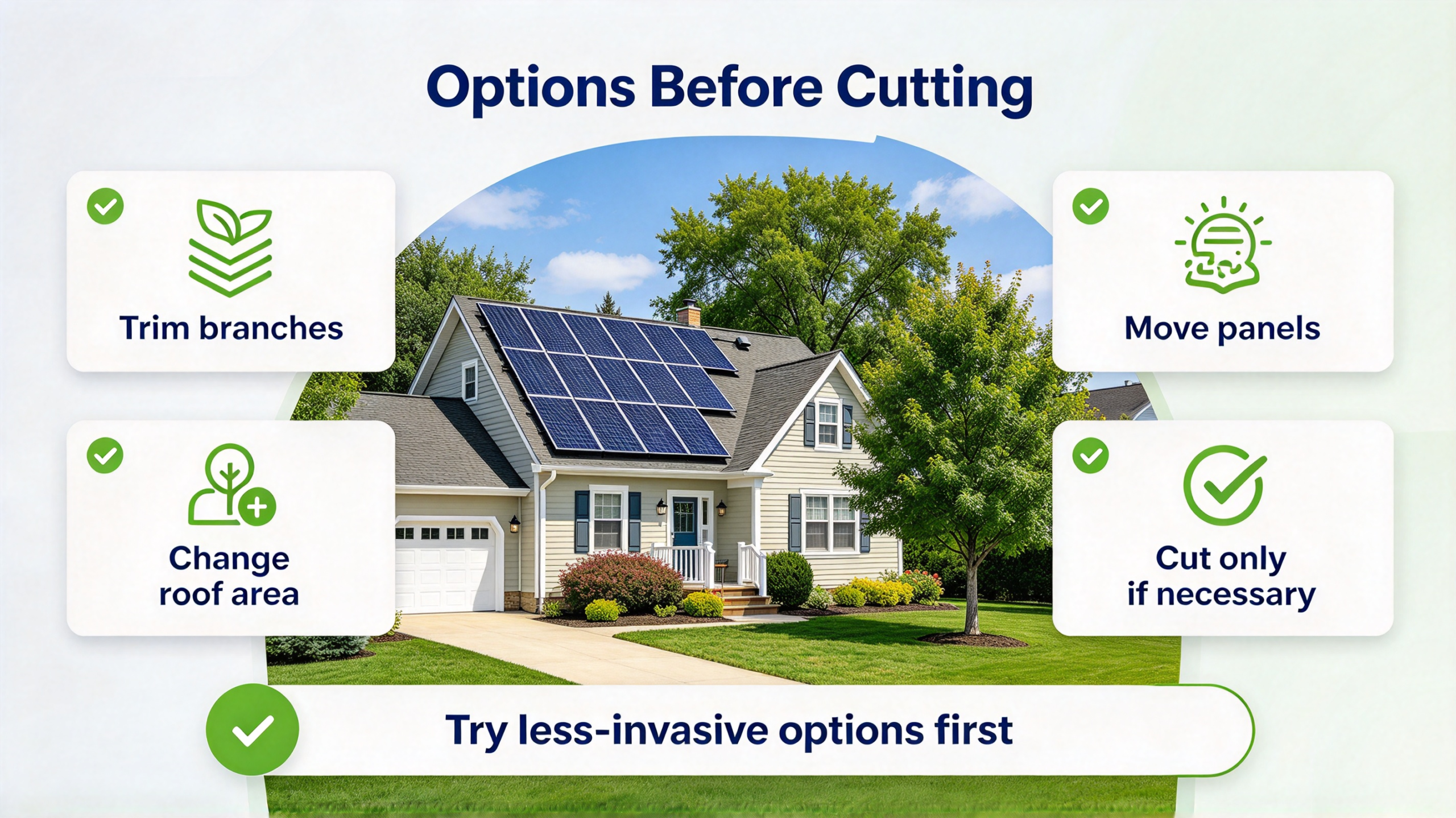
TL;DR: Do you need to cut down trees for solar? Usually not. Most shade problems fall into one of three groups: shade that costs almost nothing and can be ignored, shade that trimming fixes, and shade that no amount of trimming will solve. The test is to find out which one you have before anyone touches a saw – and the answer is decided by how much shade lands on the array between mid-morning and late afternoon.
Do You Need To Cut Down Trees For Solar?
Three possible answers, and only one of them involves removing a tree:
- Ignore it. Shade that arrives early or late in the day, or that only touches the edge of the array in midwinter, often costs a couple of per cent a year – not worth a chainsaw
- Trim it. Shade in the middle of the day can often be solved by lifting the canopy, and that is a recurring job rather than a one-off
- Change the plan instead. If shade covers the best roof face all afternoon, removing the tree is not the cheapest fix – moving the array or adding module-level electronics usually is
The mistake almost everyone makes is judging shade by eye at the wrong time of day. A tree that looks harmless at 8am can be the problem at 1pm.
Why Shade Costs More Than People Expect
Solar panels are wired in strings. On a conventional string inverter, the current has to pass through every panel in the series, and the weakest panel sets the limit for the whole string. Cover one panel heavily and the string can drop well below what the remaining panels are producing.
That single fact is why shade matters more than the area it covers. It also explains the three ways to make a system more tolerant of it:
- Microinverters or optimisers. Each panel behaves independently, so shade on one module does not drag the rest down
- More MPPT trackers. Shaded panels can be placed on their own input rather than shared with clean ones
- A different layout. Keeping the shaded area off the array entirely
The trade-offs are set out in our comparison of microinverters and string inverters, and the underlying behaviour is covered in our explainer on how panels behave in shade and clouds.
The Three-Step Test
This takes about twenty minutes and gives you a number instead of an opinion:
- Step 1 – find the valuable hours. The bulk of a system’s daily output is produced between roughly 9am and 3pm. Shade outside that window matters far less than shade inside it
- Step 2 – watch the array at those hours, not at random. Check where the shadow falls at 9am, noon and 3pm. A sun-position app on a phone will show you where the sun will be in December, which is the month that decides how bad the problem really is
- Step 3 – count panels, not trees. What matters is how many modules sit in shadow, and for how long. One panel shaded for thirty minutes is a different situation from four panels shaded for four hours
If the installer is quoting only from a satellite image, ask them to bring a shade measuring tool or to walk the site at midday. Simulation software is good, but it is not a substitute for standing in the garden.
What The Numbers Roughly Look Like
| Level of shade | Typical annual production loss | What usually fixes it |
|---|---|---|
| Edge of array, early or late only | 1-3% | Nothing – accept it |
| One panel, part of the morning | 3-8% | Trimming, or per-panel electronics |
| Two to four panels through the midday window | 8-20% | Trimming, re-layout, or a bigger system |
| Half the array shaded in the afternoon | 20-40% | Different roof face, relocation, or removal |
Those ranges are planning estimates, and a real figure depends on layout, the type of inverter and exactly when the shadow lands. Treat them as a way to judge whether you are arguing about 3% or about 30% – because only one of those is worth a serious decision.
Trimming Versus Removing
These are not the same decision, and the difference is time:
- Trimming is recurring. A tree grows back. Lifting the canopy might solve the problem for three years, then it starts again – so budget for it as maintenance, not as a one-off
- Trimming has limits. If the canopy is taller than the roof line, or the trunk is close to the house, cutting back the legal or practical amount may not clear the array
- Removal is permanent but expensive, and the cost rises fast with height, access and proximity to the building
- Check the rules first. Some trees are protected, and trees on a boundary line may need a neighbour’s agreement or a permit, depending on where you live
A useful way to think about it: a tree near a house also provides summer cooling, wind protection and property value. Removing it to gain 4% of production is usually a poor trade; removing it to gain 30% may not be.
Better Options Before You Cut Anything
- Shift the array to a less shaded roof face and accept slightly lower annual yield in exchange for a cleaner production curve
- Use module-level electronics so shade affects one panel rather than a whole string
- Add a few panels elsewhere to make up the lost production – often cheaper than tree work
- Accept a slightly smaller system. If the shade is on the west face, sizing down and keeping the array clean can produce more than a bigger array fighting the shadow
Working out how much capacity you actually need comes first, because the shade decision changes shape once you know the target. Our simple method for how much solar power you need is the right starting point.
When Removing A Tree Is The Right Answer
- The tree is already dead, diseased or dropping large limbs
- It is shading the only usable roof face for most of the day, all year
- It is causing the roof problem anyway – moss, debris, blocked gutters
- It is your tree, in a position where removal is straightforward
If two or more of those apply, removal is a legitimate part of the project rather than an overreaction. If only one applies, price the alternatives before booking a tree surgeon.
And if the shade turns out to be unavoidable on one roof face, the next question is how much of it you can recover by other means – our guide to how much shading is too much covers where that line sits.
FAQ
Do I have to cut down trees to get solar?
No. Most installations tolerate some shade, and only shade during the middle of the day has a large effect on annual production. Measure it before deciding, and price the alternatives – trimming, per-panel electronics, or a different roof face – alongside removal.
How much production do I lose from one shaded panel?
On a string inverter, one badly shaded panel can reduce output across the whole string, so the loss can be several times larger than the panel’s own share of the array. With microinverters or optimisers, the loss is closer to that panel alone.
Is trimming a tree enough, or do I need to remove it?
Trimming works when the shadow comes from lower branches that can be lifted clear of the array. If the shade comes from the top of a tall canopy, trimming rarely solves it permanently and the tree regrows.
When is the best time of year to check for shade problems?
Midwinter. The sun is at its lowest point of the year, shadows are at their longest, and that is when a marginal installation either works or does not. If the array is clear in December, it will be clear all year.
Can solar panels work in partial shade at all?
Yes, they produce in proportion to the light they receive, but shade on a string system is not proportional – it is amplified. That is why the arrangement of the panels and the choice of inverter matter more than the amount of shade in percentage terms.
Related: Solar Panel Orientation And Tilt – How To Maximize Energy Output