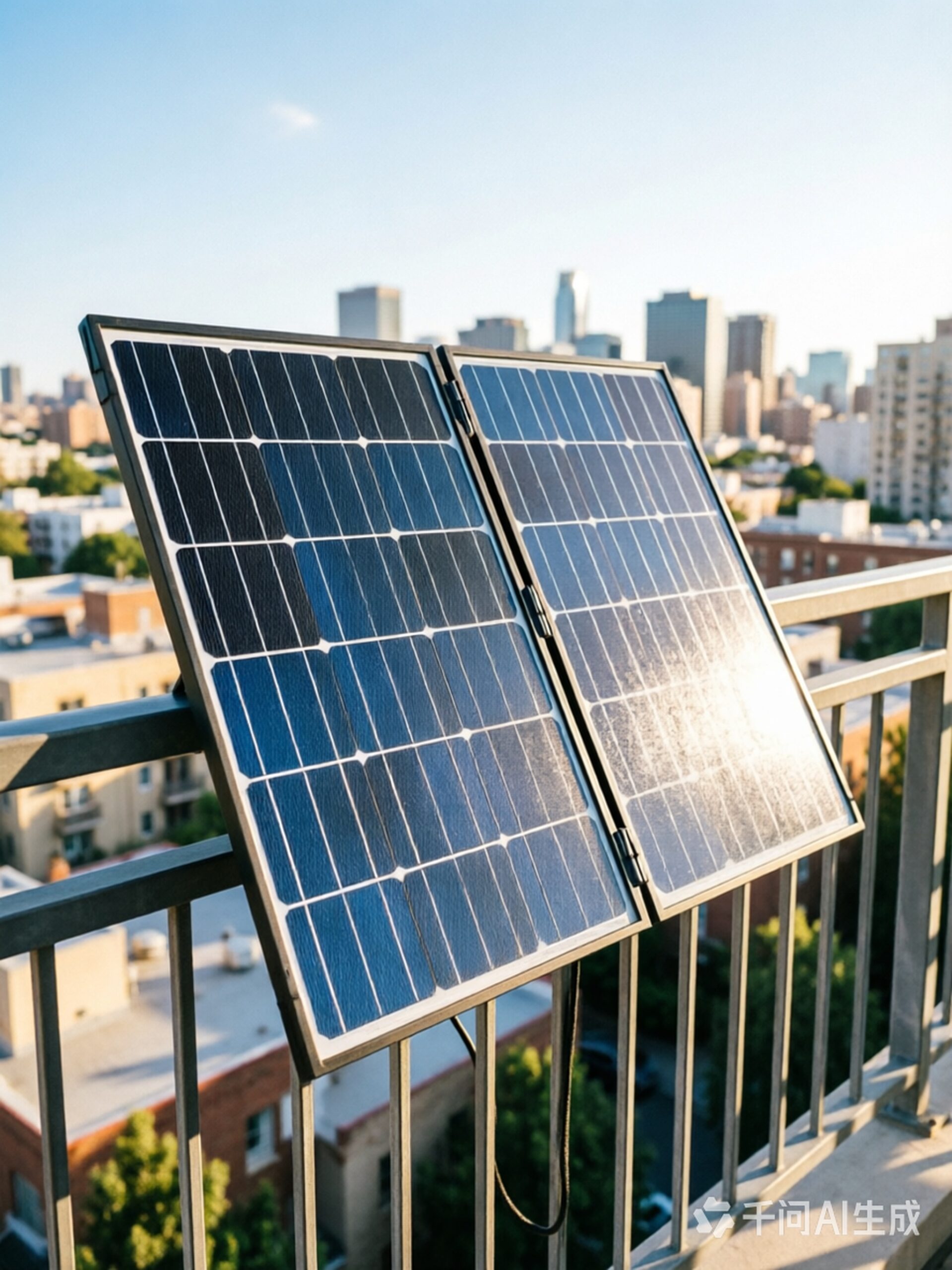
TL;DR: Solar panel orientation and tilt are two separate settings: azimuth (which way it faces) and tilt (how steeply it stands). Face true south in the Northern Hemisphere, set tilt near your latitude, and accept that being within 15 degrees of either is fine. This page is the setup guide: how to find true south, convert roof pitch, and choose a mount.
You do not need a perfect angle. You need the right direction, a reasonable tilt, and no shade. This guide covers the practical steps: checking true south, reading your roof pitch, and choosing between a flush mount, a tilted rack and a ground mount.
The Two Settings, in Plain Terms
| Setting | What it is | What it controls |
|---|---|---|
| Orientation (azimuth) | Compass bearing the panel faces, 180 = true south | Total annual energy and the time of day it arrives |
| Tilt | Angle between the panel and the ground | How output is spread across the seasons |
Direction has the larger effect. If you want the full comparison, it is in solar panel angle vs direction. This page assumes you have accepted that and now need to set both correctly.
Find True South, Not Compass South
A phone compass points at magnetic north, and magnetic north is not true north. In the continental US the declination ranges from about 16 degrees east on the Pacific coast to about 17 degrees west in the Northeast. That is enough to shift a due-south roof into a south-southeast one.
Three reliable ways to find true south:
- Solar noon. At solar noon a vertical pole’s shadow points true north. Solar noon is not 12:00 on the clock; look up the time for your location and date.
- Sun-path tool. SunCalc or a solar design app draws the true south line and the December shadow line for your address.
- Satellite map with a bearing tool. Google Earth can show the roof plane and its bearing directly.
Read Your Roof Pitch in Degrees
US roofs are described as rise over 12 inches of run. Convert it before comparing with the ideal tilt.
| Pitch | Degrees | At 35 degrees latitude |
|---|---|---|
| 2/12 | 9.5 | Too shallow, but workable |
| 3/12 | 14.0 | About 20 degrees under |
| 4/12 | 18.4 | About 15 degrees under |
| 5/12 | 22.6 | About 10 degrees under |
| 6/12 | 26.6 | About 5 degrees under |
| 7/12 | 30.3 | Essentially ideal |
| 8/12 | 33.7 | Essentially ideal |
| 10/12 | 39.8 | Slightly steep, good in winter |
| 12/12 | 45.0 | Steep, sheds snow well |
Almost every pitched roof in the US already sits within 15 degrees of a good tilt. Do not add tilt frames to a 4/12 or steeper roof; the hardware costs more than the energy it recovers.
Which Roof Planes Are Worth Using
| Facing | Output vs south | When it makes sense |
|---|---|---|
| True south | 100% | Always the first choice |
| SE or SW | 93-96% | Close enough, use it |
| ESE or WSW | 86-90% | Acceptable if south is full |
| East or west | 78-84% | Only if the roof is otherwise unusable |
| North | 48-58% | Usually a mistake |
If you have several planes, fill the best one first, then the next. Splitting an array across east and west needs separate strings or microinverters and produces a flatter, lower total.
Mounting Options and What They Do to Tilt
| Mount | Tilt | Best for | Trade-off |
|---|---|---|---|
| Flush roof mount | Follows the roof pitch | Pitched roofs, most homes | Cannot correct a poor angle |
| Tilted roof rack | 5-15 degrees added | Low-slope roofs under 15 degrees | Wind load, extra hardware |
| Ground mount | Set freely | Yards, poor roofs, snow | Footings, trenching, permit |
| Ballasted flat roof | 5-10 degrees | Commercial membranes | Heavy ballast, row spacing |
On a low-slope roof, a small tilt frame can recover 5-10% of output, but it also increases wind uplift and roof penetrations. The trade-offs by roof type are in solar panels on different roof types.
How Much You Lose When It Is Not Perfect
| Error | Typical annual loss |
|---|---|
| Azimuth within 15 degrees of south | 1-2% |
| Azimuth 30 degrees off south | 3-5% |
| Azimuth 45 degrees off south | 6-9% |
| Tilt within 15 degrees of ideal | 1-3% |
| Tilt 30 degrees off ideal | 8-11% |
This is why “close enough” is a real strategy. The last 10% of perfection costs more in hardware and labour than it returns in energy.
Shade Beats Both Settings
A chimney shadow across one module can cost more than 30 degrees of tilt error. Check the roof at 9am, noon and 3pm, and look at the winter horizon, not just the summer trees. The threshold is covered in how much shading is too much.
Setup Checklist
| Check | How |
|---|---|
| True south | Solar noon shadow or SunCalc |
| Roof bearing | Satellite bearing tool |
| Roof pitch | Pitch gauge or the table above |
| Shade at 9, 12 and 3 | Photos on a clear day |
| Plane priority | Best azimuth first, then next |
| Mount type | Flush unless the pitch is under 15 degrees |
Once the layout is set, the remaining choice is the exact tilt number. That is covered in solar panel angle calculator.
Conclusion
Solar panel orientation and tilt are simple once you separate them: find true south, read the roof pitch, and pick the best plane you have. Being within 15 degrees of either ideal is good enough for almost every home. Spend the effort on shade and layout instead.
FAQ
Which direction should solar panels face?
True south in the Northern Hemisphere and true north in the Southern Hemisphere. Southeast and southwest are within about 5% of south.
What is the best tilt angle for solar panels?
Close to your latitude for a fixed system. At 35 degrees latitude, 30-35 degrees is effectively ideal.
Is an east- or west-facing roof bad for solar?
It produces 78-84% of a south array but spreads output into morning or evening, which can suit time-of-use tariffs.
How much output do I lose if my roof is not perfect?
About 1-2% within 15 degrees of south, 6-9% at 45 degrees off, and 1-3% within 15 degrees of the ideal tilt.
Should I add tilt frames to a pitched roof?
No. On a 4/12 or steeper roof the gain is small, and the wind load, penetrations and cost are not worth it.
How do I find true south?
Use the shadow at solar noon or a sun-path app. Do not trust a phone compass without correcting for magnetic declination.
Does tilt matter more than direction?
No. Direction has roughly three to four times the impact on annual output.
Can I correct a low-slope roof?
Yes, with a tilt rack of 5-15 degrees, but check wind uplift and penetrations first.
What if my roof faces north?
It produces 48-58% of a south array. Price a ground mount or a carport before accepting that.
Do I need to change the tilt in winter?
Only on an adjustable mount. The gain is 3-5% a year, and climbing a roof twice a year is rarely worth it.
How do I measure my roof pitch?
Use a pitch gauge or a level and tape: rise over 12 inches of run, then convert with the table above.
Related: Solar Panel Angle vs Direction
3 thoughts on “Solar Panel Orientation and Tilt – How to Maximize Energy Output”