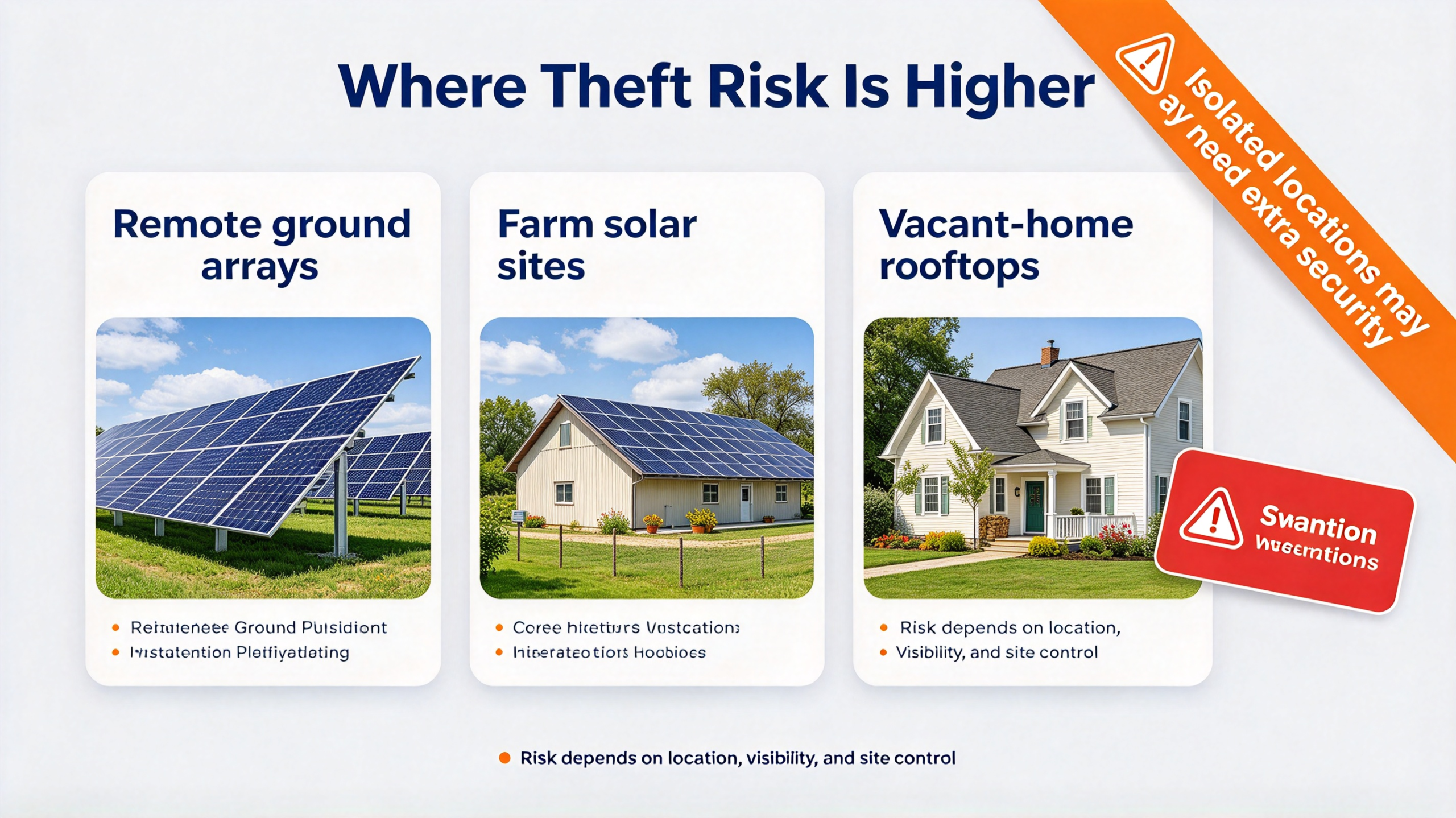
TL;DR: Solar panel theft is rare on rooftops, because getting up there with tools and coming back down again is slow and visible. The real exposure sits with ground mounts, rural and commercial sites, and construction-phase jobs where the equipment is staged before it is installed. The defence is not expensive: locked hardware, a serial-number record, lighting or a camera, and monitoring that tells you within hours.
How Common Is Solar Panel Theft?
The honest answer depends entirely on where the system is, not on how much solar there is in the area.
- Rooftop residential systems: uncommon. A thief needs a ladder, time, somewhere to put the modules and a way to move them without attracting attention
- Ground mounts and rural arrays: higher risk, because the panels are at working height and the site is often dark and unobserved
- Commercial and utility sites: targeted in some regions, usually for cable rather than for modules
- Construction phase: the most exposed period of a project. Equipment sits on site, sometimes for days, before anyone is living there or watching it
So the useful question is not “are panels stolen?” but “is my array the easy target on this street?”
What Thieves Actually Take
It is usually not what owners expect:
- DC cable. Copper has a resale value everywhere, needs no serial number, and can be cut out in minutes. This is the most common target on larger sites
- Ground-mount modules. Accessible, unbolted from above, and taken in multiples
- Inverters. Valuable, but heavy, and usually inside a locked enclosure
- Mounting hardware and racking. Occasionally, most often on job sites
Modules are the least attractive item of the four, because each one carries a serial number and a matching model code. That does not make them theft-proof, but it does explain why cable and loose equipment disappear more often than panels do.
Why Ground Mounts Are Different
A ground mount is a row of expensive panels at knee or chest height, often on a property with no fence, no lighting and no neighbour with a view of it. Everything that makes a ground mount good for production also makes it easy to reach.
That does not mean ground mounts are a bad choice – they are often the best option, and the design trade-offs are covered in our comparison of ground-mounted and roof-mounted systems. It means the security question belongs in the design conversation rather than being thought about afterwards.
The Cheap Deterrents That Actually Work
| Measure | What it stops | Typical cost |
|---|---|---|
| Security bolts or locking clamps on the racking | Quick removal of modules | $200-$800 for a residential array |
| Serial number record with photos | Resale, and problems with insurance claims | Free |
| Motion lighting | Approach at night, which is when most theft happens | $100-$400 |
| Camera covering the array | Approach, and provides evidence afterwards | $150-$600 |
| Fencing or a planted screen | Vehicle access and visibility from the road | Varies widely |
| Conduit instead of exposed cable runs | Cable cutting, the most common loss on larger sites | Part of the install |
The pattern is the usual one: the cheapest measures prevent the most common losses. Locking hardware and a serial record cost very little and remove most of the motive, because stolen modules that can be identified are hard to sell.
Marking Your Panels: What Actually Works
The point of marking is not deterrence on the night. It is making the modules unsellable afterwards.
- Photograph every serial number while the panels are new. The label is usually on the back sheet or the frame, and it becomes unreadable after a few years of weather
- Record the model code alongside the serial. Buyers and recyclers check both
- Visible marking helps, permanently marking helps more. Engraving or a UV marker on the frame is not visible to a thief at night, but it is what makes a panel identifiable when it turns up somewhere
- Keep the file somewhere you will still find it in three years. A cloud folder beats a photo on a phone that gets replaced
An identifiable module is a liability to whoever is holding it. That is the whole mechanism.
Monitoring Is Your Alarm System
Most arrays already have a monitoring platform, and it is the fastest way to notice that something has physically disappeared.
- A string dropping to zero while the rest of the array produces normally is an electrical signature, not a weather pattern
- A sudden drop in the middle of a clear day points to something being disconnected rather than cloud
- Flat output from a section of the array can mean modules are gone rather than faulty
- No data at all may mean the gateway or its supply cable has been taken
The practical step is to know what normal looks like, so an abnormal day stands out immediately. Our walkthrough on tracking your system’s output explains what to watch and how often.
Does Insurance Cover Stolen Panels?
A solar system is usually treated as part of the property or as scheduled equipment, so theft is normally a covered peril under a homeowners or commercial policy.
- Check the deductible before assuming a claim makes sense – a small loss may be cheaper to absorb
- Expect to provide evidence: a police report, serial numbers, and the original installation documentation
- Ground mounts and detached structures sometimes have separate limits, so confirm that the array is included
- Business interruption cover matters on commercial sites where lost production has a cost of its own
Our guide to solar panel insurance covers the rest of what policies typically do and do not include.
If It Happens: What To Do
- Do not touch damaged wiring. Cut cables can leave live conductors exposed, and the DC side stays energised in daylight
- Report it to the police and get a reference number – insurers will ask for it
- Call the installer to isolate the affected strings safely and confirm what is missing
- Photograph what remains, including serial numbers of any modules left in place
- Check the monitoring history for the exact time the output changed; that timestamp helps both the police report and the claim
Buying A Property With Panels: Check The Record First
If you are buying a house with an existing array, the theft question turns into a documentation question. Ask for the serial number record, the installation paperwork and the monitoring account details – not because the panels might have been stolen, but because those three things tell you whether the system was installed properly and whether you can claim on it later.
An array with no paperwork is not necessarily a bad array. It is an array you cannot insure properly, cannot claim on, and cannot verify. That is worth knowing before you sign.
Record Your System Before Anything Happens
This is the step almost nobody does, and it is free:
- Photograph every panel’s serial number while they are still on the roof or rack
- Keep the model codes, installation date and installer details in one folder
- Photograph the inverter and any monitoring hardware
- Save the monitoring app login somewhere you will still have it in three years
That folder is what turns a vague claim into a straightforward one, and it is also the reason stolen equipment is harder to move on: an identifiable module is a liability to whoever is holding it.
Theft is one of the less common ways a system fails, and knowing the others makes an array easier to look after – our roundup of common solar panel problems covers the rest.
FAQ
Is solar panel theft a real problem?
It varies by location. Rooftop residential systems are rarely targeted because access is slow and visible. Ground mounts, rural arrays, commercial sites and construction-phase installations carry most of the real risk.
What gets stolen most often from a solar system?
Copper DC cable is the most common target because it can be removed quickly and has resale value everywhere. Modules and inverters are taken too, but they are heavier and easier to trace.
Does insurance cover stolen solar panels?
Theft is normally a covered peril under a homeowners or commercial policy, subject to your deductible and the terms for detached structures. Keep serial numbers and a police report reference to support the claim.
How do I stop solar panels being stolen from a ground mount?
Locking hardware, lighting or a camera covering the array, and a serial number record. Removing the resale value matters more than physical security: identifiable modules are difficult to sell on.
Can monitoring tell me if panels have been stolen?
Yes. A string dropping to zero while others produce normally, or a sudden loss on a clear day, is usually an electrical or physical event rather than weather. The timestamp it provides is valuable evidence.
Do solar panels have serial numbers?
Yes, every module has a serial and a model code on a label on the back sheet or frame. That is precisely why modules are the least attractive thing to steal – and why photographing the labels on install day is the cheapest protection you can buy.
Can stolen solar panels be tracked?
Sometimes. The serial number is what makes it possible, because legitimate resale channels and recyclers check them. Without a record of the numbers, there is nothing to match against.
1 thought on “Solar Panel Theft: How Common Is It And How To Prevent It”