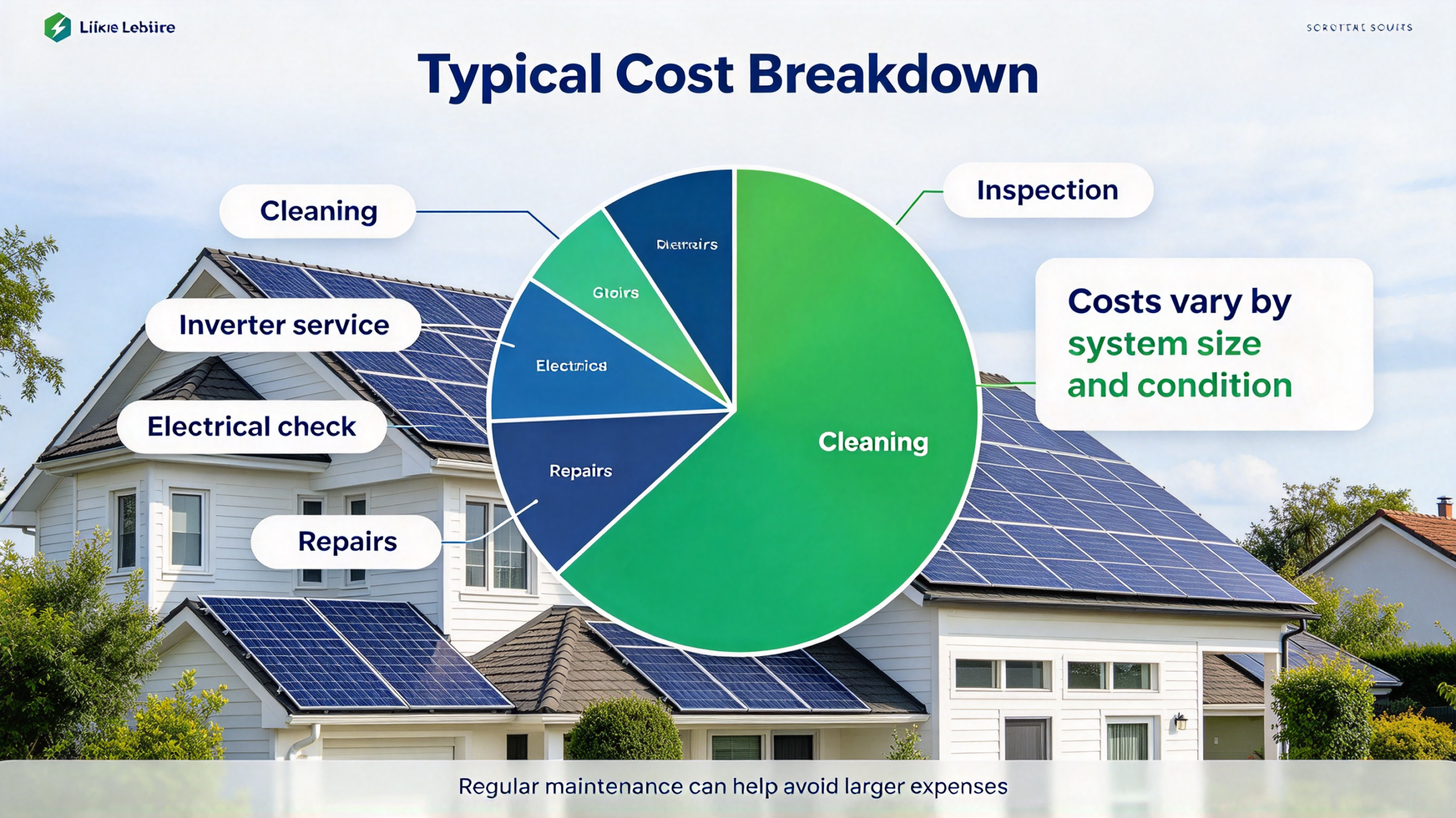
TL;DR: The annual solar maintenance cost for most homes runs between $0 and $200 during the fiTL;DR: Solar panel maintenance cost for most homes runs between $0 and $200 during the first 10-15 years, because panels, racking and wiring have no moving parts to wear out. The real costs arrive later: an inverter replacement around year 10-15, optional cleaning, and one-time storm repairs. Spread those over the system’s life and a realistic average budget is roughly $150-$300 per year.
Solar marketing usually skips past maintenance, which leaves homeowners guessing. The honest answer is that you will spend almost nothing for a decade, and then a few larger bills will show up. Planning for both is what keeps the numbers boring.
When Does Solar Panel Maintenance Cost Anything At All?
There is nothing to lubricate, no belts, no filters, and no fuel. A solar array is panels bolted to a rack, wired to an inverter, and connected to a meter. Rain handles most of the cleaning, wind keeps leaves moving, and the inverter reports its own performance.
- Product warranty: panels typically carry 25 years on power output and 10-12 years on materials and workmanship
- Monitoring: most inverters include free app-based monitoring for the life of the unit
- No scheduled service: manufacturers do not require annual servicing to keep the warranty valid
That last point is worth repeating, because it is the most commonly misunderstood part of solar ownership. Nobody needs to come out every year.
Cleaning: The Only Routine Item
Cleaning is almost always discretionary. Rain does most of the work. A professional visit generally runs $150-$500 depending on roof height, pitch, and system size. Doing it yourself costs the price of a soft brush and distilled water, if you are willing to work safely from the ground with a long pole. Solar panel cleaning cost covers when it is actually worth paying for.
The Inverter: Where The Real Money Goes
String inverters typically last 10-15 years, and replacing one costs roughly $1,000-$2,500 installed. Microinverters usually last longer but cost $150-$400 each if one fails. Budget a reserve of about $100-$200 per year from the day the system is installed, and the eventual replacement will not feel like an emergency. Solar inverter replacement cost has current pricing.
Storm Damage: Usually An Insurance Question
Hail, wind, and falling branches are the most common cause of unplanned spending. Most of these are insurance claims subject to your deductible, not maintenance. Two or three cracked panels after a hailstorm can easily exceed a $1,000 deductible, so it usually makes sense to file. What insurers expect in that claim is covered in solar panel hail damage, and the policy side is in solar panel insurance.
Does Monitoring Or Insurance Add An Ongoing Cost?
Monitoring: usually free. Some third-party platforms charge a subscription, but the manufacturer’s own app generally does not.
Insurance: adding solar increases the insured replacement value of your home, so some carriers raise the premium slightly. Expect a small increase rather than a large one, and tell your insurer the system was added – an unlisted array can complicate a future claim.
Batteries And Roofs
A battery adds nothing to annual maintenance. There is no servicing to do, but the battery itself will need replacement at some point, which is a capital cost rather than an annual one. Solar battery maintenance covers how to stretch its life.
A roof replacement is not a solar cost, but it belongs in the plan. If the roof needs replacing, the panels have to come off and go back on, which is a separate expense from the roofing itself.
The Cost Year By Year
- Years 1-5: $0-$100 per year – monitoring and the occasional visual check
- Years 6-10: $0-$200 per year – the same, plus optional cleaning
- Years 10-15: $200-$400 per year, or a single $1,000-$2,500 inverter bill if you did not save for it
- Years 15-25: $100-$300 per year, with panel output slowly declining on its own
- 25-year average: roughly $150-$300 per year, all in
What Changes The Number
Those ranges assume an average home in an average climate. Five things move them:
- Climate and soiling. A dusty, agricultural or high-pollen location can mean three washes a year instead of one, and that is the biggest swing on the annual figure
- Roof height and pitch. Cleaning quotes are built on access more than on panel count – a steep two-storey roof costs more to reach
- System size. Cleaning and inspection scale with the array, but not in proportion: a 4kW and an 8kW system often cost similar amounts to wash
- Local labour rates. Inverter replacement is the one line item where regional labour makes a visible difference, and it is also the largest single bill you will face
- Whether you have a battery. It adds nothing to annual maintenance, but it adds a second capital replacement to plan for
How It Compares To What You Save
A useful sanity check: maintenance should stay a small fraction of what the system earns.
A typical 5kW array saves somewhere in the region of $1,500-$2,000 a year on electricity, depending on local rates. Against that, $150-$300 a year of maintenance is roughly 10-15% of the savings – and most of it arrives in the two years around the inverter replacement rather than spread evenly.
That comparison is also the practical test for any annual contract. A plan costing $600-$1,000 a year would be 30-50% of your savings, spent on equipment that has no scheduled service to perform. The same arithmetic sits behind how long solar takes to pay for itself.
What Not To Buy
- Annual maintenance contracts. Plans priced at $400-$1,000 a year usually buy peace of mind rather than work that prevents failures. There is nothing to service
- Paid “tune-ups”. Panels cannot be tuned. Output is set by the hardware and the weather
- Panel washing with hard water. It leaves mineral spots that cut output more than the dust did. Use filtered or distilled water, or let the rain handle it
- Unlicensed repairs. Any work on the DC side should be done by a licensed electrician, both for safety and to protect the warranty
Routine Checks You Can Do Yourself
Watching costs nothing: watch the monitoring app once a month, look at the array from the ground after any major storm, and keep the area around the inverter clear and ventilated. Solar panel maintenance tips for beginners has a short list that covers everything that actually matters.
- Compare your monthly production to the same month last year. A slow decline is normal; a sudden drop means something
- Photograph the array after every storm, from the ground. It is much easier to file a claim with dated photos
- Never walk on the panels or scrub them with anything abrasive
- Keep trees trimmed back so shade does not creep in over the years
- Save the original paperwork, including the warranty documents and installer contacts
FAQ
What does solar panel maintenance cost per year?
Very little. There are no moving parts and no required service intervals. Budget under $200 a year for the first decade, then allow for a $1,000-$2,500 inverter replacement around year 10-15. Averaged across the full 25 years, a realistic figure is $150-$300 per year.
How much does it cost to maintain a solar panel?
For a single panel, effectively nothing in the first decade. The costs are system-level, not panel-level: a wash every year or two at $150-$500 if you pay someone, and the inverter replacement later. Nothing on the panel itself requires servicing.
Are solar panels expensive to maintain?
No – they are among the cheapest large purchases you can own. The mistake is believing the opposite and buying an annual service contract at $400-$1,000 for equipment that has nothing to service.
Do I need to clean my panels every year?
Usually no. Rain handles most of it. Annual cleaning makes sense in dusty, agricultural or high-pollen areas, or if output has visibly dropped. How often solar panels actually need cleaning breaks this down further.
What is the most expensive part of solar maintenance?
The inverter. It is the one component with a real service life, typically 10-15 years, and replacing it costs $1,000-$2,500. Saving for it in advance is the single best way to avoid a surprise.
Can paid maintenance contracts void my warranty if I skip them?
No. Only damage or work done by an unlicensed person affects the warranty. Skipping paid maintenance contracts does not void anything, because those contracts are not required by any manufacturer.
Related
Next up: Solar Panel Maintenance in Winter: What You Need to Know
1 thought on “Annual Solar Maintenance Cost: What You’ll Actually Pay”