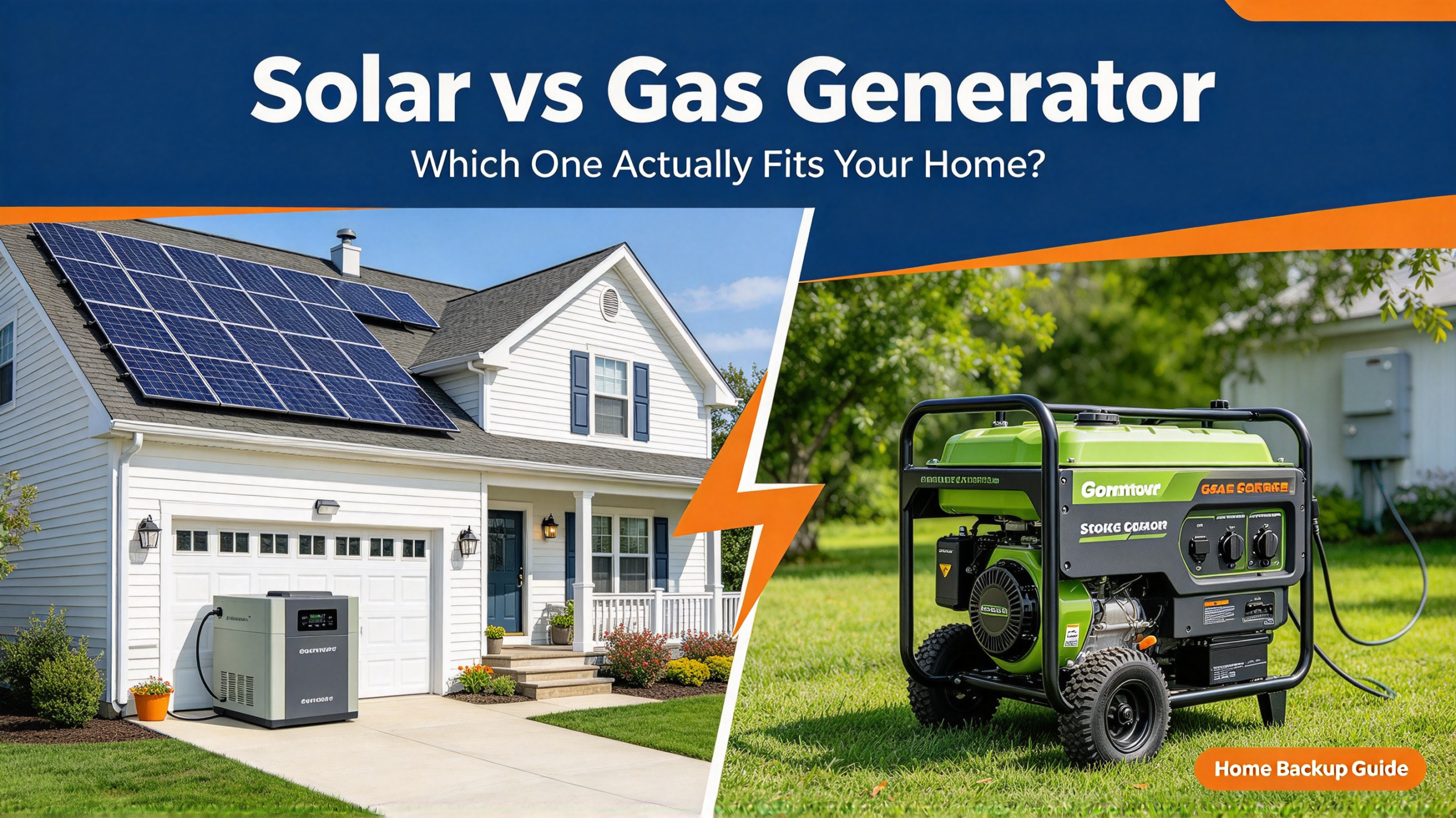
TL;DR: Solar vs gas generator is not a fair fight unless you compare the same job. A battery-backed solar system is silent, fume-free and safe indoors, but its runtime is limited by usable kWh. A gas generator is cheap per watt and runs as long as you supply fuel, but it is loud, needs maintenance and must stay outdoors. Match the system to your outage length and critical loads, not to the biggest number on the box.
The phrase “solar generator” causes most of the confusion. In a portable product, it means a battery with an inverter built into a case; the solar panels are separate. In a home system, it means rooftop solar plus a battery. Neither one is a direct replacement for a fuel generator in every situation. The useful comparison starts with what you need to keep running and for how long.
What “Solar Generator” Actually Means
| System | What it is | Typical size | Best job |
|---|---|---|---|
| Portable solar generator | Battery, inverter and charge controller in one case; panels are separate | About 0.5-5 kWh | Short outages, essentials, apartment or indoor use |
| Rooftop solar plus home battery | Installed array, hybrid inverter and wall-mounted battery | About 5-20+ kWh | Whole-home or critical-load backup, daily bill savings |
| Portable gas generator | Fuel engine and alternator on a frame | About 2-7.5 kW | Heavy tools, long outages, outdoor use |
| Standby generator | Permanently installed propane or natural gas unit | About 7-22 kW | Whole-home backup and frequent long outages |
A battery does not create energy; it stores it. A gas generator creates electricity only while fuel is supplied. That single difference explains most of the trade-offs below. For the portable-only comparison, see portable solar generators vs gas generators.
Solar vs Gas Generator: The Real Decision
Start with the length of your typical outage. A two-hour blip and a five-day storm are different problems, and they justify different equipment.
| Outage pattern | Better first choice | Why |
|---|---|---|
| A few hours, a few times a year | Portable solar generator | No fuel, no noise, enough for essentials |
| One to two days, occasional | Larger battery or battery plus small generator | Battery carries the night; generator recharges if needed |
| Three days or more, regularly | Standby generator or home battery plus generator | Fuel provides long runtime; the battery handles short gaps |
| Whole-home backup with medical loads | Installed battery with critical-load panel, plus a backup plan | Needs tested circuits and enough surge power |
| Off-grid living | Large solar array and battery bank | No utility connection to cover nights and cloudy periods |
The common mistake is buying a battery for a multi-day outage without checking the load. A 10 kWh battery sounds large until a 1.5 kW air conditioner or a 2 kW well pump starts. Runtime is usable kWh divided by average load, and motor startup can be several times the running watts.
Runtime and Load Capacity
Battery runtime is fixed by usable capacity. A gas generator’s runtime is fixed by fuel, but its output is limited by the generator’s continuous and surge ratings. Both need to be matched to the load.
| Load | Running power | Startup surge | What it means |
|---|---|---|---|
| Fridge and freezer | 80-150 W average each | 2-3x compressor start | About 2-4 kWh a day for both |
| Router, lights and phones | 30-80 W total | Small | Adds roughly 0.3-0.8 kWh a day |
| Well pump | 500-1,500 W | 2-3x at start | Needs a high surge rating |
| Furnace fan | 300-800 W | 2-3x at start | Check voltage and transfer method |
| Window AC | 500-1,500 W | 2-4x at start | Often too much for a small battery |
| Central AC | 2,000-5,000 W | 2-4x at start | A portable battery is not the right tool |
A 10 kWh battery with 8 kWh usable can run a 500 W average essential load for roughly 16 hours before losses and reserve. The same battery may run a 1.5 kW air conditioner for only about five hours, and the startup surge could trip it before the runtime calculation matters. A gas generator with 5 kW continuous output can carry more load, but fuel consumption rises with load.
What Each Option Costs
The purchase price is not the whole cost. Fuel, maintenance, replacement batteries, permits and electrical work all belong in the comparison.
| Option | Typical installed cost | Ongoing cost | Main trade-off |
|---|---|---|---|
| Portable solar generator | About $300-$3,000+ depending capacity | Near zero if charged from mains or existing solar | Runtime ends when the battery is empty |
| Rooftop solar plus home battery | Often $15,000-$35,000+ before incentives | Inverter and battery replacement over time | High up-front cost; best whole-home solution |
| Portable gas generator | About $400-$1,500 | Fuel, oil, filters and stabiliser | Loud, outdoor-only, shorter service life |
| Standby generator | About $5,000-$15,000+ installed | Annual service and fuel | Permanent install; handles heavy loads |
A portable battery can look expensive per kWh, but it may be the cheapest way to keep a fridge and router alive in an apartment. A standby generator can look cheap per kW, but the install, fuel and service add up. Compare the cost of the job you need done, not the cost per box. Battery pricing is broken down in solar battery backup cost.
Safety: The Rule That Overrides Everything
Never run a gas generator indoors, in a garage, in a shed, or near an open window or door. Carbon monoxide is colourless and odourless, and generator exhaust kills people during outages every year. “The door was open” and “only for ten minutes” are not safety plans.
A battery has no exhaust and can be used indoors when it is undamaged and its vents are clear. It still produces heat and should not be covered. Keep it away from water, use the correct charger, and do not daisy-chain power strips or overload outlets.
If you want to power home wiring, use a transfer switch installed by a qualified electrician. Do not backfeed a house with a double-ended cord. That mistake can injure utility workers and damage the generator or battery.
Can Solar Recharge the Battery During an Outage?
Yes, if the panels are connected and the system is designed for it. A portable panel may produce roughly 1.2-1.8 kWh a day in good sun after losses. A rooftop array can produce much more, but only if the inverter and battery are configured to operate during a grid outage.
This is where a solar-plus-battery system differs from a simple power station. A grid-tied solar array normally shuts down when the grid fails unless it has backup capability. Ask the installer to explain exactly what will run during an outage and how the battery will recharge. A battery that cannot recharge from the roof is a one-shot reserve.
When a Battery Is Not Enough
- Central air conditioning. The startup surge can exceed a small battery’s peak output.
- Electric resistance heat. A large heating load can drain a battery in hours.
- Multi-day outages. Without enough solar recharge, the battery eventually empties.
- Whole-home backup. Portable units are not designed to carry every circuit.
- Well pump and large motors. These need a verified surge rating and often a soft starter.
- Medical equipment. A tested critical-load panel matters more than the battery’s marketing capacity.
A gas generator or standby system fills some of those gaps, but it introduces fuel storage, noise, exhaust and maintenance. The right answer may be a hybrid: a battery for short outages and a generator for the rare long event. The comparison with a permanent standby unit is in home battery vs standby generator.
A Hybrid Setup That Works
For a storm-prone house, a practical setup is a battery for the fridge, router, lights and medical loads, plus a generator for long outages. The battery carries the first hours quietly. If the outage continues, the generator runs for a few hours to recharge the battery and power heavy loads, then shuts off. That uses less fuel than running a generator continuously for days.
The electrical details matter. The battery needs a critical-load panel or a backup interface. The generator needs a transfer switch and correct grounding. Do not assume a portable generator can charge a battery through a regular outlet unless the manufacturer explicitly supports that arrangement.
Common Mistakes
- Comparing kWh with kW. One is energy, the other is power; you need both.
- Ignoring startup surge. A fridge, pump or AC can draw several times its running watts at startup.
- Buying by outage fantasy. Size for the outages you actually get, not a week-long disaster.
- Running a gas generator indoors. No exception, no garage, no shed.
- Backfeeding the house. Use a transfer switch and a qualified electrician.
- Assuming solar will recharge during an outage. Confirm the inverter and battery support it.
- Forgetting fuel storage. Gasoline degrades; rotate it and use stabiliser as directed.
- Skipping maintenance. A generator that has not run in two years may not start when needed.
What to Verify Before Buying
| Item | Why it matters | Red flag |
|---|---|---|
| Usable kWh | Sets the runtime for your loads | Only the nameplate capacity is quoted |
| Continuous and surge kW | Determines whether motors can start | No surge rating is published |
| Backed-up circuits | Shows what will actually stay on | “Whole home” is claimed without a circuit list |
| Transfer method | Makes the connection safe and legal | A double-ended cord or dryer-outlet backfeed |
| Recharge plan | Determines whether a long outage is survivable | The seller assumes solar works during a grid outage |
| Fuel storage | Keeps the generator running safely | Gasoline stored indoors or left for years |
| Warranty terms | Sets the replacement cost and coverage | No throughput or capacity-retention details |
| Monitoring | Lets you see state of charge and faults | No low-battery or fault alerts |
Conclusion
Solar vs gas generator is a question about the job, not a brand preference. A battery-backed solar system wins on quiet, indoor safety and automatic operation, but it is limited by usable kWh and surge power. A gas generator wins on long runtime and heavy loads, but it needs fuel, maintenance and strict outdoor placement. For short outages, choose the battery. For multi-day heavy loads, choose fuel or a standby system. For many homes, the best answer is both.
FAQ
Is a solar generator better than a gas generator?
For short outages, indoor use and small loads, yes. For multi-day outages or heavy motors, a gas generator or standby system is usually better. The right choice depends on outage length and load.
Can a solar generator run a whole house?
A portable unit cannot for long. An installed home battery can power selected circuits or, with enough capacity and load management, most of the house. It still depends on the backup panel design.
Can I run a gas generator indoors?
No, never. Carbon monoxide from generator exhaust can kill. Run it outdoors, away from windows, doors, vents and attached garages.
How long can a battery run a fridge?
A fridge that averages 100 W uses about 2.4 kWh a day. A battery with 2 kWh usable may run it for less than a day after losses; a 5 kWh usable battery may cover a day or more depending on temperature and cycling.
How long will a gas generator run?
It depends on the tank and load. A small portable unit may run several hours at half load; a larger generator burns more fuel. Check the manual for fuel consumption at 25%, 50% and 75% load.
Do I need both a battery and a generator?
Many storm-prone households do. The battery handles short outages quietly, and the generator covers long events or recharges the battery. Two tools can be cheaper than one oversized system.
What size battery do I need?
Add the daily kWh of the circuits you want to back up, then add 20-30% for losses and reserve. Check continuous and surge kW separately. Do not size from the solar array alone.
What size generator do I need?
Add the running watts of the loads you want to run at the same time, then check the startup surge of the largest motor. A qualified electrician can calculate the service and transfer-switch requirements.
Can solar panels recharge the battery during an outage?
Only if the inverter and battery are designed for backup operation. A standard grid-tied inverter usually shuts down during an outage. Ask the installer to demonstrate the backup mode.
Can I connect a generator to my house wiring?
Yes, with a proper transfer switch installed by a qualified electrician. Do not use a double-ended cord to backfeed a dryer outlet or main panel.
What about a standby generator?
A standby generator runs on propane or natural gas, exercises itself and can carry heavy loads. It costs more to install and needs annual service, but it is a better fit for frequent multi-day outages.
Which is cheaper in the long run?
It depends on use. A battery has a high purchase price and low running cost. A gas generator is cheaper to buy but needs fuel and maintenance. If you rarely use backup power, the total cost may be closer than the sticker prices suggest.
Related: Portable Solar Generators vs Gas Generators
3 thoughts on “Solar vs Gas Generator: Which One Actually Fits Your Home”