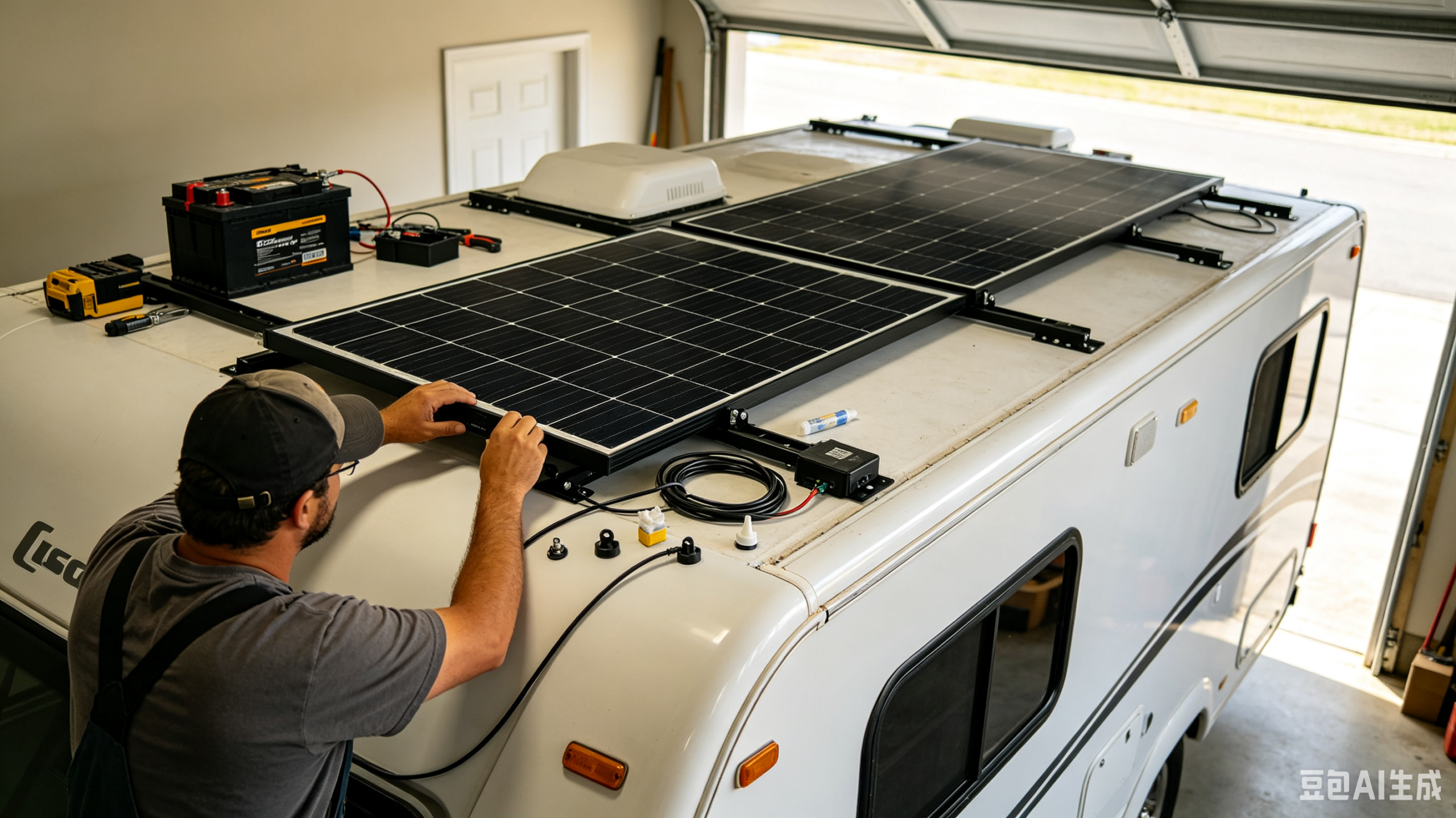
TL;DR: An RV solar system for a weekend van is about 200-400 W of panel and 100-200 Ah of lithium; a full-time van with a compressor fridge and Starlink needs 600-1,000 W and 300-400 Ah. Size from the load list, not from the roof. Add a DC-DC charger from the alternator, because solar alone rarely covers a cloudy week.
Van builds fail for a predictable reason: the owner sizes the array for lights and a phone, then adds a fridge, a fan and Starlink. The roof cannot grow, so the battery and the alternator have to carry the difference. Here is the load math, the three system tiers and the wiring that keeps it safe.
Start With a Real Load List
| Device | Watts | Hours/day | Wh/day |
|---|---|---|---|
| 12 V compressor fridge | 45 (30-50% duty) | 12 effective | 540 |
| Starlink or router | 45 | 24 | 1,080 |
| Laptop | 60 | 3 | 180 |
| LED lights | 10 | 4 | 40 |
| Roof fan | 25 | 6 | 150 |
| Water pump | 80 | 0.3 | 24 |
| Phone and camera charging | 30 | 2 | 60 |
That is about 2.1 kWh a day. Remove Starlink and it drops to roughly 1 kWh. That single device is why so many “400 W is enough” builds fail.
Three System Tiers
| Weekend van | Full-time van | Small RV | |
|---|---|---|---|
| Daily energy | 0.6-1.0 kWh | 1.5-2.5 kWh | 2-4 kWh |
| Array | 200-400 W | 600-1,000 W | 800-1,400 W |
| Battery | 100-200 Ah LFP | 300-400 Ah LFP | 400-600 Ah LFP |
| Inverter | 500-1,000 W | 1,500-2,000 W | 2,000-3,000 W |
| Alternator charging | Optional 20-30 A | 30-60 A DC-DC | 60-80 A DC-DC |
The full-time tier is the one that surprises people. Two 400 W panels fit most long-wheelbase vans; a short van may only take 400-600 W, which is why the alternator matters.
12 V, 24 V or 48 V
| System | Best for | Trade-off |
|---|---|---|
| 12 V | Up to about 2 kW inverter | Thick cables at high current |
| 24 V | 2-3 kW loads, longer cable runs | Needs a DC-DC converter for 12 V devices |
| 48 V | Large systems, air conditioning | Most RV appliances are 12 V; conversion adds cost |
For a normal van build, 12 V is still the practical choice because the fridge, fan, pump and lights are native 12 V. Go 24 V only when the inverter is 2 kW or more and the cable runs are long.
Mounting: Fixed, Tilting or Portable
| Option | Pros | Cons |
|---|---|---|
| Fixed roof mount | Cheapest, no setup, secure | Flat angle, loses 10-20% vs tilted |
| Tilting roof rack | +10-20% in winter, better in low sun | More hardware, must be stowed before driving |
| Portable folding panels | Aim at the sun, park in shade | Must be set up, stolen risk, cable trip hazard |
| Roof + portable | Best of both | Two systems to wire and store |
A common full-time setup is 600 W fixed plus a 200 W folding panel for winter. The portable panel is worth more than another 100 W on the roof because you can aim it.
Charging From Solar, Alternator and Shore
| Source | Typical output | When it matters |
|---|---|---|
| Solar | 3-5 kWh/day per kW in summer | Parked, sunny, midday |
| Alternator + DC-DC | 30-60 A, or 0.4-0.8 kW while driving | Driving days, cloudy weeks |
| Shore power | 0.5-3 kW | Campsites, long stays |
| Generator | 1-2 kW | Rare, noisy, last resort |
A DC-DC charger is the single best upgrade for a van that moves. One hour of driving can replace a cloudy day of solar. It also protects the starter battery from being drained by the house bank.
The wiring between the alternator and the house battery is covered in how to choose the right solar charge controller and series vs parallel solar panel wiring.
Wire Gauge, Fuses and Grounding
| Current | Up to 3 m | Up to 6 m |
|---|---|---|
| 10 A | 4 mm2 | 6 mm2 |
| 20 A | 6 mm2 | 10 mm2 |
| 40 A | 16 mm2 | 25 mm2 |
| 60 A | 25 mm2 | 35 mm2 |
| 100 A | 35 mm2 | 50 mm2 |
These are starting points for a 3% voltage drop at 12 V. Use the cable manufacturer’s table for the exact run, and size the fuse to the cable, not to the load.
Three safety items are non-negotiable: a fuse within 30 cm of the battery positive, a DC disconnect between the panels and the controller, and a ground bond between the battery negative, the chassis and the inverter case.
Inverter Sizing for Van Loads
Add the watts of everything that can run at once, then add 25% for surge. A kettle at 1,500 W plus a laptop at 60 W needs a 2,000 W inverter, not a 1,000 W one.
Inductive loads are the trap: a blender or a vacuum can draw two to three times its rated watts at startup. If the inverter trips on startup, the battery cable or the inverter is undersized, not the battery capacity.
Cold, Heat and Ventilation
LFP batteries should not charge below 0 C. If the battery lives in an unheated garage box, use a heated battery or a BMS with low-temperature cutoff. In summer, a battery box in a metal van can reach 45 C; ventilate it and keep it out of direct sun.
Five Build Mistakes
| Mistake | Result | Fix |
|---|---|---|
| Sizing solar for summer only | Flat in December | Add alternator charging or a portable panel |
| No DC-DC charger | Cloudy weeks kill the bank | 30-60 A DC-DC from the alternator |
| Undersized inverter cables | Voltage drop, hot cables, tripping | Size to current, not to the label |
| Battery inside the living space without venting | Heat and off-gassing | Sealed LFP plus a ventilated enclosure |
| No fuse at the battery | A short becomes a fire | Fuse within 30 cm of the positive post |
Closing Thoughts
An RV solar system is a small off-grid system with a moving roof. Size from the load list, budget for the fridge and Starlink, and treat the alternator as a second charging source rather than an emergency. The shed and tiny-home version of this math is in solar power for sheds and tiny homes.
FAQ
How much solar do I need for a van?
200-400 W for a weekend van, 600-1,000 W for full-time living with a fridge and Starlink. Roof space is usually the limit.
How many batteries for a camper van?
100-200 Ah of lithium for weekends, 300-400 Ah for full-time. That is 1.2-5 kWh usable.
Can I charge from the alternator?
Yes, with a DC-DC charger. It typically delivers 30-60 A and protects the starter battery.
Do I need an inverter?
Only for AC devices: laptop chargers, a kettle, a blender, a hair dryer. Lights, fridge, fan and pump run on 12 V.
Is 400 W enough for full-time van life?
Rarely, if you run a compressor fridge and Starlink. It covers about 1.4 kWh a day in summer sun and much less in winter.
Should I use 12 V or 24 V?
12 V for most vans. Move to 24 V when the inverter is 2 kW or more or the cable runs are long.
Can I mount panels flat on the roof?
Yes, but flat loses 10-20% vs a tilted panel and does not shed snow. A small tilt or a tilting rack is worth it.
How do I stop the starter battery draining?
Use a DC-DC charger or a battery isolator. Do not connect the house bank directly to the starter battery.
Do I need a vent for the battery?
Sealed LFP needs less venting than lead-acid, but the enclosure still needs airflow for heat. Lead-acid must be vented to the outside.
Can I run air conditioning off van solar?
Only with a large array and battery: roughly 3-6 kW of solar and 10-20 kWh of storage for a small unit. It is a different budget.
How long does a van solar system last?
Panels 20+ years, LFP batteries 8-15 years, controllers and inverters 8-12. Vibration and heat are the real wear items.
Related: What Size Inverter Do I Need?
1 thought on “How to Set Up a Solar System for Your RV or Van”