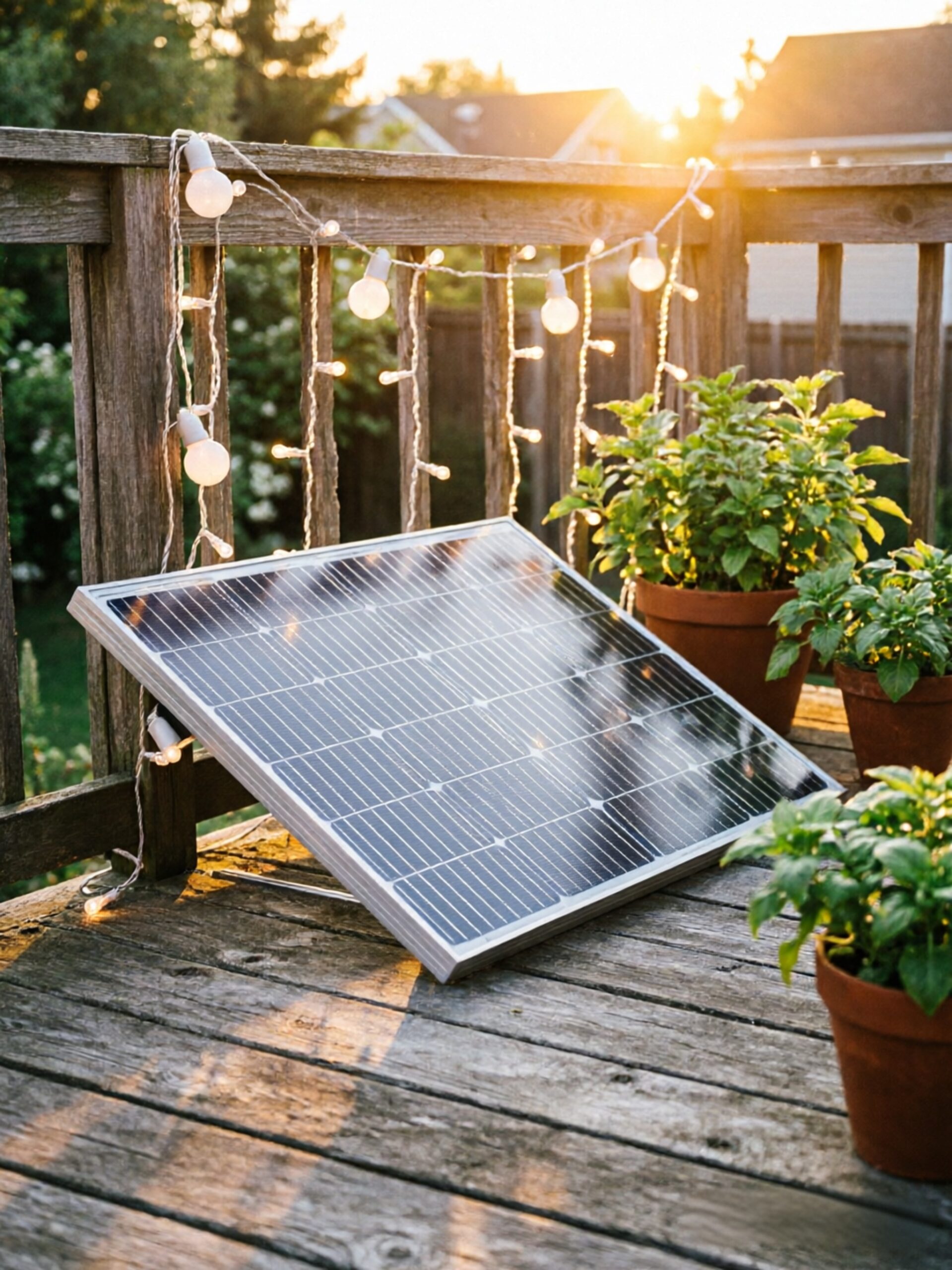
TL;DR: Solar panel wattage is instantaneous power at standard test conditions, not energy per hour. A 400 W panel does not make 400 Wh every hour; in real sun it makes roughly 1.2-1.6 kWh a day in summer and 0.4-0.8 kWh in winter. Size from daily watt-hours, then pick panels that fit the roof and the charge controller.
The number on the box is a rating, not a promise about today. A 400 W panel is tested at 1,000 W/m2 and 25 C cell temperature, and it will spend most of its life below that. Understanding the difference between watts and watt-hours is the single most useful thing a beginner can learn.
What Solar Panel Wattage Actually Means
| Term | What it measures | Analogy |
|---|---|---|
| Watt (W) | Power at one instant | How fast water flows |
| Watt-hour (Wh) | Energy over time | How much water filled the bucket |
| Kilowatt-hour (kWh) | 1,000 Wh | What the utility bills you for |
| Peak sun hours | Equivalent hours at 1,000 W/m2 | How long the tap runs at full flow |
A 400 W panel running at full rating for one hour produces 400 Wh. If it runs at 80% for five hours, it produces 1,600 Wh, or 1.6 kWh. The wattage tells you the flow rate; the sun tells you how long it flows.
Common Panel Sizes, and What They Fit
| Rating | Typical size | Weight | Typical use |
|---|---|---|---|
| 50-100 W | 0.3-0.5 m2 | 3-6 kg | Camping, balcony, gate, small battery |
| 150-200 W | 0.8-1.1 m2 | 8-12 kg | Van roof, shed, portable kit |
| 300-350 W | 1.6-1.8 m2 | 18-21 kg | Small rooftop, ground mount |
| 400-450 W | 1.8-2.1 m2 | 20-24 kg | The residential standard |
| 500-600 W | 2.3-2.7 m2 | 26-32 kg | Large roofs, commercial, utility |
Bigger panels are cheaper per watt, but heavier and harder to lift. Two people can handle a 400 W module; a 600 W module usually needs three or a lift.
What a 400 W Panel Really Produces
| Condition | Output | Daily energy (5 sun hours) |
|---|---|---|
| Perfect lab (STC) | 400 W | 2.0 kWh theoretical |
| Clear summer day, cool | 360-400 W | 1.6-1.8 kWh |
| Clear summer day, hot roof | 330-360 W | 1.4-1.6 kWh |
| Thin cloud | 200-320 W | 0.9-1.4 kWh |
| Heavy overcast | 40-100 W | 0.2-0.4 kWh |
| Winter, low sun | 150-250 W | 0.5-0.8 kWh |
That is why a 400 W panel is often described as “about 1.5 kWh a day” in summer. It is not a fixed number; it is a range that depends on where you live and when you measure.
Size From Watt-Hours, Not Watts
List what you want to run, for how long, and add it up.
| Load | Watts | Hours/day | Wh/day |
|---|---|---|---|
| Phone and tablet | 15 | 3 | 45 |
| Laptop | 60 | 4 | 240 |
| LED lights, 4 | 32 | 5 | 160 |
| Router | 10 | 24 | 240 |
| Mini fridge | 80 | 8 effective | 640 |
For 1,325 Wh a day, in a place with 4 peak sun hours, the array is 1,325 / (4 x 0.75) = 442 W. That is one 450 W panel, or two 250 W panels.
Voltage and the Charge Controller
A 400 W panel usually has a Vmp around 34-40 V and an Imp around 10-12 A. That matters for two reasons:
- The controller must accept the array’s voltage. A 12 V battery system with a 40 V panel needs an MPPT controller, not a PWM one.
- The cable must carry the current. Higher voltage means lower current for the same watts, which is why 48 V systems use thinner cable.
The matching rules are in how to choose the right solar charge controller and series vs parallel solar panel wiring.
Why Higher Wattage Is Not Always Better
- Weight. A 600 W module is 30 kg; roof access and mounting get harder.
- Physical fit. One large module may not fit between a chimney and a ridge; four smaller ones might.
- Inverter matching. A single 600 W panel into a small inverter can clip or exceed the input window.
- Replacement cost. One big module is more expensive to replace than one of four small ones.
How to Read a Datasheet
| Field | What it tells you |
|---|---|
| Pmax | Rated watts at STC |
| Vmp / Imp | Voltage and current at maximum power |
| Voc / Isc | Open-circuit voltage and short-circuit current, for sizing the controller |
| Temperature coefficient | How much output falls per degree above 25 C |
| Dimensions and weight | Roof fit and lifting |
| Warranty terms | Product and performance years |
The Vmp and Voc numbers decide whether the controller survives; the Pmax number only decides how much power you can harvest. Check both. The efficiency rating is a separate question, covered in solar panel efficiency ratings.
Conclusion
Wattage is a flow rate, not a daily total. Multiply it by real sun hours and a derate, and you get the number that matters: watt-hours. Size the array from your daily load, then choose panel sizes that fit the roof, the controller and the number of people available to lift them.
If you already know your daily kWh, the panel count follows: how many solar panels do I need.
FAQ
What does wattage mean on a solar panel?
It is the panel’s power output at standard test conditions: 1,000 W/m2 and 25 C. It is not the energy it will produce in an hour.
Does a 400 W panel produce 400 Wh every hour?
No. It produces 400 Wh only if it runs at full rating for a full hour. Real output is usually 70-90% of the rating, and only around midday.
How many kWh does a 400 W panel make a day?
About 1.4-1.8 kWh in clear summer sun, 0.5-0.8 kWh in winter, and 0.2-0.4 kWh under heavy overcast.
How many watts do I need for a fridge?
A small efficient fridge draws about 80 W and uses 0.6-1 kWh a day, which needs roughly 200-300 W of panel in a sunny climate.
Is a higher wattage panel always better?
No. Larger panels are heavier and may not fit the roof or the controller. Per-watt cost is usually lower, but installation is harder.
What is the difference between W and Wh?
W is instantaneous power; Wh is energy over time. A 100 W load for 10 hours uses 1,000 Wh, or 1 kWh.
How big is a 400 W panel?
About 1.8-2.1 m2 and 20-24 kg, depending on the cell technology and frame.
Can I mix panels of different wattages?
On separate controllers or with optimisers, yes. On one string, the lowest-rated panel limits the rest. See can you mix different solar panels.
What size panel charges a 100 Ah battery?
About 200-300 W in a sunny climate, and 400 W or more in winter or cloudy conditions.
Does panel wattage determine the inverter size?
Indirectly. The inverter is sized to the array’s DC power and the loads, usually with a DC/AC ratio of 1.1-1.3.
Why do panels cost less per watt as they get bigger?
Framing, wiring and junction boxes scale with the panel, not with the watts, so a larger module spreads those costs over more output.
Related: How Many Solar Panels Do I Need?
1 thought on “Understanding Solar Panel Wattage – A Simple Guide”