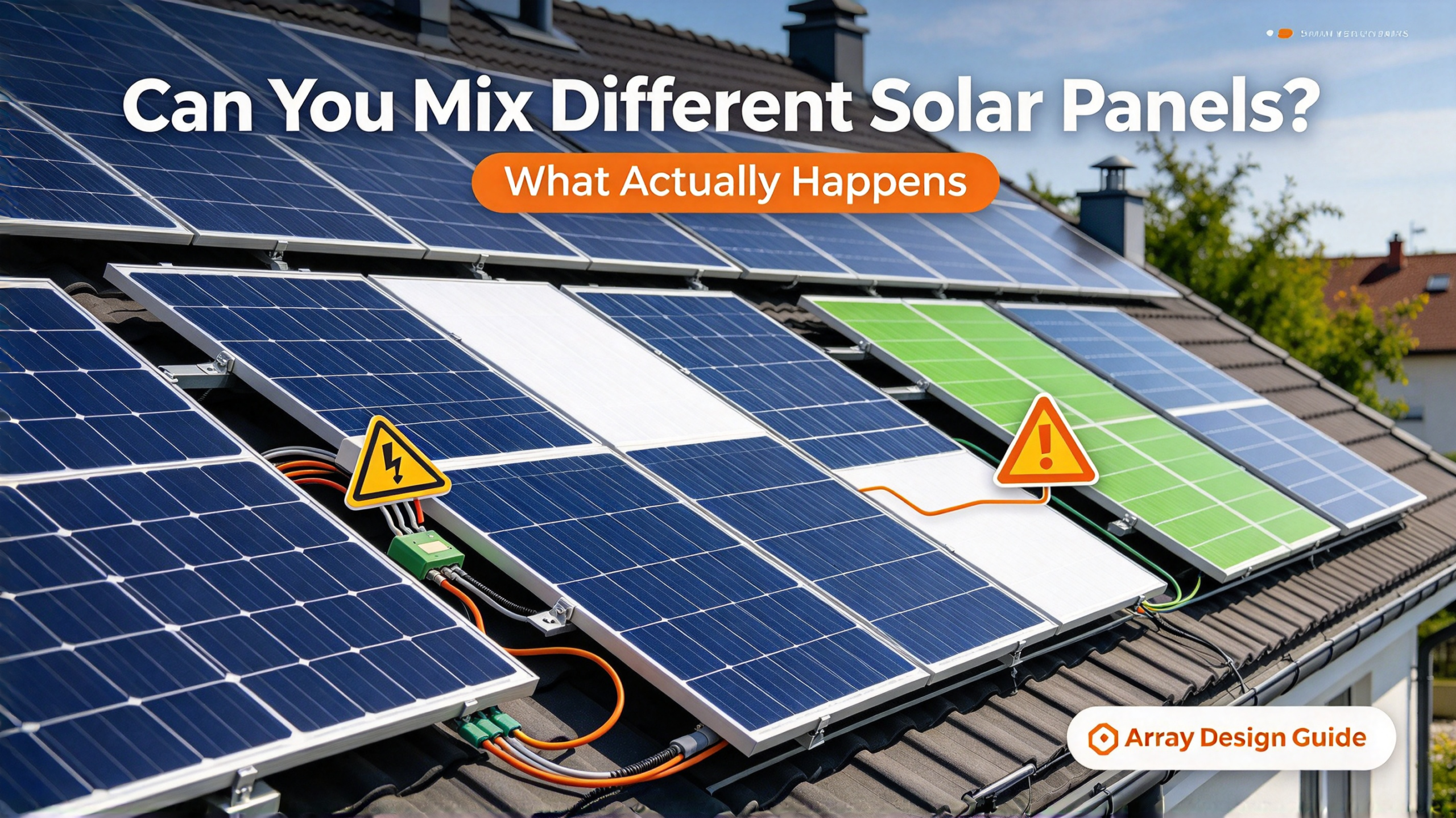
TL;DR: Can you mix different solar panels? Usually yes, but only if you match the electrical ratings, not the marketing wattage. Panels in one series string run at the lowest current; panels in parallel run at the lowest voltage. Keep Vmp within about 5%, keep different orientations or ages on separate MPPT inputs, and check the controller’s cold-weather voltage limit. A small mismatch costs a few percent; a bad one can cost most of the array.
The question is not “can I connect these two panels?” It is “what will the string do when one panel is weaker, hotter, older or facing a different direction?” A mixed array can work well, but it needs a wiring plan. This guide gives the numbers to compare, the combinations that work, and the ones that should stay separate.
Can You Mix Different Solar Panels? Short Answer
Yes, you can mix different solar panels if their working voltage and current are close enough for the way you wire them. Brand, colour and cell type do not matter by themselves. The nameplate ratings do. Two different brands with matching Vmp and Imp behave like matching panels; two identical-looking panels with different electrical ratings may not.
The practical rule is simple: match Vmp first, match Imp for series strings, and keep genuinely different panels on separate MPPT inputs or separate controllers. If the difference is large, do not force them into one string just to save a cable.
Why Panels in One String Have to Agree
A solar panel is a current source with a voltage curve, not a battery. When panels are connected together, the wiring decides which number becomes the limiting factor.
| Connection | Voltage | Current | What limits the group |
|---|---|---|---|
| Series string | Voltages add | Current stays the same | The lowest-current panel sets the string current |
| Parallel branch | Voltage stays the same | Currents add | The lowest-voltage panel can drag the group down |
| Series-parallel array | Each string adds voltage, strings share current | Strings must have compatible voltage | A weak string or reverse current |
In series, one weak panel throttles the whole string. In parallel, a large voltage difference can make the stronger panel push current backwards into the weaker one. That reverse current becomes heat, and heat in a shaded or mismatched panel is how hot spots start. The problem may not show up as a dead system. It often looks like a string that is simply a few percent below the others.
The Numbers That Matter More Than Wattage
Wattage is the headline number. These are the working numbers on the datasheet and nameplate.
| Rating | What it means | Why it matters when mixing |
|---|---|---|
| Vmp | Voltage at maximum power | Match this first, especially for parallel connections |
| Imp | Current at maximum power | Match this for series strings; the lowest value limits the string |
| Voc | Open-circuit voltage | Check the controller’s maximum input voltage, including cold weather |
| Isc | Short-circuit current | Used for fuse, breaker and wire sizing |
| Temperature coefficient | How voltage changes with temperature | Cold weather raises Voc and can exceed the controller limit |
| Pmax | Maximum power at standard test conditions | Useful for comparing size, not enough for matching |
If you only remember one rule, remember this: a 100 W panel and a 200 W panel can work together in parallel if their Vmp is close. They should not share one series string unless their Imp is also close, because the string will run at the lower current.
The 5% Compatibility Rule
The exact loss depends on the wiring, temperature and irradiance. For a practical field decision, use these bands.
| Difference in Vmp | Typical result | What to do |
|---|---|---|
| Within 5% | Usually works well | Same MPPT input is acceptable if Imp is also close |
| 5-10% | A few percent of output may be lost | Use separate MPPT inputs if available |
| More than 10% | Meaningful loss or reverse-current risk | Separate controller, separate string, or do not mix |
| Different Imp in series | The lowest current sets the string | Keep them in parallel or use separate MPPTs |
These bands are a starting point, not a licence to ignore the datasheet. A 5% Vmp difference in a two-panel garage system may be fine; the same difference in a high-voltage string near the controller limit may not be. Always check the actual ratings and the controller’s window.
Common Mixing Scenarios
| Scenario | Does it work? | Why |
|---|---|---|
| Same wattage, different brands | Usually yes | Brand is irrelevant if Vmp and Imp match |
| 100 W and 200 W, same Vmp, parallel | Usually yes | Voltages agree and currents add |
| 100 W and 200 W, different Vmp, series | Not recommended | The lower-current panel limits the string |
| Old panel plus new panel, series | Usually a poor match | The old panel’s current has fallen with age |
| Different orientations on one MPPT | Usually a compromise | The controller tracks one operating point for the input |
| Bifacial plus monofacial on one string | Usually separate them | The rear-side gain is different and hard to predict |
Different orientations are not an electrical rating problem at first. They are a production problem: one panel may peak in the morning while the other peaks in the afternoon. If they share one MPPT input, the controller finds a compromise that is not ideal for either. Separate MPPT inputs, optimisers or microinverters solve it properly. The orientation basics are in solar panel orientation and tilt.
Old Panels and New Panels
The most common mistake is adding one old panel to a string of new ones. The old panel may still work, but its current has declined. In a series string, that lower current sets the ceiling for every panel behind it. The new panels cannot deliver their full output because the old panel is the bottleneck.
A single old panel on a small setup can be acceptable if the loss is small and the voltage matches. Adding an old panel to three new ones is usually a waste of the new capacity. Test the old panel’s Voc and Imp before connecting it, inspect for cracks and delamination, and expect the warranty to be limited or expired. The testing method is in how to test a solar panel with a multimeter, and the ageing numbers are in solar panel degradation rate.
MPPT, Optimisers and Microinverters
An MPPT charge controller tracks the best operating point for the array. It is useful, but it tracks one operating point per input. If two mismatched panels share that input, the controller finds the least-bad compromise. It cannot make a bad pairing good.
| Equipment | What it optimises | Best use |
|---|---|---|
| MPPT controller | One operating point per input | Small mismatches and normal string design |
| DC optimiser | One panel or small group | Mixed orientations, partial shade, odd panel sizes |
| Microinverter | One or two panels | Panel-level tracking and simpler expansion |
| Separate controller | An independent array | Large voltage or current differences |
If you know the array will be mixed, put the money into per-panel electronics or a second controller rather than forcing everything into one input. The gain is not just output; it is the ability to add a panel later without redesigning the whole string. Shade behaves like a temporary mismatch, so the same logic applies. See how much shading is too much.
Check Series Voltage Before You Connect
Series strings add voltage. That is useful until a cold morning pushes the open-circuit voltage above the controller’s maximum. The datasheet’s Voc is measured at 25°C; cold weather raises it.
| Illustrative example | At 25°C | At -10°C | Check |
|---|---|---|---|
| One panel, Voc 41.5 V, -0.27%/°C | 41.5 V | About 45.4 V | Use the actual datasheet coefficient |
| Four panels in series | 166 V | About 182 V | Safe only if the controller is rated above 182 V |
| Five panels in series | 207.5 V | About 227 V | Too high for a 200 V controller |
This is a simplified calculation, not a design sheet. Use the panel’s temperature coefficient, the record low temperature for the site, and the controller’s maximum input voltage. Leave headroom for tolerance and calibration. If the number is close, reduce the string length or use a controller with a higher voltage rating.
When Not to Mix Panels
- The Vmp difference is over 10%. Use separate controllers or separate arrays.
- The Imp difference is large and the panels must be in series. The string will run at the lower current.
- One panel is old and clearly degraded. It becomes the bottleneck for new panels.
- The panels face different directions. Use separate MPPT inputs or panel-level electronics.
- One is bifacial and one is monofacial. The rear-side gain makes the match unpredictable.
- The cold-weather Voc exceeds the controller limit. Do not connect the string, even if it works on a warm day.
- You cannot verify the ratings. A used panel with a missing label is not a safe design input.
Safety and Code
PV modules produce voltage whenever light falls on them. Turning off the inverter does not necessarily de-energise the DC side. Work on the array at night, cover the modules, or use a qualified electrician. Respect the maximum system voltage, use fuses or breakers for parallel strings, and follow the rapid-shutdown requirements for your location.
Do not mix battery chemistries or nominal voltages on the same charger, even if the solar panels are compatible. That is a different electrical system with different risks. Battery life and compatibility are covered in how long solar batteries last. If a mixed array is already installed, compare the mixed string with a clean string on the same day; a consistent gap is the sign that the mismatch is costing you. Monitoring is explained in solar panel monitoring.
Conclusion
You can mix different solar panels, but you cannot ignore the electrical ratings. Match Vmp first, match Imp for series strings, check cold-weather Voc, and keep different orientations or ages on separate MPPT inputs. A small mismatch costs a few percent; a bad one costs most of the array. If the difference is large enough that you need extra electronics, price those parts before deciding the old panel is “free.”
FAQ
Can I mix different solar panels?
Usually yes, if their Vmp and Imp are close and the wiring suits the difference. Match Vmp within about 5%, keep large differences on separate MPPT inputs, and check the controller’s cold-weather voltage limit.
Can I mix 100W and 200W solar panels?
Often yes in parallel if their Vmp is close. In series, the lower-current panel limits the string, so the 200 W panel may not deliver its full output.
Can I mix different brands of solar panels?
Yes. Brand does not matter by itself. What matters is the nameplate Vmp, Imp, Voc and the temperature coefficient. Two different brands with matching ratings can work together.
Can I mix old and new solar panels?
You can, but the old panel usually has lower current and becomes the bottleneck in a series string. One old panel on a small setup may be acceptable; adding it to several new panels usually wastes new capacity.
Should mixed panels be wired in series or parallel?
Parallel is usually easier when Vmp matches and you need more current. Series requires matching current and careful voltage checks. If the panels differ a lot, use separate MPPT inputs or separate controllers.
Do mixed panels damage the inverter?
Not directly if voltage and current stay within the inverter’s limits. The real risks are lost output, reverse current and hot spots in badly mismatched panels. Check the design before connecting.
Can mismatched panels cause a fire?
They do not spontaneously ignite, but sustained reverse current or a hot spot can damage a panel and create a safety risk. A visibly hotter panel or a failing connection should be isolated and inspected.
Do I need an MPPT controller for mismatched panels?
An MPPT controller helps with small mismatches, but it tracks one operating point per input. If the panels are genuinely different, optimisers, microinverters or a second controller are the proper fix.
Can I mix panels with different orientations?
You can, but keep them on separate MPPT inputs or use panel-level electronics. One controller input will find a compromise between the two orientations, which is rarely the best result.
Can I mix bifacial and monofacial panels?
It is possible, but the rear-side gain makes the output hard to predict. Keep them on separate strings or MPPT inputs, and compare the actual production before adding more.
Can I add panels to an existing string later?
Sometimes. Match the existing panels’ Vmp and Imp, check the controller’s voltage and current limits, and confirm the wiring and fuses can handle the extra current. A second string is often cleaner than extending the old one.
Can I mix battery chemistries on the same charger?
No. Different chemistries and nominal voltages need separate, compatible charging equipment. Mixing them can damage the battery or create a safety hazard.
Related: Series vs Parallel Solar Panel Wiring
3 thoughts on “Can You Mix Different Solar Panels? What Actually Happens”